Saturday, 26 April 2014

The Campaign in Northern Portugal January - May 1809, Part 1

With the my next scenario, Oporto, fast approaching and to give context to our game next month I thought I would pick up the thread from our game in December, which saw us re-staging the events at the Battle of Corunna.

Battle of Corunna January 16th 1809 - Game AAR

Action at Corunna back in December last year
The following is taken from Volume II of Sir Charles Oman's History of the Peninsular War

On November 28th 1808, Sir John Moore, in answer to a question from Lord Castlereagh, wrote the following conclusions as to the practicability of defending Portugal.

Sir John Moore
"I can say generally that the frontier of Portugal is not defensible against a superior force. It is an open frontier, all equally rugged, but all equally to be penetrated. If the French succeed in Spain it will be vain to attempt to resist them in Portugal. The Portuguese are without a military force..... no dependence can be placed on any aid that they can give. The British must in that event, I conceive, immediately take steps to evacuate the country. Lisbon is the only port, and therefore the only place from whence the army, with its stores can embark... We might check the progress of the enemy while the stores are embarking and arrangements are being made for taking off the army. Beyond this the defence of Lisbon or Portugal should not be thought of". 

Four months later, on March 7th, 1809, Sir Arthur Wellesley answered the same question, put to him by the same minister, in very different terms.

Sir Arthur Wellesley
"I have always been of the opinion that Portugal might be defended, whatever might be the result of the contest in Spain, and that in the meantime measures adopted for the defence of Portugal would be highly useful to the Spaniards in their contest with the French. My notion was that the Portuguese military establishment ought to be revived, and that in addition to those troops His Majesty ought to employ about 20,000 British troops, including 4,000 cavalry. My opinion was that, even if Spain should have been conquered, the French would not be able to overrun Portugal with a smaller force than 100,000 men. As long as the contest may continue in Spain, this force (20,000 British troops), if it could be placed in a state of activity, would be highly useful to the Spaniards, and might eventually decide the contest".

As a caveat to the contradicting opinion offered by Sir Arthur who held Sir John as a military commander in very high regard, it is only fair to quote Sir Arthur's reasoning for his difference in opinion.

"I have as much respect as any man can have for the opinion and judgement of Sir John Moore, and I should mistrust my own (if opposed to his)in a case where he had an opportunity of knowing and considering. But he positively knew nothing of Portugal *(Rather like Napoleon), and could know nothing of its existing state."
*My comment

These two opinions expressed to the British government by two senior military minds help to explain the shift in opinion of the British government in their reaction to Sir John Moore's army being forced to evacuate from Corunna, and, given the vote of confidence in Wellesley to return to Portugal, why he so vigorously pursued the expulsion of the French from Oporto.

Events between Corunna and Oporto


Marshal Soult Commander 2nd Corps 
The Battle of Corunna was fought on the 16th January and Soult received such a surprise from a British army that he thought was demoralised, that he was content to let them re-embark in relative peace, save for placing a few artillery batteries to fire into the roadstead at the British transports.

On the 19th of January the Governor of Corunna asked for terms and the town opened its gates to the French army. Further round the coast was the equally strong harbour town of Ferrol containing a large amount of British supplies. It was well garrisoned with soldiers from the Marquis de la Romana's army together with sailors from a hulked naval squadron left over from the 1805 Trafalgar campaign, manning the guns of the fort. On the 25th of January the Governor of Ferrol, Admiral Melgarejo, surprised the French commander when, on being summoned, he opened his gates to the French troops. In gratitude for his handing over the ships and stores undamaged he was recommended for service under King Joseph.

With his rear cleared of all possible trouble, or so he thought, Marshal Soult could now take stock of the situation and see how he could carry out the Emperor's last set of orders. The winter campaign that his corps had just carried out had, if anything, ruined it more than the British for it was trying to exist in a mountainous region that three armies, British, French and Spanish, had marched over for a month. The following figures are quoted from Oman

15th January Returns
Infantry             35559
Cavalry               7368
Artillery               1468
Total                 44395

Less Detached   8000
         Sick           10000
Available            26395

Again it was the horses that really suffered and 3,000 men were without mounts. Unlike in Europe where an army could hope to regain strength as these detachments found their way back to the main force, many men were lost to marauding guerrillas and to garrison commanders unwilling to lose the services of these men in their own defence.

Useful links on orders of battle
French II Corps 15th January 1809
French Army in Spain 1st February 1809
La Romana's Army December 1808

Marshal Ney VI Corps Commander
Until Marshal Ney with 6th Corps could come up from Lugo to take over the garrison duties for Corunna and Ferrol, Soult was reluctant to move south, but he wisely used the delay to build up his transport and supplies in preparation for the move into Portugal.

On the 8th of February the 2nd Corps set off on it's invasion of Portugal, following the advance guard of Franceschi's and Lahoussaye's cavalry together with Heudelet's infantry. Good news greeted the advance as Franceschi was able to report that he had been able to overawe the fortresses of Vigo and Tuy and capture them for no loss as their commanders had surrendered on the first summons.

Map to illustrate Soult's advance into Portugal and the key towns en-route
There was thus no force to bar Soult's way into Portugal across the River Minho, other than the militia garrison of Valenza which covered the main road, and the ferry point. He now decided to carry out an assault crossing close to the river mouth and outflank this little fortress. The combination of bad weather and inexperience caused this exercise to be a complete failure, and those French troops that made it to the opposite river bank were easily rounded up and made prisoners by the Portuguese militia.

An idea of how the march from Tuy to Rivadavia
must have been like for Soult's army
Soult now decided to march east along the Minho into the mountains and towards the lowest bridging point at Orense. This proved to be a difficult march over terrible roads and tracks under constant harassment from guerrilla attacks and sniping. Leaving his sick under guard at Tuy, he began the march on the 17th February, (one week after he should have been in Lisbon, according to the Emperor!!) and made acquaintance with the Galician insurrection. Heeding La Romana's call to arms, local leaders and priests called out all their able bodied men and took to the hills, destroying bridges and ferries, blocking roads and attacking messengers. The French force retaliated by taking and sacking the sizable town of Rivadavia on the 18th. On reaching this town Soult took stock and decided to he could no longer protect his heavy guns and transport and so Merle was ordered to convoy them back to Tuy.

From Rivadavia the flood plain opened out towards Orense, thus relieving the French from much of the previous harassment. At Barbantes, Soult was able to pass some of his troops over the Minho using an imperfectly scuttled ferry (Wellesley would return the compliment of this idea at Oporto), so that he was able to take the town of Orense from both sides, the town falling on the 20th February. Soult then called a weeks halt to the march to allow his force to regroup and forage for much needed supplies.

Pedro Caro, Marquis of la Romana
Before setting out on the 4th of March, Soult received a plea from Ney to turn back and help pacify Galicia as he felt his 16,000 men were insufficient to control the area. Soult, however, pleaded the Emperor's orders and recommenced his march. On reaching Allariz, instead of taking the road westward towards the coast he took the more mountainous route to the south east and on towards Monterey. The reason he chose the more difficult route was that his scouts had discovered Romana's army behind the Sierra Cabrera and the route westward would have exposed his communications to that force. Romana pulled back just in time to avoid being caught but lost his rearguard in the withdrawal and Soult halted at Monterey whilst he scouted the road to Chaves.

As soon as the French began to advance Portuguese General Silveira decided to evacuate the dilapidated fortress of Chaves, but local troops mutinied and vowed to defend their homes. This they did by firing off all their ammunition at no particular target and when summoned to surrender by Soult, they complied having no power to do otherwise.

From Chaves, Soult decided to risk heading back towards the coast, moving into the coastal plain around Braga and thus undoing the defences behind the River Minho that had caused him so much of a problem and reopening his communication to his garrisons on the Spanish border in Galicia. Unknown to Soult, the Portuguese commander in the area General Freire was only too willing to evacuate this zone but the mutinous rabble he commanded were preventing him.

Soult's army was forced to fight all the way to Braga only to find the high ground straddling the road into the town occupied by 25,000 men. Soult waited three days to bring up the bulk of his army to deal with this threat. The wait proved too long for General Freire who tried to flee the army but was caught and summarily executed. His successor Baron Eben took command by acclamation and promptly threw up extra field entrenchments.


When Soult finally attacked, the result was never in doubt. Once the Portuguese infantry was pushed out of its defences Soult unleashed his cavalry and inflicted over 5,000 casualties whilst suffering only 200 to his force. But as the French were congratulating themselves with their victory, news came that guerrillas had cut off communications to the north and to Chaves, and the recently defeated levies were taking up blocking positions on the road to Oporto.

After a short halt to reorganise his forces in Braga, the French advanced to and crossed over the River Ave, brushing aside the defences at little cost to themselves, so that by the 27th March they were in front of the defences of Oporto.


The defences encircled the city for about seven miles. Twelve redoubts crowned the hill tops with plenty of artillery. Ditches and fortified buildings also formed part of the defences. To hold the line the Bishop of Oporto, who was in nominal command, had about 7,000 regulars and militia backed up by about 20,000 Ordenanza and levies. These last were in a permanent state of mutiny and were holding drum head courts martial for any of those considered by the mob to be traitors.

Marshal Soult summoned the city to surrender and this was refused, so there was nothing for it but to storm the works. He fixed the assault for early the following day, the 29th of March, but prepared his assault by taking out some of the outlying defences first.

Hoping to profit from a dawn attack the French columns were ready early, but a severe thunderstorm drenched both attackers and defenders. When it cleared away, Soult called off the assault for an hour for his men to recuperate and to give the ground time to dry out for the supporting artillery (I wonder if he remembered this decision when he stood by the Emperor in wet sodden fields in 1815 just outside Brussels).
At 7am the signal was given and the attack began.

Unlike the all out attack at Braga, this time Soult employed a little finesse by having flanking columns move in to draw in the Portuguese reserves and units placed in the centre. Once this was observed to have had the desired effect, he sent in a French division in the centre supported by cavalry. As the plan evolved the French troops soon found themselves herding a panic stricken mob through the streets towards the River Douro. Instead of surrendering, the mob made for the bridge of boats spanning the river across from the town to Villa Nova. With the crush and panic and possibly some of the pontoons sinking under the weight, those who stopped and tried to turn back were crushed by the onrushing fugitives and many ended up in the water with French skirmishers firing from the banks. Once the French realised the catastrophe they were witnessing they stopped firing. With this and the fighting in the entrenchments, Oman estimated the casualties to have been 8,000 Portuguese for the loss of about 400 French troops.

Marshal Soult oversees his victory at the first Battle of Oporto

Two months behind the schedule set by his Emperor, Soult was now able to lay claim to Portugal's second largest city, and to take stock of the strategic situation. Since the receipt of the message from Ney requesting him to turn back and aid him in his struggle with the Galician Insurgents, Soult had received no news of events elsewhere. On the day that Oporto fell, Silveira had recaptured Chaves with its hospital and garrison of about 2,000 men, whilst above the Minho, his fortresses were under threat, with Vigo surrendering to the Royal Navy. Of Marshal Victor operating on the Portuguese border in Estremadura there was no news. He had therefore no alternative but to hold his position and send out strong expeditions of divisional strength to succour his garrisons and find out hard information.

Heudelet was sent north to reopen the lines of communication, with the garrison at Tuy beset by guerrillas, he defeated Portuguese insurgents on his way to the town. He found out that Vigo had fallen and that Ney was in no position to support operations in Portugal.

Loison's division severely mauled Silveira's levies when they attempted to make a stand at Amaranthe (see the map above), but the Portuguese quickly rallied and held the bridge over the flood swollen River Tamega. With no other way over as all the other bridges were destroyed, Loison was forced to await events and it was not until May 2nd that he was able to force a way across and disperse the levies who fell back behind the River Douro. Content with his progress, Loison held his ground with nearly a quarter of Soult's army.

This dispersion of his forces and very few supplies meant that Soult had no strength to push on southwards to his real goal, Lisbon. Only Mermet's division and the light cavalry were sent forward over the Douro as an advance guard and to observe the remnants of the Bishop's army. Soult was confident that once his rear was secure again and his supply situation improved, the advance could continue.

Next Post - The situation with the British forces and the arrival of Sir Arthur Wellesley.

Wednesday, 23 April 2014

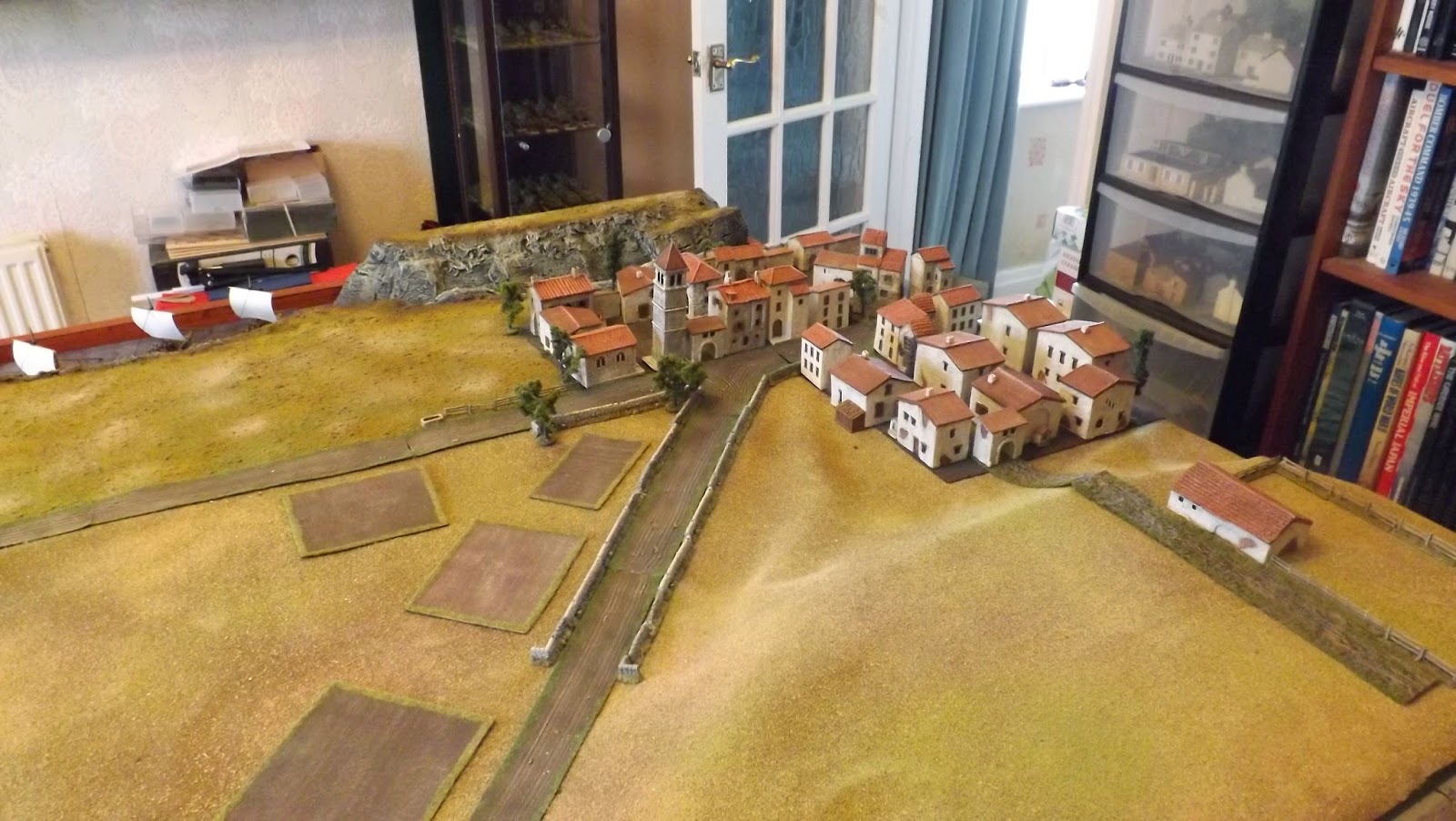
Oporto Table - Update


So with all the major units completed, I can now turn my attention to finishing off the table. All the buildings except one very important one are now done and the townscape is able to be laid out. The internal roads and squares will have some cobbled areas added and my warehouse area at the edge of town bordering the cliff edge will get some barrels and goods stacked about to indicate that it is a trade area of town


The Oporto tower, I completed earlier, forms a nice centre piece for the initial French garrison and will indicate General Foy's HQ acting as a suitable high lookout point from where he will spot the initial British troops landing and from where his dispatch will start from to warn Marshal Soult of the British assault. I am really pleased that it has the same aspect as the picture at the top of the post, it's there if you look hard.

A question came up in one of the previous posts about the table as to where the British gun batteries would be placed. Trust me when I say that they will sit nicely on the rocky prominence facing the town and be in medium range to support British troops across the river.


Of course there is one major omission from the table, namely the Bishops Seminary and its walled garden on the outskirts of town, of which I will post later. Hopefully, this weekend I can get on with some more woods and walls, plus a few Portuguese skirmishers.


One peculiar fact escaped my attention during the run in to completing this project. That being, next month is the 205th anniversary of the battle taking place on the 12th May 1809. Frankly I am amazed it didn't occur to me earlier, but I guess that just shows there are a lot of things going on in my life at the moment and that particular fact just came to me in the last few days. So, I thought I would try and run this game first time as near to the anniversary as possible, which as the 12th falls on a Monday (a day of work, sadly) will be the Sunday the 11th. No pressure then!!

Sunday, 20 April 2014

14th Light Dragoons

British Light Dragoons at the charge, in this case the 20th at Vimeiro


With the completion of the 14th British Light Dragoons I have now finished all the units required for my Oporto scenario, phew!

Although last, the 14th Light Dragoons are by no means least, as this unit not only played a major role in adding to the final discomfiture of Marshal Soult's army as it fled from Oporto, but, as you can see, it has a Peninsular War record second to none.

1809: DOURO; Oporto; TALAVERA
1810: Almeida; Villa de Puerco; Frexadas; BUSSACO; Torres Vedras; Rio Mandevilla; received volunteer recruits from Royal Waggon Train
1811: Pombal; Redinha; Cazal Nova; Foz d’Arouce; Sabugal; Gallegos; FUENTES D’ONORO; 1st siege of Badajoz; Nave d’Aver; Carpio
1812: Ciudad Rodrigo; Badajoz; Villa Franca; Llerena; Alaejos; Castrillos; SALAMANCA; Penerada; Blasco Sancho; Madrid; Matilla; retreat from Salamanca 
1813: Burgos; Huarte; VITTORIA; Ostiz; Roncesvalles; Almandroz; Maya; Bastan; NIVELLE; Cambo; NIVE; Mendionda; Hasparren
1814: Hellette; Garris; Sanveterre; ORTHEZ; Aire; Castel Paget; Tarbes; Toulouse; Bordeaux

For more information on the 14th Light Dragoons then follow the links to the Napoleon Series, an excellent resource on all things Napoleonic.

Napoleon Series14th Light Dragoons Regimental History & Colonels

Napoleon Series 14th Light Dragoons


As with most of my cavalry, I have opted to use AB figures. It has to be said that no one sculpts a horse quite as well as Anthony Barton.


Ok, so it is now just a case of finishing off the table terrain and refining the orders of battle prior to playing the game, some time next month. In between time I have a few projects to complete for some friends, so expect a bit of Seven Years War Cavalry and Infantry, plus a final look at the Oporto table in its finished state, more anon.

Wednesday, 16 April 2014

Albuera - Peter Edwards


I thought I would post my thoughts on a book I have just finished reading, Albuera by Peter Edwards.

The first thing to say is that it has taken me six months to finally finish reading this book. I speak as one who regularly read a book a month for several years previously. So what has changed?

I have thought long and hard about this recent change in my reading habits and have concluded the issue is two fold and both technological, namely the IPad and the IPod.

Both the aforementioned bits of kit are able to offer multiple books in audio and visual formats together with other distractions such as podcasts, and I find I have developed a bit of a surfing approach to my reading/listening, which I mostly do in the evening before turning out the light. I am not happy about this as the ability to focus on a main book for a month or so and get the full on input of its content is a pleasure that feeds the mind, something that flitting between different media fails to do. I have therefore decided to get control of this new habit and discipline my time back to regular bedtime reading, starting with Wellington v Massena that I picked up last night.

So back to Albuera. Firstly I don't intend this as a full on review. This book was first published back in 2008 and I have found and read some excellent reviews prior to my purchase. These then are my thoughts in the perspective of an historical wargamer keen to see my games reflected in the historical text.

The first thing to say is that this is not a book just about the battle of Albuera, but more about the campaign of 1811 between the British and French forces in the Peninsula at that time. Thus the text follows a timeline of events covering the combat at Barrosa in March and ending with the final clash in September at El Bodon, taking in the two major actions at Fuentes, Albuera the two failed sieges of Badajoz and the minor actions in between. If you want a book that just focuses on Albuera I would turn to one of my favourite books of all time, Albuera by Guy Dempsey which forensically breaks the battle down almost minute by minute with excellent detail and maps.

This being said I found Peter Edwards book a jolly good read with plenty of references from British eyewitnesses mixed with a former soldiers eye for analysis of the sources and the facts. I am sure the "oh no not another biased British history" pundits will have a problem with this, but the fact is is that most of the accounts from this period have come from British veterans who wrote down their experiences. I wish I could find more such references from French, Spanish and Portuguese sources, but given those limitations the book allows the reader to follow the events of that year in the context of why the opposing commanders were doing what they did and how the common soldier on the ground experienced those events.

As with most other commentators on the period, Marshal Beresford comes in for severe criticism for his handing of the Battle of Albuera and indeed for his performance leading up to it. I think from this and other sources I have read Beresford was quite clearly unsuitable for independent command and unable to deal with the pressure, becoming paralysed when his leadership was most required. His reputation is somewhat redeemed by his unquestionable organisational abilities and this fact was born out by the steadiness and courage displayed by the Portuguese units trained under his leadership that helped salvage a victory from defeat in the closing stages at Albuera.

Marshal William Beresford

William Beresford, 1st Viscount Beresford

The author took time to analyse certain accepted facts about the war that have sprung from the histories of Napier, Oman and Fortescue, such as the uncontrolled, almost thoughtless activities of British cavalry and the unreliability of the Spanish. There are obviously well recorded instances of both these deficiencies happening, but to balance these Edwards emphasises the steadiness and courage of Zayas' infantry at Albuera as they faced down the divisions of Girard and Gazan for an hour before any support from their British allies earning back a great deal of respect from the redcoats that was lost to them at Talavera.

 In addition I learnt some new facts about the brilliance of British cavalry at the charge and its ability to win when it counted, namely Colonel Head leading the 13th Light Dragoons at Los Santosa and the brilliant ambushing of Latour-Maubourg's cavalry division of about 3,000 sabres at Usagre by Major General William Lumley with about 2,300 sabres. The action caused 250 casualties to the French force with as little as 20 casualties to the British. However the main impact was a psychological one causing the French cavalry to become very wary of tackling their British counterparts from then on.

Battle of Usagre

In addition to the text, the maps of the main battles were well illustrated, an area that can often let the best written books down.

What I think I got from this book was the highlighting of how pivotal a year 1811 was in the overall outcome of the Peninsular War. It was in 1811 that the initiative and the confidence in the face of the enemy deserted the French and moved irrevocably to Wellington and his allied force. This year of campaign doesn't have the dash and elan of Wellington's later movements and actions of 1812 and 1813 but the lightening campaigns of those two years could not have been as successful were it not for the fact that in 1811 the French commanders and their armies started to doubt their ability to overcome the allied army under Wellington in open battle and this timidity impacted on their behaviour for the rest of the war. The fact that Napoleon started to draw down his forces in the Peninsula only exacerbated an already unstable French position.

I have, following reading this book, decided to get a copy of Ian Fletcher's "Galloping at Everything" to get an opposing view of the abilities of British cavalry. I am beginning to wonder if the commonly accepted opinion of British cavalry and its commanders  as being rash and uncontrollable is a little overstated. Yes there are clear examples of this behaviour starting with Vimeiro and ending with Waterloo with even the Duke weighing in with his criticisms. Perhaps it is the case that as units became more experienced and became aware of their superiority to their opponents, occasions of great success coupled with control were possible as demonstrated at Sahagun, Benevente and Usagre.

So in conclusion, I am very pleased to have read this book, finally, and to have it in the library. If you haven't read it and you want a better understanding of what happened in 1811 in the Peninsular War then get a copy.

Polly Oliver AWI Miniatures - Web Site Update


I got a message from the guys at Polly Oliver just before we set off to Rome that the new web site was going live on the 12th of April.

I saw a post about it on TMP but thought I would highlight the fact here as I was able to post about the return of this lovely range of figures after my visit to PAW 2014 back in February.

Polly Oliver Castings

The catalogue is up and running with Paypal facilities. UK customers will have post and packing calculated as they shop, but overseas customers are asked to email their requirements so that the order can be calculated with the exact postage and a return email will detail the total cost.

On the site you will also find the Polly Oliver Blog which is giving updates on future additions and other associated news, all good stuff. I noticed a post on a flags range as well.

So there you go Polly Oliver are back at last

Tuesday, 15 April 2014

Rome Postscript - Trajan's Column

As a sort of postscript to our trip to Rome I thought you might like to see the pictures I took of Trajan's Column.

The Internet connection in Italy was painfully slow so I waited until I got home to put up the shots I took. With a 28mm collection for the Dacian Wars being put together for later this year I had more than just a passing interest in this monument.


The depictions of boats really emphasise the naval aspect of the Dacian War

Great detail on the bridge of boats and the Legionary standards

I'm guessing this could be the boss overseeing events


These chaps look like Numidian cavalry

The shield patterns and designs are so well illustrated. All that is lacking is the colour

More Numidians!

Roman Auxiliary Cavalry seeing off  some Cataphracts on the right

You know what this is. Every Imperial Roman Army has to have one

Note the Dacians desperately defending the gate
 

Auxiliary and Legionary infantry

Legionary Standards

I think this is Dacian cavalry attempting to flee across a river. Note the Cataphracts top right

Note the detail on the Legionary shields, with standards and the Eagle in the background
 

The start of the operation at the bottom of the column with the frontier forts and supplies stacked close by

Engineers hard at work


Bloody battle with a few club men getting stuck in. Baggage wagons in the background