Monday, 17 March 2014

Oporto Table Build


So with just the last four units to complete to have both forces for Oporto ready, I thought I had better turn my attention to a bit of Terra genesis and so last week with the help of my eldest son Tom and his mate who owns a large van, I popped off down to the hardware store and purchased a lot of styrene boards.

This morning the postman delivered about a dozen 15mm Spanish buildings from Magister Militum, that will help form the outskirts of Oporto. The chapel and vintners house are my favourites together with the bell tower I posted on last October .


Having just finished off some 28mm Roman Auxiliary Cavalry from my Hail Caesar prchase, pictures to follow, I decided to get stuck into the terrain build, this afternoon. At 6.30pm I called it a day and thought I would post on progress and the plan.


The map above is the table plan with a grid of one foot squares, with a scale of one inch to fifty paces using Carnage & Glory we have a table scale of four feet equating to about a mile.
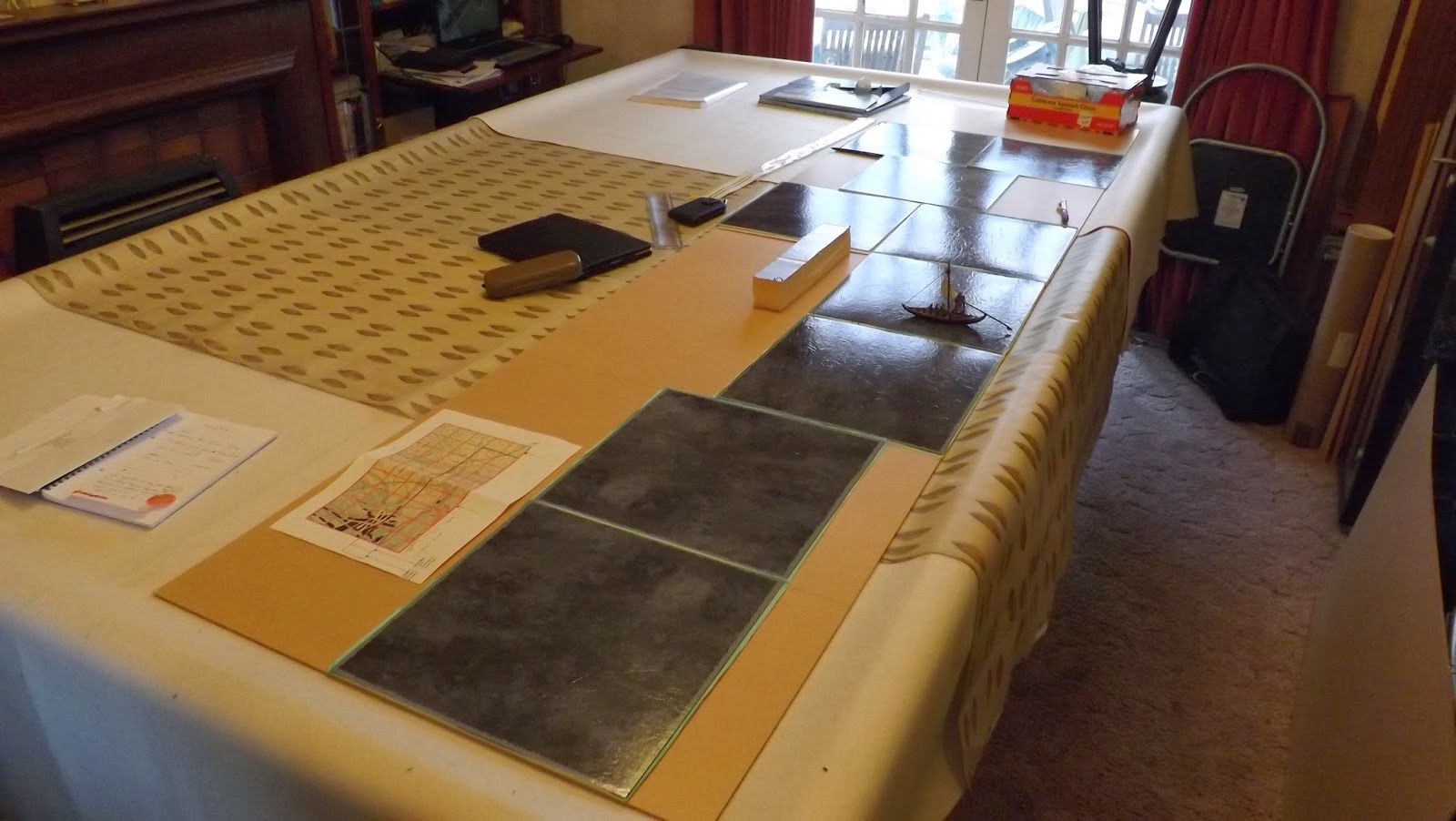

Last week I got hold of some floor tiles that will form the River Douro, an idea I have shamelessly adopted from Shed Wars and his terrain building ideas, see link to the blog in my blogs followed list. The picture above is my laying out the tiles and boat plus 50mm of styrene to get an idea of the look of the plan in 3D. The cliffs will be 100mm high to give an impression of the gorge that is the key terrain feature of the battle.


The picture below gives an impression of how formidable a barrier the cliffs along the Douro appear to any would be attacker, and must have provided a huge false sense of security to Soult. I want to try and capture that aspect in my set up.


Ok so after a Monday afternoon of sawing through 50mm styrene boards, this is the result of the first days efforts. As you can see over half the table is just raised ground which will form the area the French forces will need to exit across as the Anglo Portuguese move in from various parts of the board.


The other half of the table is taken up by the river gorge where the allies will be desperately trying to support their bridgehead in the Seminary by keeping up a ferrying service of allied infantry whilst using the opposite cliff tops to fire their artillery from in support.


The bark placed along the front edge of the first cliff section is another idea "pinched" from the ever resourceful Shed Wars (they do say imitation is the sincerest form of flattery) and, when the rest of it turns up, will help to shape the styrene section of the table.


This was the table build finished this evening with the styene left to stick to the hard board bases. Updates on progress to follow.

Saturday, 15 March 2014

1st Battalion, 16th Portuguese (Lisbon) Infantry


The 16th Portuguese Infantry Regiment composed the other two battalions of the four battalion force that accompanied Sir Arthur Wellesley's army to Oporto as detailed in my previous post about the 10th Regiment.

One of the first recorded accounts of the Allied army contacting the forward elements of Marshall Soult's army on the approach to Oporto mentions the role of the 16th as they went into action at Grijo.

Battle of Grijo

Wargames Society - Action at Grijo


Lord Londonderry wrote of the action on May 11th 1809 referring to the role of the 16th Regiment in action under the view of Sir Arthur

"On the 11th Wellesley ordered Major-General Hill (3 battalions plus one company) to endeavour to
outflank Mermet's position on the east whilst he with Major-General Paget's Division advanced (Paget's First division had two brigades of infantry and twelve pieces of cannon: we suppose that's the 1st brigade with two Guards battalions and an extra company, plus the 2nd brigade with two English battalions, one Portuguese and an extra company).

The position occupied by the French generals was strong in its right and centre ; the one resting
on a wood filled with tirailleurs ; the other covered in front by villages and enclosures. But the left was the weak point, and the eagle-eye of the British general, at a glance, perceived that it could be turned.

Without once halting his column, he ordered General Murray, from the rear of the advanced guard, to move round by the right, throwing, at the same time, the 16th Portuguese into a pine-wood on the left.

The latter were intended rather to distract the enemy's attention than themselves to attempt any thing
serious; whilst General Paget, supported by two battalions in reserve, manoeuvred upon their front. A very heavy firing immediately began; but the enemy no sooner observed the judicious movement round their left, than they abandoned their strong ground, and fled. Upon this, our troops were again thrown into column, and the march resumed as if nothing had happened; every movement being made with the same coolness, and in as perfect order, as if at a field-day"


More information about the 16th Regiment can be found here.

Napoleon Series - Portuguese Infantry


As with the 10th Regiment, the 16th are entirely AB figures and the King's Colour is from GMB Flags.


Friday, 14 March 2014

New AWI/Napoleonic 18mm Flags at GMB

If like me you are a fan of GMB flags you might like to know that they will have a new range of AWI flags available, see details below. With the re-launch of Polly Oliver figures, which I posted about on my trip to Plymouth PAW last month, and the 18mm range from Blue Moon, these new AWI flags and Colours will be a welcome addition to the 15mm/18mm collector.

New American Revolutionary War 1776
(In AB compatible 18mm) six flags in each pack

British Infantry Regiments
The first seven packs are for Brandywine  - with additional packs to add Regiments for other battles.
ARWB01   4th, 23rd and 28th  Regiments of Foot
ARWB02   5th, 10th and 27th  Regiments of Foot
ARWB03   49th, 40th and 55th  Regiments of Foot
ARWB04   1st & 2nd batts 71st Foot and Queen's Rangers
ARWB05  15th, 17th and 42nd Regiments of Foot
ARWB06   37th, 33rd and 46th  Regiments of Foot
ARWB07  44th, 28th and Foot Guards  Regiments
ARWB08   9th, 21st and 45th  Regiments of Foot
ARWB09  20th, 22nd and 47th  Regiments of Foot

Hessian Regiments
ARWH01 Erbprinz, Donop and Mirbach Infantry Regiments

Continental/American Regiments 
ARWA01  Sons of Liberty flags ( vertical stripes )
ARWA02  Virginia Militia
ARWA03 Liberty flags ( white )
ARWA04  Liberty flags ( Red & blue)
ARWA05  Massachusetts Pine tree flags ( variants )
ARWA06  New England 'an appeal to heaven'  ( variants)
ARWA07 Betsy Ross ( stars and stripes ) x6
ARWA08  South Carolina ( 1st, 2nd & 3rd Regts )
ARWA09  Connecticut ( 1st - 3rd Regts )
ARWA10  Connecticut ( 4th - 6th Regts )
ARWA11  South Carolina Crescent flags
ARWA12  New York ( 1st & 3rd regts included )
ARWA13  North Carolina
ARWA14  Colonial merchant ( horizontal stripes )
ARWA15  Pennsylvania Militia
ARWA16  Rattlesnake flags
ARWA17  Rhode Island
ARWA18  New Hampshire militia ( includes Stark's )
ARWA19  Grand Division flags - blue
ARWA20 Grand Division flags - red
ARWA21  Grand Division flags - buff
ARWA22  Grand Division flags - white
ARWA23  Grand Division flags - blue
ARWA24 Ex King's militia flags ( altered )

ARWA25  Congress or Continental flag 1777  ( 2 versions - stars in square or border )

In addition they will be adding 1812 French, Wurttemburg and Saxon Napoleonics in the next week or two, and we can expect a range for the Crimean War.

Tuesday, 11 March 2014

1st Battalion, 10th Portuguese (Lisbon) Infantry


The 10th Infantry were one of two regiments, the 16th being the other, each of two battalions, deemed ready enough in 1809 to accompany Wellesley's army on its march north from Lisbon to attack Marshal Soult's army at Oporto.

The Portuguese army was going through a process of reorganisation and training under Marshal Beresford, an able administrator who was a fluent Portuguese speaker. This reorganisation would see the Portuguese army become a major component of the Allied force that would eventually pursue French forces from the Iberian peninsula into France itself.


The 10th are shown in their 1806 regulation dress. As this battalion was one of the first of what were to become known as "Wellington's Fighting Cocks", I like to think these chaps would have been dressed in their original uniforms for the Oporto campaign. After 1810 the Portuguese infantry adopted British style blue uniforms with stovepipe shakos (as per the illustration above). Interestingly the British infantry in 1814 would adopt the Belgic shako, an obvious imitation of the Barretma shako seen here worn by the 10th.


Regular visitors to the blog will notice an absence of skirmish bases with the Portuguese. The answer to this is that the Portuguese line infantry regiments, trained to British methods,  would normally be brigaded with a Cacadore (Light Infantry) battalion trained to fulfil the function of the British brigade light battalion and be able to aggressively skirmish to the front of the brigade as well as defend it from enemy skirmishers.

In the unlikely event that the line battalions were attacked by enemy skirmish units, they could detach their grenadier company to perform a defensive skirmish screen. In "Carnage & Glory" this is modelled by allowing the battalion to defend against enemy skirmishers but not to be able to attack enemy units with skirmish fire, that being the responsibility of the Cacadores.

I love the soldier second rank, second from right in the forage cap - AB excellence
The 10th and 16th regiments joined the Oporto campaign without their Cacadore units and their battalions were parcelled out separately to the other British brigades. Thus in the Oporto scenario they will be relying on the British brigade light battalions to skirmish ahead of them when on the attack.


The battalion illustrated is composed entirely of figures from AB with a mounted colonel adapted from a British figure, that is with a head transplant and the double breasted jacket filed down to the single breasted version that Portuguese officers would wear. As always the Colour/Standard is from the excellent range of flags from GMB, with the King's Colour here displayed with the 1st battalion. My second battalion will have the white Regimental Colour.


The AB figures are, as always, a superb sculpt and a pleasure to paint. One particular figure that really makes the unit stand out are the chaps in forage caps (as in the illustration below) - superb. I also like the fact that the figures come in winter and summer dress and this allows the unit to have a campaign look.


If you would like to know more about the 10th Infantry and the other Portuguese battalions involved in the Peninsular War then follow the link to The Napoleon Series - Portuguese Infantry . The drop down menu at the bottom of this page will allow you to search by unit, enjoy.


Sunday, 9 March 2014

First Game of Hail Caesar Played - First Impressions


Courtesy of friends and fellow members at the Devon Wargames Group, I got to play my first game of Hail Caesar in my journey of discovery to decide on a preferred set of rules to play my collection of 28mm ancients. See the Devon Wargames Group Blog for a game report on the action yesterday. I thought I would post my first impressions.

First thing to say is I really enjoyed this set of rules, in spite of my reservations. As part of a generation of players that was brought up on rules from the Pre-Games Workshop era I have come to view a lot of the works that have come out of that stable as leaning more towards the game side of the spectrum rather than the simulation. I was not a fan of WAB and its amazing horses that seemed to kill more enemy soldiers than the riders on their backs. So it was with some reservation that I approached my first game having bought the rule book and Dacian supplement on taking soundings from far more experienced ancient enthusiasts than me.

I can see why some former WRG players might have reservations on this particular set of rules and the Black Powder ethos of being able to have a pre-curry game with your mates is obvious to see in the relaxed style they are written in with an obvious invitation to adopt, adapt and improve with house rules. The movement capabilities for instance are very imprecise, deliberately so, and in my mind to no great detriment to the game. That being said there are some clever mechanisms that seem to capture the remorseless slog of an ancient hand to hand melee where it gets up close and personal and the ability to tailor rule additions to model specific characteristics of a particular army are there and seem to work very well.

Hail Caesar game played yesterday at the Devon Wargames Group
The sequence of play is very logical with play alternating from side A to side B starting with commands to divisions and units, ranged attacks and lastly hand to hand combat. All very easy to get into after a few moves. A level of friction is built into this process by not being sure exactly what your force will be able to do in its turn and with an optional extra of blunder moves being possible with extreme die rolls producing unforeseen effects to a force in its attempt to move.

Casualties are recorded using markers or small dice in our game, with no requirement to remove figures. This facilitates multiple figure bases to be used, both two key factors that are a preference of mine.

The game play is simple and straight forward, not simplistic and there do not seem to be any strange fantasy factors that I mentioned previously, which was very reassuring.

On the downside for me is the use of an IgoUgo sequence that seems to me to be a rather tired mechanistic process. I think the case for moving away from this approach to a more initiative driven sequence which can change from move to move as one side gains the upper hand is a more intuitive way of simulating the ebb and flow of how battles seem to work in reality. 

The other issue for me that affects a lot of rules, not just these, is the lack of fatigue effects on the units over time. This probably comes from my computer rules usage, but I really do miss the effects of movement and combat wearing down the will and ability of units to keep fighting. This is not easy to model in paper based rule sets without, it seems, rather cumbersome recording methods.


If there was something that I would really want to change, it is the roll to hit, roll to save methodology of the combat process. I do think it is tiresome to have to roll multiple dice to establish casualties from hits and saves. Why couldn't you just have a casualty table that had the save effects already built in to the roll to hit calculation? If you included a morale result with the casualty result as well the game would move along at a much better pace. That is probably the "Lardy" in me coming to the fore.

With the Lardies rules in mind the straightforward structure of Hail Caesar does allow you to focus on the period rather than the rules and as the Roman commander I was quickly able to concentrate on using my Legionaries to their best in the face of wild barbarian attacks without having to spend too much time thinking about the special rules involved and the die roll factors were quickly mastered.

My final small point is, and I know this has been mentioned by other commentators but still merits a comment, please, please, pretty please can all rule sets have an index included for quick reference. It really does wind one up when you have to resort to flicking through pages to find the reference you need, grrrr!

I very much enjoyed playing Hail Caesar and would definitely play them again. Whether they turn out to be my turn to Ancient Rule set remains to be seen. I intend to have another play through of Crusader Ancient rules Crusader Miniatures . I have also printed out a copy of The Die is Cast Ancient Rules to try out,  and to test the Computer option I have ordered up a copy of "Macedon, Rome and Hellas" from Computer Strategies, courtesy of Magister Militum

We were playing in 15mm yesterday and I found myself picturing the 28mm Warlord figures on the table battling among the trees in desperation. Resist, resist, one project at a time!

Next up progess on the Oporto table build and Portuguese Line Infantry.


Friday, 7 March 2014

Hail Caesar - Painting Practice


All the first purchases have now arrived and I am resisting the temptation to dive straight in and start painting, but only just. What is it about wargamers and new toys?

I did find myself spending a few days researching the Dacian Wars and Germanicus in Germania, not to mention thinking about other rule sets and bases. I think I will get a German starter army and work on them before the Dacians, but that might change. The Ancient Brits look great and I fancy doing some chariots at some stage.

I have also spent some time looking at various painting techniques and have discovered some very talented people in the world of 28mm Ancients. Warpainter shade dipping seems to be a fashion in some quarters and I have also looked at the effects from the new washes from Games Workshops ranges.


I am a confirmed three coat painter myself and though more time consuming than shading seems to give a brighter look to the figures. I note that some even combine both getting depth from the shading and then highlighting over. Unable to resist a little "messing about" whilst focusing on the Napoleonic project I played around with this Hanibal figure that was given away as a freebie at Salute 2004. I make no claims on colours for this model, it was simply an exercise in using various colour shade options.

If I am honest, it kept me away from diving in to those Romans!


Wednesday, 5 March 2014

2nd/17th Legere Peninsular War


Ok, for those of you who are now thoroughly bored with Legere battalions on JJ's, the good news is I have now completed the final battalion of the eleven that Marshal Soult will have with him at Oporto. Thus the 2/17th Legere is now in the "tin" and enables me to turn my attention to Wellington's "Fighting Cocks" the Portuguese army units that have been trained to British methods by Marshal Beresford and now have a sprinkling of British officers in their ranks.


The final battalion carries the standard of the 17th Legere, the history for which is covered in my previous post.


The battalion is composed of figures from the Xan range with a mounted colonel from AB and the standard is from GMB flags.


Now I do have some friends who doubt that new units are being created here and that its just pictures of the same one posed differently. I can almost here Steve pulling the lap top closer to compose his response.

So for those doubters out there I have put together a parade shot of Marshal Soult with four of his five new battalions ready to contest the crossing of the Douro.


Speaking of the Douro, I now have a few weeks of "gardening leave" whilst I wait to start a new job in April and I thought it might be a good time to start putting together the terrain for this game. The river gorge at Oporto poses quite a few challenges and the first one has been to decide where to model the action. So I'll post my thoughts and record the other modelling challenges as I go.


Next up, Hail Caesar painting practice, Oporto Scenario thoughts and Portuguese Infantry.