Sunday, 18 August 2024

All at Sea - Battle of Camperdown Fleet Review

The Battle of Camperdown - Thomas Luny
The pell-mell battle between the two vanguard divisions is well under way as the two opposing flagships, Vrijheid, about to lose her mainmast, and Venerable exchanging close in broadsides, as the burning Dutch 64-gun Hercules drifts out of the action as her crew fight to extinguish the flames.

Last weekend a ten-month project was completed when the last models needed to finish off both fleets for the Camperdown collection were showcased and added to their respective line-ups and as promised I thought I would show the first pictures of the two fleets arrayed for the first time together, rather as I did with the Trafalgar collection back in 2021, together with a summary of the history behind the battle and plans for games with the collection.

In 1795 Holland was added to the number of Britain's enemies. The country had been overrun by the French, whose cavalry captured a frozen-in Dutch fleet by galloping over the ice.

The French cavalry take the battle fleet caught in the ice in the waters of Texel, 21 January 1795 - Charles Mozin

The commander given the task of blockading the Dutch fleet was the impressive figure of Admiral Adam Duncan, commanding very much a Cinderella force scraped together at a time when most ships of the line in good condition were already allocated to the Channel, Mediterranean or West Indies stations; with most of the North Sea ships not only in a poorer state but also tending to be older and smaller vessels.

Admiral Adam Duncan in 1798 by Henri-Pierre Danloux 

Much of this squadron was made up of 64-gun ships and fourth-rate 50's, the latter definitely too weak for the line of battle, and the former now widely regarded as less than ideal. 

Apart from the stretched nature of the Royal Navy's resources, the main argument for the allocation of such ships to Duncan's command were that his cruising ground was never far from a British base, and its maintenance facilities, easily accessible for his old and decrepit ships, but also because the Dutch navy was itself comprised of ships that were small for their rate. 

This period chart from the London Gazette, October 16th 1797, produced at the time to illustrate the position of the Battle of Camperdown, also shows well the proximity to the British mainland from the Dutch coast that helped Duncan's squadron maintain its ships cruising these waters between the North Sea and English Channel.

The summer of 1797 saw most of Duncan's ships in a state of mutiny, and at one time he only had his own flagship, the Venerable 74-guns, the Adamant 50-guns and a cutter to maintain the blockade, and he was forced to maintain the pretence of signalling to imaginary ships over the horizon to keep the Dutch in port, where fortunately they remained until well into the autumn.

The two opposing fleets for Camperdown assembled, with the British fleet to the left of picture, from the range stick and the Dutch to the right of picture. Fifty vessels in all, twenty-four British and twenty-six Dutch.

French plans for 1797 had included an invasion of Ireland covered by the Brest fleet initially to be joined by the Spanish, but they were defeated at the Battle of Cape St Vincent on February 14th and returned to Cadiz, which left the Batavian-Dutch Republic and its fleet based in the Texel.

The Battle of Cape St Vincent, February 14th 1797 - Derek Gardner

By October 1797 the plan was in abeyance, but the Dutch fleet, under Admiral De Winter, left the Texel notwithstanding, and it is not clear whether he was raiding int the North Sea, or going to join the Brest fleet, or merely to try conclusions with Duncan's fleet, most of which had been in a mutinous state; or perhaps he was under orders to sail from a Dutch higher command determined to make a gesture, against their commanding admiral's better judgement.


The Batavian-Dutch fleet was not in the happiest of states either, following an aborted revolution in the Netherlands just before the French Revolution, which left a strong republican faction in the country that was more than prepared to throw in its lot with the invading French.

Admiral Jan Willem de Winter

A large proportion of Dutch naval officers including De Winter were of the republican persuasion, but a great many of the sailors were of the traditionalist party which supported the rule of the exiled Orange family, however in the event the fighting power of both fleets does not seem to have been affected by these ideological splits, and both fought with the wholehearted (but far from vindictive) pugnaciousness that seems to have characterised battles between the British and Dutch.

Orangists taunt Elsevier's Free Corps in Rotterdam, 1785 - Charles Rochussen

In early October 1797 most of Duncan's fleet were forced to victual and refit at Yarmouth Roads, leaving a small observation squadron, and were there on the 9th October when the hired armed cutter, Active arrived to signal the news that the Dutch were out, that saw Duncan get underway immediately, sighting the enemy fleet off their own coast early on the 11th of October near the village of Kamperduin, later anglicised to Camperdown that lends its name to the battle that followed.

HM Armed Cutter Active, under Commander J Hamilton, signals to Admiral Duncan in Yarmouth Roads the intelligence of the Dutch fleet being at sea, which led to the Battle of Camperdown - John William Huggins circa 1830.

Neither fleets were in a neat formation, so both began forming a line of battle, with the Dutch edging away into shallow water, that forced Duncan to conclude that he didn't have time for careful manoeuvring and signalled for his fleet to 'pass through the Enemy's Line and Engage from Leeward', after first hoisting the signal flags for 'General Chase', which resulted in, with one exception (Agincourt, whose captain was subsequently court-martialled) his ships proceeding to engage the enemy as closely as possible.

A representation by an unknown artist of the British and Dutch fleets five minutes before the action commenced on the 11th October 1797 - National Museum of Scotland.    

In his letter to Lord Spencer at the Admiralty, after the battle, Duncan reported that he; 

'. . . immediately gave chase and soon got sight of them, forming line on the larboard tack to receive us, the wind at the NW. As we approached them I made the signal for the squadron (fleet) to shorten sail, in order to connect them; soon after I saw land between Camperdown and Egmont, about nine miles to leeward of the enemy, and finding there was no time to be lost in making the attack, I made the signal to bear up, break the enemy's line, and engage them to leeward, each ship her opponent, by which I got between them and the land, whither they were fast approaching. My signals were obeyed with great promptitude.'
 

Admiral Duncan's fleet at Camperdown, with the seven 74-gun third-rates, extreme left, the seven 64-gun third rates next, with Duncan's division of six ships to the fore and his second in command, Vice Admiral Richard Onslow's eight in the second rank. Next are the two 50-gun fourth-rates, Adamant and Isis that were both technically part of Duncan's division, but Adamant re-joined the fleet from a prior reconnaissance, and ended up attaching to Onslow's division in the approach to battle. Next in line are the two fifth-rates, Beaulieu and Circe, then the sixth-rate Martin, the lugger Speculator and the four cutters, King George, Rose, Diligent and Active.

He further added;

'For the particulars of our victory, I shall leave your Lordship to my public letter, and shall just say I was obliged to lay all regularity and tactics aside, we were so near the land, or we should have done nothing.'

Battle of Camperdown - Derek Gardner

Thus as can be deduced from Duncan's account that any suggestion that Camperdown anticipated Nelson's very deliberate and calculated attack at Trafalgar, eight years later is in error in that Duncan's plan of attack was one that was a response to a situation developing that he observed prior to his decision to steer for the enemy to quickly put his fleet between them and the land; this would see his fleet form loosely into two distinct groups, as depicted above with his own division less Adamant which had previously been detached to observe and was now with Onslow.


Yet his need for a speedy approach needed to avoid confusion and to break through the Dutch line successfully each ship had to steer for her opposite number in such a way as to not block the fire or movement of flanking ships, thus Duncan's approach was anything but headlong, nor could it be as the speed of his ships could scarcely have exceeded three knots in the fresh or moderate breezes recorded in the ships logs, and the thirty signals he sent to the fleet in the space of about three hours were all intent on speeding up the battle by way of making adjustments of distance and bearing so as to avoid the need for bringing to and dressing his line during the approach.

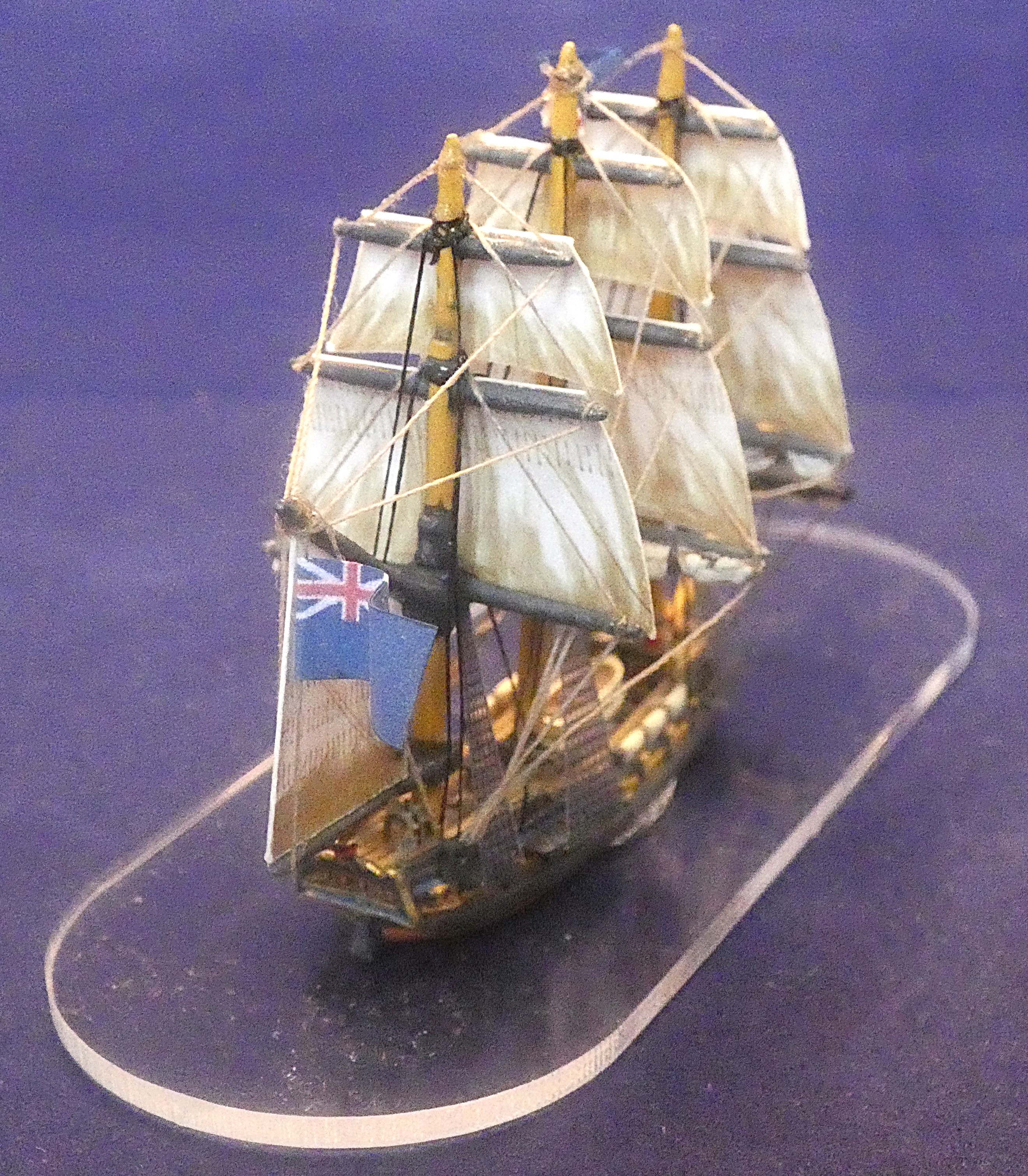
The seven British 74's with from nearest to camera, Triumph, Venerable and Bedford in the forward line of three, and the four ships of Onslow's division similarly,  Russel, Montagu, Monarch and Powerful.

Admiral Jan Willem de Winter put to sea from the Texel with fifteen ships of the line, very weak in firepower. He made no attempt to manoeuvre when approached by the British fleet but simply formed in line ahead on the larboard tack on a north-easterly course with the wind NW by N, within sight of the Dutch coast, supported by three heavy frigates and four brigs used to support his line from the impending attack by Duncan's sixteen ships of the line.


When Onslow opened the battle at about 12.40pm, he succeeded in breaking through the Dutch line, raking bow and stern respectively of the ships he passed between, and was followed in a similar fashion by roughly half the British fleet in some measure; that saw two separate pell-mells resulting, with the Dutch ships in the centre not fully engaged.

The four British hired armed cutters can be seen alongside the lugger Speculator, sloop Martin, and frigates Circe and Beaulieu.

The Dutch fought with all their accustomed bravery but were heavily worsted by the superior British gunnery and mutual support tactics of the pell-mell, with the Dutch doing what they could to assist ships nearest to them, but with the British showing marked superiority in their in-fighting changes of position.


They also showed superiority in preventing the Dutch doing the same thing, and by 3pm the battle was over and many Dutch ships had struck, with nine of the line and two other ships eventually secured, with the prisoners including Admiral de Winter and another flag officer.

In the centre are the seven British 64s, with Duncan's forward three comprising, nearest to camera, Belliqueux, Lancaster and Ardent, and to the rear similarly, Agincourt, Monmouth, Veteran and Director, and to the left of the picture, the two 50-gun fourth-rates, Isis, extreme left and Adamant

The fleets had been carried to leeward in the fighting and many of them were now close in shore so that Duncan had great difficulty in getting off the coast with his prizes.


In terms of percentage of captures to total of enemy force, this was the most complete victory achieved by British Royal Navy in the whole of the Revolutionary and Napoleonic Wars with the exception of the Nile.


In the captured Dutch naval personnel was their commander Vice-Admiral de Winter who had this to say after his capture to a comment from Admiral Duncan about the result of the battle;

Duncan Receiving the Surrender of de Winter at the Battle of Camperdown, 11 October 1797 - Daniel Orme (NMM)

"Your not waiting to form line ruined me: if I had got nearer the shore and you had attacked, I should probably have drawn both fleets on it, and it would have been a victory for me, being on my own coast.".

The four Dutch 74-gun third-rate flagships can be seen in the forward line comprising Vrijheid, nearest camera, Staaten Generaal, Brutus and Jupiter, note all Dutch ships of the line have lateen rigged mizzens. In the rear line are the five 68-gun third-rates, with Gelijkheid, nearest camera, next to De Vries, Leijden, Cerberus and Haarlem.

The two Dutch 64's Wassanaer (11) and Hercules (3) with forward of them, the 44-gun razee Mars, and alongside obscured beyond the four Dutch fourth-rate 56-gun Beschermer, Batavier, Alkmaar and Delft.

The Dutch light ship line up comprising from right to left the frigates Monnikkendam, Embuscade and Heldin, then the two corvettes, Waakzaamheid and Minerva, the four brigs Atalante, Ajax, Galatee and Daphne and finally the aviso Het Hassje.


As well as running the collection at the Naval Wargames Society Meeting at the Fleet Air Arm Museum on Saturday 28th September, for a play through of the complete battle using David Manley's fleet action rules, 'Far Distant Ships', 


I've also put together a new scenario for Kiss Me, Hardy just looking at the battle between the British and Dutch vans, prior to the arrival of support from the British rearward or leeward division having defeated the Dutch rear and centre.


All the models seen are using the small and large third-rates from Warlord Games Black Seas range of models, together with the fourth-rates, whilst the frigates and cutters are also using models from the Warlord range, several of the smaller ships are 3-D prints from Turner Miniatures and Only Games, whilst the British lugger Speculator is a scratch build based on the hull of the Warlord Schooner.

The seven British 74's closest to camera with HMS Venerable prominent and her signal No.5 flying at the mizzen 'Engage the Enemy Closely'.

Those that have followed in the build of this collection over a series of fourteen separate posts will know that I have covered the individual histories of the ships as they were built, together with the information around the changes made to models to better make them fit the look of their historical counterparts, and for those who would like to look back at those posts I will add links to each of them individually at the bottom of this post.

The seven British 64's seen bow on. All these models are based on the Warlord Games 'Small Third-Rate' designed to generically represent the various 64's, 68', and 70's found among many of the European navies at this time, with the models coming with a range of figureheads and capable of being fitted with the plastic options from the generic plastic third-rates.

As mentioned, as well as the fleet action using Far Distant Ships, I am working up a new scenario from the battle entitled 'Nailing the Colours – Battle of Vanguards' focussing n the attack by Admiral Duncan's van on Admiral de Winter and the van of the Dutch fleet


The two British fourth-rates Adamant (closest to camera) and Isis. Both using the generic option from the Warlord range and fitted out with plastic fifth-rate masts, sails and bowsprits.

Thoughts have now turned back to scenario and battle planning to arrange the required table space to facilitate the whole battle and parts of it in 1:700 or about one inch to twenty yards.

The British 'small-ships' with HMS Beaulieu heading up the line from the left, followed by Circe, Martin, the lugger Speculator and the four cutters Diligent, Active, King George and Rose.

The Dutch line up with the four 74-gun flag-ships with Venerable closest to camera, flying Admiral de Winters flag on a jackstaff on the mainmast, and with the five 68-gun third-rates in line behind.

The Dutch razee Mars, closest to camera with the two 64's Hercules and Wassenaer directly behind, and to the right, the four 56-gun fourth-rates Beschermer, Batavier, Alkmaar and Delft.

The Dutch 'small-ships' with from left to right the fifth-rate frigates, Monnikkendam, Embuscade and Heldin, the two sixth-rate corvettes, Minerva and Waakzaamheid, the four brigs, Atalante, Ajax, Daphne and Galatee, and at the far end of the line, the little aviso (dispatch boat) Het Hassje.

The Dutch small-ships seen from the other end of the line.

If you would like to see a video review of the collection on JJ's Wargames YouTube channel, click on the link below;


In addition I have attached the links to the project build posts by subject matter below.


By subject the posts cover the the following:

Part One - The Dutch 74's (note I mistakenly painted these in the late-Napoleonic war white scheme but changed them later to the more appropriate puke-yellow for Camperdown.

Part Two - British 64's of the Leeward Division

Part Three - British 74's of the Leeward Division

Part Four - The Leeward Division Completed (HMS Powerful 74-guns, HMS Agincourt 64-guns and HMS Adamant 50-guns).

Part Five - The Dutch Rear Completed (Cerberus 68-guns, Haarlem 68-guns and Alkmaar 56-guns).

Part Six - Leijden 68-guns, Wassenaer 64-guns and Batavier 56-guns.

Part Seven - Hercules 64-guns, Admiraal Tjerk Hiddes De Vries 68-guns and the razee Mars 44-guns.

Part Eight - Batavian Battle Line Completed (The 68-gun Gelijkheid and 56-gun Beschermer).
All at Sea, Battle of Camperdown Build Project, Part Eight

Part Nine - Duncan's Spearhead (The British 74's Venerable, Triumph and Bedford)

Part Ten - The British Battle Line Completed ( HMS Belliqueux, HMS Lancaster and HMS Ardent each 64-guns and the veteran old lady, HMS Isis 50-guns).
Part Eleven - The Small Ships (1) Minerva, Waakzaamheid, Circe and Beaulieu

Part Twelve - The Small Ships (2) The Dutch 32-gun frigate Heldin and the four British cutters, Rose, King George, Active and Diligent.

Part Thirteen - The Small Ships (3) 'Let's Build a Lugger'. - His Majesty's Hired Armed Lugger Speculator

Part Fourteen - The Small Ships (4) Sloop, Brigs and Aviso - The 16-gun British sloop, Martin, the 6-gun Batavian Dutch aviso (dispatch or advice boat) Het Hassje and the four Batavian-Dutch brigs, Galatée, Daphné, Ajax and Atalante

I hope you have enjoyed this Project Build and I look forward to posting AAR's on the games to be played with this collection going forward.

In the meantime, JJ's continues with lots of other stuff to come.

As always, more anon 
JJ

Friday, 9 August 2024

All at Sea, Battle of Camperdown - Project Build (It's Done), Part Fourteen, The Small Ships (4) Sloop, Brigs and Aviso


It's a really great feeling of satisfaction when a project reaches a conclusion, something I have experienced several times in the lifetime of this blog, be that the building of the Talavera collection, Trafalgar and Cape St Vincent fleets and now the Camperdown collection, properly started back on the 23rd of September with the first post in this series looking at the project build process and the history reflected in the various models

These last six models, the British 16-gun sloop, Martin, and the Batavian-Dutch 16-gun brigs, Galatée, Daphné, Ajax and Atalante and the aviso Het Hassje (the Hare or Rabbit in English) complete the collection of models required to bring the complete Battle of Camperdown to the table in glorious 1:700 scale, and my planner below now shows all the various ships that took part in their respective lines marked up with the white dot of 'doneness'.

The collection is complete.

These last six models have required a little extra effort and I may come back to them over time and make changes, but for now these are the models that will take the table in the first playing of Camperdown.

The reason for the extra effort were the challenges in finding the right models to represent these actual vessels, with a scarcity of sources in English detailing precisely the look and layout of the Batavians, and a not exact model of a 'Hound-class' sloop or any of these vessels requiring choices to be made as to which models seemed to come closest to catching the look on the table.

The first-hand illustration of the Battle of Camperdown, with my assumed positioning for the Batavian-Dutch brigs and aviso.

So to start the ball rolling with this final showcase in the series, I present the 16-gun British sloop, Martin and the 6-gun Batavian Dutch aviso (dispatch or advice boat) Het Hassje.


HMS Martin 16-guns, Hound-class sloop
HMS Martin was a 16-gun Hound-class sloop of the Royal Navy, and served at the Battle of Camperdown in 1797 and captured two privateers before she disappeared in 1800.

The model being used here is the 3-D print from Turner Miniatures of a Swan-class sloop, produced by Only Games, with masts and sails from the Warlord brig, the Swan class being of a similar size, 300 tons, layout and armament to the Hound-class.


Martin was built to a design by John Henslow and ordered from Woolwich Dockyard on the 17th January 1788. Master Shipwright John Nelson worked on her until August 1790, after which William Rule completed her. 

Her general characteristics were:

Tons burthen 320 89/94 tons (bm)
Length of gundeck 100 feet
Beam 27 feet
Draught 13 feet

Scale: 1:48. Plan showing the body plan, stern board with some decoration detail, sheer lines, and longitudinal half-breadth proposed (and approved) for building Martin, (1790); Fury (1790); Serpent (1789); Rattlesnake (1791); Hound (1790), all 16-gun Sloops. Signed by John Henslow [Surveyor of the Navy, 1784-1806].(RMG)

Her armament consisted of:
Upper Gundeck: 16 x 6-pounder long guns.
Quarterdeck and Forecastle, QD: 4 x 12-pounder carronades and Fc: 2 x 12-pounder carronades

She was launched on 8 October 1790 and commissioned on 13 January 1791, having cost a total of £8,732 to build, with a further £1,674 spent on fitting out.


Martin's first commander was George Duff, who would go on to command HMS Mars at Trafalgar, where he was killed in 1805, under whom she sailed off the East coast of Scotland. On 17th March 1792, in the Firth of Forth, the brig Paisley ran into Hales Castle, which sank. Paisley rescued three of Hales Castle's six crew and Martin rescued the other three.


Commander William Lobb took over Martin in April 1795, during which time she served as a Royal escort for Princess Caroline of Brunswick. On 10th December 1795 under her new commander, Samuel Sutton, Martin departed Britain for the West coast of Africa, followed by a voyage to Jamaica.

Scale: 1:96. A contemporary full hull model of the 'Atalanta' (1775), a 16-gun sixth-rate sloop, built in bread and butter fashion and finished in the Georgian style (RMG). This model captures the look of this 3-D print of HMS Swan from Turner Miniatures and of a similar tonnage (300 plus) and gun set up, does not have the later style of side gallery windows as seen on the hull plan above.

Returning to British waters, on 14th February 1797 Martin and HMS Espion captured the privateer Buonaparte in the North Sea. Buonaparte was armed with sixteen 6-pounder guns (eight of which she threw overboard during the chase), and one long 12-pounder gun. She had a crew of 110, of whom 82 were on board, and had sailed from Cherbourg on the 1st of the month, but had captured only a sloop in ballast, which the British were able to recapture.


While Martin was in the North Sea she also transported the Duc d'Angoulême, the future Charles X of France, from Leith to Cuxhaven, and on 27th June Sutton's service brought him promotion to post-captain.

Martin immediately came under the command of Charles Paget, under whom she was present at the Battle of Camperdown on 11th October 1797 serving as a signal repeater for the starboard, or weather division under Admiral Adam Duncan, who was also the overall commander.


Martin disappeared without trace and with all hands in the North Sea in October 1800, and she is presumed to have foundered in heavy seas.

Batavian-Dutch Aviso - Het Hassje
This model is a bit of a mash-up, using the 3-D hull of the schooner Pickle from Turner Miniatures and Only Games and Warlord Brig masts to produce a 'Snow' like rigged vessel, likely acquired, as some sources suggest, from the VOC, (Dutch East Indies Company) for naval duties.

 
The only sources I've found for this vessel are for the Hassje, brig rigged and built in 1788 for the VOC of about 160-180 tons bm, but captured by a British whaler in August 1797, recaptured by a French privateer on her way to the UK and later taken back by the British, so it seems unlikely to be our Hassje.


The other vessel is also named Hassje, also brig-rigged, with no details on her size, or when built or taken into service, but that she was also captured by the British in 1803 and entered service with the Royal Navy in 1804 as the fireship HMS Phosphorus.


Either way, the first hand illustration of the opening of the Battle of Camperdown (see above), shows five Batavian Dutch brig-rigged vessels in the second line, four of which must be the brigs known to have been present and with the ship-rigged small ships accounted for by the two fifth and two sixth-raters, hence my decision to portray the Het Hassje as seen with a VOC look about her with her white hull paint job.


Point to note, the anchors are the 3-D print option from Only Games, using the smallest prints which with a bit of clipping seem to work really well with the small ship models.

At the Battle of Camperdown Het Hassje was under the command of Liutenant ter Zee Harteveld.


Batavian-Dutch 16-gun brigs, Galatée, Daphné, Ajax and Atalante
And finally, I present the four new Batavian-Dutch brigs, Galatée, Daphné, Ajax and Atalante, using the 3-D printed hulls from Turner Miniatures and Only Games of the French Curieux-class 16-gun brig married with Warlord brig masts and sails.


In the first incarnation, my Batavian-Dutch brigs were going to use the Warlord flush deck cruiser class type they have as their generic offered model brig, as seen below in our playthrough of the attack of the Leeward Division at Camperdown earlier this year using Far Distant Ships.
The Warlord models are a nice generic option for a brig and will still be in the Batavian fleet to represent their later larger 18-gun options, but on seeing the model of the 16-gun Atalante, held by the Dutch Maritime Museum in Amsterdam illustrating the classic small poop deck covering the small commander's cabin in the stern, I set about looking for a similar model to capture this look.


I am really pleased with the Curieux brig and its similarity to the model seen above, right down to that poop and with not much to go on with the other three brigs decided to build all four around this model.


As with the Hassje, there is not a lot of information about these Dutch brigs and as historical modellers we can only look forward to another title from Rif Winfield to hopefully fill the gap.


That said I have discovered a Batavian brig, Atalante acquired by the VOC on 3rd September 1796, and later captured by the British in 1804 (HM brigs Beaver and Scorpion in a cutting out raid). The large scale model of a 16-gun brig pictured is likely of that vessel.


Similarly there is an 18-gun brig, Ajax, built for the VOC in October 1796, with the following general characteristics:

Length of gundeck 106 feet, 9 inches
Beam 29 feet, 10 inches
Draught 16 feet, 8 inches


A Dutch manuscript mentions a corvette of 16-guns (supposedly ship-rigged) acquired by the VOC on 30th September 1796 and given to Morocco in 1804.


The 16-gun brig Galatée or Galathe is also shown launching in 1795 for the Admiralty of the Maze in Rotterdam and later captured on the 30th August 1799 by the British at the Vlieter surrender, and she is shown to have had a displacement of some 260 tons bm.


At the Battle of Camperdown Ajax was under the command of Liutenant ter Zee Arkenbout, Atalante was under the command of Liutenant ter Zee Pels, Galatée was under the command of Liutenant ter Zee Reverji, and I have not a lot of information about Daphné, other than she was under the command of Liutenant ter Zee Frederiks.

A beautiful illustration of 16 to 18-gun brig with the graceful lines seen in these models

It is important to note that in the case of the Batavian-Dutch fleet their second line of brigs, sloops and frigates were intended to fight any British ships breaking through the Dutch line and indeed it is recorded that some indeed did just that and were either badly shot up or sunk for their temerity, it being the custom that ships of the line did not fire at unrated opposition unless fired upon by them.

Thus my Batavian-Dutch brigs like their larger compatriots in the small-ship line will be testing to see if they have such temerity in our games with the collection going forward.

So that concludes the build process and now my attention turns to toping and tailing the rules to be used with the collection going forward which sees me planning a new scenario from the battle using 'Kiss Me, Hardy', entitled 'Nailing the Colours - Battle of Vanguards' in honour of Sunderland's very own Jack Crawford who famously climbed to the top of the mainmast of HMS Venerable to nail the fallen flag of Admiral Duncan to it to make sure there was no hint of any surrender in her action with the Dutch flagship Vrijheid.

Jack (John) Crawford - Known as 'The Hero of Camperdown'.

I'm hoping to run the scenario for the first time at 'Clotted Lard' on the 21st September, which will recreate the attack on the Batavian Dutch line by Duncan's Windward Division of ships that resulted in a very hard fought action until the Leeward Division ships came up in support having overwhelmed the Batavian Dutch rear and centre.

'Nailing the Colours - Battle of Vanguards' my new scenario using Kiss Me, Hardy

Then the following Saturday, 28th September, I will be taking the collection up to Yeovilton for the annual Naval Wargames Society meeting there to stage the whole battle on a very large table using Far Distant Ships, David Manley's fleet action rules, and if you are around why not come to the show which will also allow you to visit the marvellous Fleet Air Arm Museum at the same time as enjoying some wargaming fun.


In the meantime, if you would like to see the collection complete, I am aiming to put a video and post together, similar to when the Trafalgar collection was finished, showing all the models together to give a better impression of how the collection will look on the table in the heat of battle.

So as you can see lots of stuff to come here on JJ's, with some more Turner Miniature 3-D prints in the rigging yard as I write, plus my trip to the Darwin Aviation Museum, last year, and the Camperdown Fleet Review, prior to some big game AAR's to come.

More anon
JJ

Friday, 2 August 2024

All at Sea - HM Cutter Entreprenante, 3-D Print from Turner Miniatures & Only Games.

The Royal Navy armed cutter Entreprenante shadowing the remnants of the Franco-Spanish fleet as it runs into Cadiz after the disastrous defeat at Trafalgar - Thomas Butterworth.

It was back in April 2021 when I was concluding work on building the opposing fleets for Trafalgar using the Warlord range of 1:700 models, that I focused on completing the small ships for the opposing sides and Entreprenante was of course included, see link below.

JJ's Wargames - All at Sea, Small Ships at Trafalgar

With work going on to complete my Camperdown collection in a similar way, I recently constructed the four hired cutters for the British fleet and used the three unbuilt models I had in stock together with the one seen above, used to represent Entreprenante in her first incarnation.

Entreprenante mark-one brings up the rear of the Inshore Squadron at Trafalgar 2023 played with the DWG and Penarth club.
JJ's Wargames - Trafalgar 2023

Thus I was in need of another model to complete my British Trafalgar collection, for the next time it takes to the table, likely next year in time for the two-hundred and twenty-fifth anniversary of the battle and thus I turned to a more exact recreation of this famous little ship, the smallest to participate at Trafalgar and beautifully replicated by Henry Turner, and so I have put this specific showcase together to look at the model and the history in a bit more detail than in my original post.

His Majesty's Armed Cutter Entreprenante is listed as being captured from the French in 1798 and may have been a privateer from Socoa, or possibly nearby Saint-Jean-de-Luz, on the Franco-Spanish Pyrenean border, and under the command of Ensign Dominique Délouart, of Bayonne, although there are no records indicating where or by whom she was taken.

My brand-spanking new, more accurate representation of HMAC Entreprenant, courtesy of Turner Miniatures and Only Games.

In design she probably differed little from the standard British cutters of the period, and her general characteristics were:

Tons burthen 126 59/94 tons (bm)
Length of gundeck 67 feet
Beam 21 feet, 6 inches
Draught 11 feet

Scale 1:32. A full hull model of a 10-gun cutter (circa 1800 - RMG).

Her armament consisted of:
Gundeck: Originally 10 x 4-pounder long guns, from December 1803: 10 × 12-pounder carronades

Map illustrating Genoa where Entreprenante together with a British naval squadron that consisted of HMS Minotaur, Phoenix, and Mondovi (an ex Venetian/French brig 14-guns) operated in support of the Austrian siege 19th April - 4th June 1800

Purchased for the Navy in November 1798 and registered in the 10th January 1799 Entreprenante was commissioned in February 1799 under Lieutenant Charles Claridge and by April 1800 was under the command of Lieutenant William Swiney in the Mediterranean, part of Admiral Lord Keith's fleet, supporting the Austrian siege of Genoa, and having previously shared in the capture of the Madona del Grazie, sent into Leghorn on the 3rd of March 1800, while in company with the Phaeton 38-guns and Minotaur 74-guns.

Bombardment of the city of Genoa by the English on the night of 20 May 1800
by Giuseppe Pietro Bagetti.

She continued a profitable period of cruising off the city, capturing a Genoese vessel from Capraia bound for Genoa with a cargo of corn on the 29th March, shared in the proceeds of the capture of the St. Rosalia on the 14th April, in company with Pheaton and the ship-sloop Peterel 16-guns, and again shared in the proceeds from the capture of the Proteus off Genoa on the 28th April.


In 1801, Entreprenante was deployed with the rest of the fleet off Egypt, bringing dispatches to Jaffa on the 21st January and then participating in the the landing of troops in Aboukir Bay protecting the left flank during assisted by the schooner Malta, the gun-vessel Negresse, the schooner Cruelle the cutter Janissary and the gun-vessel Dangereuse; with the crews involved eligible for the clasp 'Egypt' to their Naval General Service medals.

The landing of British troops at Aboukir, 8th March 1801 - Philip James de Loutherbourg 1802.

In 1802, Entreprenante was recalled home, arriving at Portsmouth on the 28th November and was paid off, refitting and having her copper replaced, undocking on the 29th October 1803 and recommissioning under her new commander Lieutenant James Brown, organising his crew around setting up rigging and taking in stores.

On the 7th January 1803 Entreprenante finally sailed from Portsmouth and moored off Spithead awaiting orders, returning to Portsmouth on the 29th January to perform remedies on some minor defects discovered after her refit, sailing again on the 2nd February, and on 12th April 1804, Lieutenant Robert Benjamin Young took command and under who she would serve during the Trafalgar Campaign the following year.


On the 7th November 1804, Entreprenante was back at Portsmouth to have her copper repaired and sailed thirteen days later. 

On the 7th September 1805 Lieutenant Young received orders to join Nelson's fleet off Cadiz and sailed on the 11th, reaching her destination on the 2nd October, with Young recording in his log observing the Cadiz light lying 10 miles off and joining the fleet on Friday 4th October to be immediately deployed with the schooner Pickle and frigates of Sir Henry Blackwood's inshore squadron watching Cadiz .

A British Cutter off Cadiz with the Spanish Fleet in the Harbour, 1797 - Thomas Buttersworth.
Eight years later in October 1805, Entreprenante was performing the same level of observation on Villeneuve's Combined Fleet, part of Sir Henry Blackwood's inshore squadron.

Monday 21st October 1805 - Battle of Trafalgar
In Entreprenante's log, Lieutenant Young records

'Squally with rain 
Refit the mainsail, shifted Jibs and closed reeft the Bowsprit per signal with the fleet
AM Moderate and cloudy at Daylight 
Observed the Enemy consisting of 35 sail to the Eastw'd
Observed the fleet wear and stood towards them under all sail 
At noon light breezes and cloudy 
The Body of the Enemy's fleet ESE 3 miles'


Being such a small vessel, Entreprenante did not play a part in the action off Cape Trafalgar but instead cruised near the fleet, acting in support where required. Her most significant part came towards the end of the action at about 5.45pm, when she with the Schooner Pickle and boats from Prince 90-guns and Swiftsure 74-guns, rescued people abandoning the French Achille 74-guns which had caught fire.

Survivors from the French 74-gun Achille which blew up at the end of the battle being rescued by British boats.

Despite the danger, Entreprenante and the forenamed ships saved 200 people from the raging inferno Achille had become before she blew up; and following the storm that developed at the close of the battle and once the weather had abated, Entreprenante was sent to Faro, Portugal with copies of Admiral Collingwood's dispatches and later returned to England.

The year 1806 saw the little cutter dry-docked in Plymouth on 13th January to have her copper replaced, spending the rest of the year patrolling the English Channel and French coast, and on the 28th June she was unsuccessful in aiding the 4-gun schooner Capelin, which had run onto the Parquette Rock while reconnoitring the harbour at Brest, returning to Plymouth in the November for repairs to her copper, suggesting a poor job done back in January.

Her Channel Fleet duties would continue through to 1809, operating from Plymouth and the appointment of Lieutenant Peter Williams as her new commander on the 4th December 1808 who would lead the recapturing of the schooner Cora on the 27th December 1808.

Entreprenante sailed for Portugal on 24th May 1809, and in January 1810 she was at Pera, Ottoman-Turkey, taking on presents from the Sublime Porte intended for George III, returning to Plymouth in March 1810 and then to make preparations for returning back to the Mediterranean, to arrive back on station on the 31st October 1810.


Entreprenante found herself becalmed off the Spanish coast near Castle Ferro, between Málaga and Cape De Gatt on the morning of 12 December 1810. Whilst she was lying there, four French lateen-rigged privateers came out to attack her. 

Action off Málaga, 12th December 1810.

One of the French vessels had eight guns, including two long 18-pounder guns, and 75 men. The second had five guns and a crew of 45 men. The last two each had two guns and crews of 25 men. Entreprenante was short-handed, having on board only 33 men.

Two of the privateers passed under Entreprenante's stern while the other two stood off her starboard bow and quarter. The ensuing battle lasted for four hours until the French retreated, having suffered heavy damage. During the action Entreprenante had lost her topmast and had two starboard guns disabled. She had also repulsed three attempts at boarding during which she had one man killed and ten wounded.

William James gives the following more fulsome account of the action;

'On the 12th of December, at 8 a.m., the British cutter Entreprenante, mounting eight 4-pounders, with 33 men and boys, Lieutenant Peter Williams, while lying becalmed off the coast of Spain, about midway between Malaga and Almeria bay, observed four vessels at anchor under the castle of Faro. At 9 a.m., they vessels, which were French latteen-rigged privateers, one of six guns, including two long 18-pounders, and 75 men, another of five guns and 45 men, and the remaining two of two guns and 25 men each, weighed and swept out towards the cutter. 

At 10 h. 30 m. a.m. the privateers hoisted their colours, and opened their fire. At 11 a.m., which was as early as her lighter guns would reach, the Entreprenante commenced firing at the privateers; one of the two largest of which lay on her starboard bow, the other on her starboard quarter, and the two smaller once right astern. The action was now maintained with spirit on both sides, at a pistol-shot distance, each party firing with round and grape shot, and the cutter with musketry also. At noon the Entreprenante had her topmast, peek-halliards and blocks, fore jeers, fore halliards, and jib-tie shot away; also two of her starboard guns disabled, by the stock of one and the carriage of the other being broken.

The Entreprenante with eight 4-pounders and thirty-three men and boys, commanded by Lieutenant Peter Williams (active 1801-14), had been becalmed off the Spanish coast near Castle Ferro when she was attacked by four French privateers, together manned by 170 men and fifteen guns. After a battle lasting about four hours, the French retreated, heavily damaged, while the Entreprenante lost her topmast and had two guns disabled. 
This view shows the Entreprenante, at about 11.00 am, firing at one of the largest of the privateers on her starboard bow (right side; to the left of this view).

Seeing the cutter in this disabled state, the nearest of the two large privateers attempted to board; but her men were driven back by the British crew, who, with the two foremost guns and musketry, kept up an incessant fire. A second attempt was made to board, and a second time it was defeated, but with a loss to the cutter of one man killed and four wounded. The Entreprenante now manned her starboard sweeps, and, getting round, brought her larboard guns to bear. With two broadsides from these, she compelled three of her antagonists to sheer off.


All the cutter's canister-shot and musket-balls were now expended; but at this moment two well-directed broadsides, doubled-shotted, carried away the foremast and bowsprit of the most formidable of the privateers. Grown desperate by a resistance so unexpected, the Frenchmen made a third attempt to board the British vessel, but met with no better success than before; although in their effort to repulse them, the Entreprenante had two of her larboard guns dismounted, and experienced some additional loss. 

The fire of the privateers now beginning to slacken, the cutter's people gave three cheers, and, with two guns double-shotted, poured a destructive raking fire into the vessel that was dismasted. This decided the business; and, at 2 h. 30 m. p.m., the two greatest sufferers by the contest were towed to the shore by boats. The Entreprenante continued sending her shot after her flying foes until 3 p.m., when they got beyond her reach. The castle of Faro at this time fired a few ineffectual shots at the British cutter.

A view of the end of the action between HM cutter Entreprenante and four French privateers of Castle Ferro, 12 December 1810. This view shows the Entreprenante, sometime after midday, having had her topmast, peek-halliards and blocks, fore jeers, fore halliards and jib-tie shot away.

Notwithstanding the length and severity of this action, and the more than double force opposed to the Entreprenante, the latter escaped with no greater loss than one man killed and 10 wounded. The loss on the part of her opponents could only be gathered from rumour, and that made it as many as 81 in killed and wounded; not an improbable amount, considering how numerously the privateers were manned, and how well the cutter plied her cannon and musketry. 

On his return to Gibraltar, Lieutenant Williams, and the officers and crew of the Entreprenante, received the public acknowledgment (sic) of the commanding officer on the station, Commodore Charles Vinicombe Penrose. Some other marks of favour were conferred upon the lieutenant; but the reward the most coveted, and, considering that a particle less of energy and perseverance might have lost the king's cutter, no one can say, a reward not fully merited, promotion, appears to have been withheld. We judge so, because, according to the admiralty navy-list, Lieutenant Williams was not made a commander until the 27th of August, 1814.'

Entreprenante remained off the Spanish coast into 1811, and on the 22nd April she captured the American merchant ship Hannah and her cargo.

A beautiful larger scale rendition of Entreprenante provided further inspiration for my own interpretation.

Entreprenante next saw action on the 25th April, this following her arriving into Málaga Bay under a flag of truce to deliver a letter to the Governor, General Sabastini, and whilst on this duty, the British spotted two French privateers coming into the harbour, escorting a prize. (The privateers were two of the vessels that Entreprenante had repulsed in December 1810.) 

Lieutenant Williams collected a reply from the Governor for Lieutenant-General Colin Campbell at Gibraltar, and Entreprenante made her way out of the harbour. One privateer had already anchored off the mole, but the other and the prize were still under way, and Williams closed on the privateer, armed as it later proved, with six guns and had a crew of 50 men and brought her to battle, which after a sharp engagement lasting fifteen minutes, Entreprenante drove her on shore, severely hulled. 

By now, the water under Entreprenante's keel was less than three fathoms (18-feet) and Williams was obliged to tack, turning his attention to the prize, and after firing a few shots, boarded her and took possession. She was the Spanish brig St. Joseph (San Jose), out of Cadiz and Gibraltar, and had been captured whilst sailing to Tarragona. Williams took her in tow and sailed her out of the harbour; this while hundreds of spectators on the mole head at Málaga watched the action, accomplished without taking any casualties. 

This was to be Entreprenante's last action, as she was recalled home, arriving at Plymouth on the 22nd March 1812 with dispatches from the Mediterranean, Gibraltar, and Cadiz, following which she was paid off in April 1812, and was broken up in June, after more than a decade of distinguished service.


The Model
This model cutter is much smaller than the Warlord generic offering and really captures the diminutive size of this 67 foot vessel perfectly with just five small guns protruding from each broadside. the mainmast and jib are scratch built but utilises sails and spanker booms and gaff from the Warlord brig, together with ratlines and colours.

With more Mediterranean style, lateen rigged offerings available now, I'm looking forward to pitting this remarkable little ship in some of her actions against the French privateers, where skilfully fighting such a small unit can be put to the test, plus it will be nice to see her on the table with the Trafalgar fleets next year.