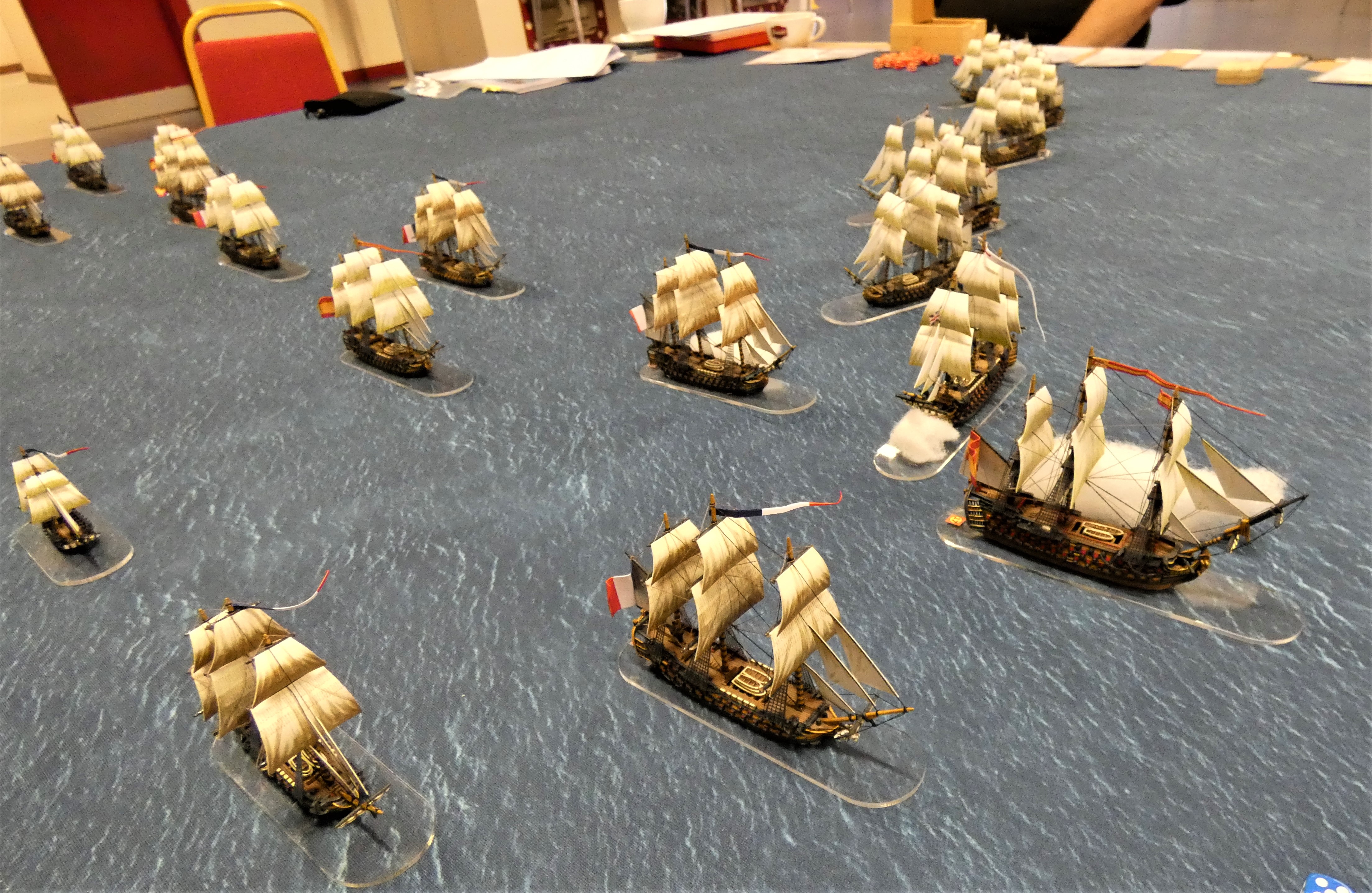
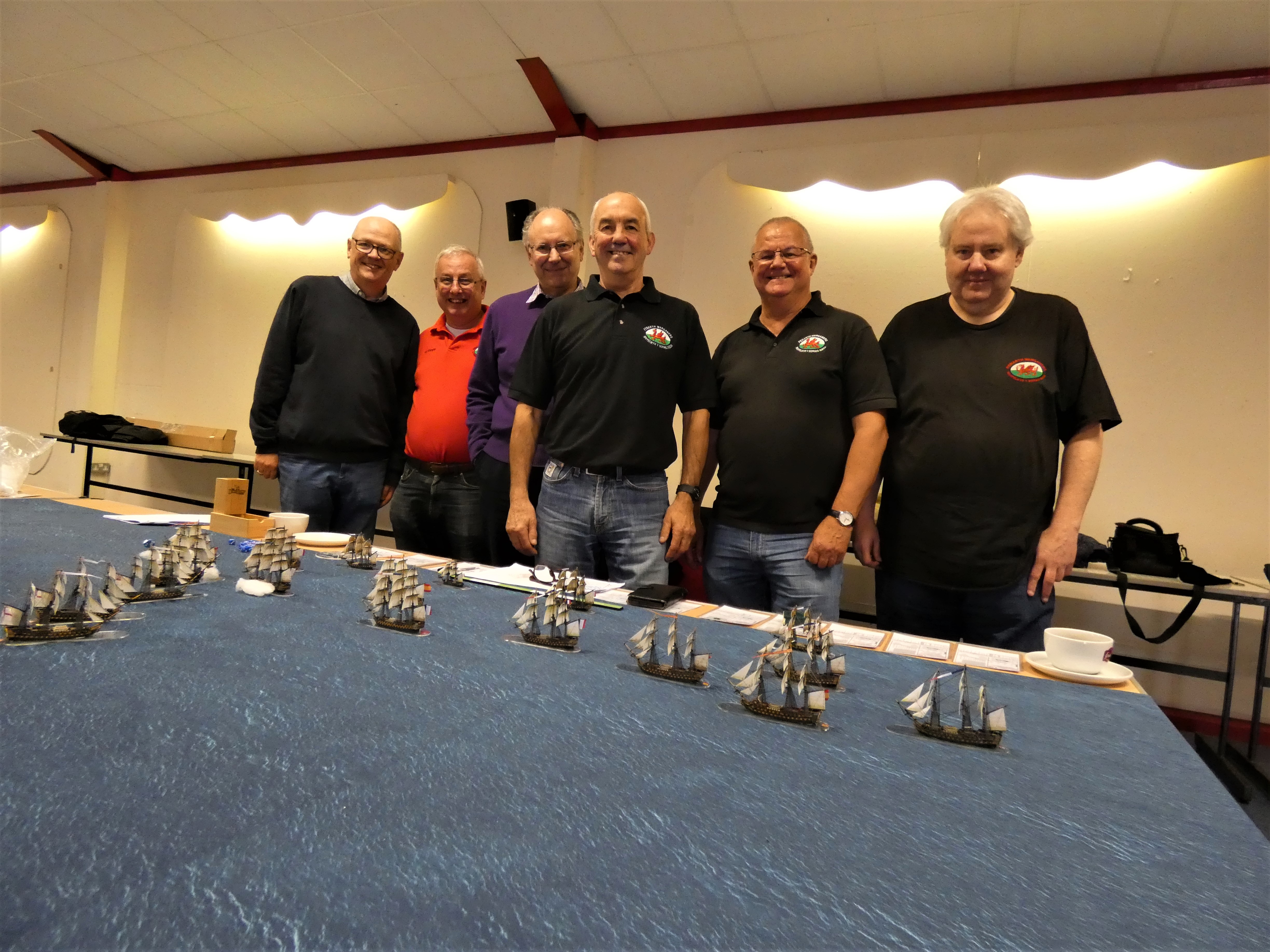
Having now returned home after an amazing four month adventure, taking in Vancouver - Canada, Fiji, New Zealand, Australia and Singapore it was so nice to get back into the routine with my first 2023 visit to the Devon Wargames Group club meeting this weekend, not only enjoying the familiar company of the chaps at club, plus getting to meet new members who have joined in my absence, but also to run and play in my first game of the year, as Tom joined me for a game of Kiss Me Hardy and a run through of the Scenario 'The Capture of the Pomone, 23rd April, 1794'.
 |
| The table is all set up ready to play 'The Capture of the Pomone' at the DWG last weekend. |
This scenario follows on from the series playtest that I ran at the DWG last year focused on several actions from 1793 and designed around Kiss Me Hardy and To Covet Glory which I have put together covering over fifty such historical scenarios with a plan to complete a first group of one-hundred taken from William James' naval history see link below.

The background to this fiercely fought frigate action is described by Mr William James in his Naval History of Great Britain:

'To endeavour to put a check to a warfare that was as profitable to one party as it was hurtful and discreditable to the other, two or three British frigate-squadrons were ordered to sea. One of these was commanded by Sir John Borlase Warren and consisted of the 38-gun-frigate Arethusa, Captain Sir Edward Pellew, 36-gun Flora, Commodore Sir John Borlase Warren, bart.,36-gun Melampus, Captain Thomas Wells, Concord, Sir John Richard Strachan and Nymphe, George Murray
 |
| The location of our action, fought on the 23rd April 1794, 06.00, 25 miles SW of Guernsey |
On the 23rd of April, at 4 a.m., rock Douvre bearing east by south four or five leagues, the Seven islands south-southwest four or five leagues, and Guernsey north-east half-east seven or eight leagues, Sir John's squadron, having just hauled round on the starboard tack with the wind at south-south-west, descried and gave chase to four strange ships approaching on the opposite tack from the south-east. These were a French squadron, composed of the 36-gun frigate, Engageante, Commodore Desgareaux; 44-gun frigate Pomone, Captain Etienne Pevrieux; 36-gun frigate Resolue, Captain (we believe) Antoine-Marie-François Montalan; and 20-gun corvette Babet, Lieutenant Pierre-Joseph-Paul Belhomme.
 |
| Commodore Sir John Borlase Warren |
Daylight discovered the national character of these ships which shortly afterwards formed in line of battle in the following order; Engageante, Resolue, Pomone, and Babet. The Flora, which was the leading British ship, as soon as she had reached the wake of the enemy's squadron, tacked, and was followed by the Arethusa, Melampus, and Concorde, in succession; but the Nymphe was too far astern to be in a situation to change tacks.
Fortunately for the British, a change of wind about this time, from south-south-west to south, enabled them to fetch to windward of their opponents. At 6 h. 30 m. a.m. the Flora, being abreast of the rearmost French ship, opened her fire, and, running on, received the fire of the Babet, Pomone, and Resolue in succession, but particularly of the two former.
At 7 h. 30 m. a.m. the Flora's maintop mast was shot away, the maintop was cut to pieces, and her foremast and all her yards much damaged. In this state, with her standing and running rigging greatly injured by the enemy's shot, the Flora dropped astern, and was succeeded by the Arethusa, who had previously been engaging the Babet.
The French now set every yard of canvas they could spread; but the Arethusa, Melampus, and Concorde, being less injured in their sails and rigging than the rearmost French ships, soon approached them, and the Arethusa and Melampus, who were the headmost, renewed the action with the Babet and Pomone.
At 8 h. 30 m. a.m. the Babet, having lost her foretopmast, and being otherwise much damaged by shot, surrendered, and was taken possession of by the Flora. By this time the Engageante and Resolue had made sail, and the Pomone alone remained to sustain the fire of the Arethusa and Melampus. The consequence was, that the main and mizen masts of the Pomone, already much shattered by the Flora's broadsides, soon came down; and the wreck with the sails upon it, catching fire, destroyed a portion of the quick-work, and, for a while, endangered the ship.
In this state, at 9 h. 30 m. a.m., after a brave resistance, the Pomone hauled down her colours, and was taken possession of by the Arethusa.
 |
| Melampus 36-guns – Chris Woodhouse |
The Concorde and Melampus, followed at some distance by the Nymphe, now, agreeably to a signal from the commodore, gave chase to the Resolue and Engageante. The Concorde, from her quick sailing, soon got near enough to the two French frigates to receive and return their fire. It was Sir Richard Strachan's intention to disable the sternmost ship, and then, leaving her to be taken possession of by his friends in the rear, to push after the leading one; but the latter, by bearing down and closing to support her second, frustrated that plan. This frigate, indeed, took so good a position across the bows of the Concorde, as to disable her in her sails and rigging, and compel her to drop astern.
Having partially refitted herself, the Concorde resumed the pursuit; yet Sir Richard had no hopes to effect more than to keep his two opponents in check until the arrival of either the Melampus or Nymphe. But as the day was advancing, and his companions in the chase rather losing ground than other-wise; and particularly as the Concorde's maintop mast, which had been shot through, was momentarily expected to fall, Sir Richard determined to secure the enemy's ship that was nearest to him.
 |
| The table setup based on James' description with Desgareaux's squadron drawn up in line of battle. |
Accordingly, changing sides in the smoke, the Concorde was soon enabled to bring that frigate to close action. The latter, which was the Engageante, defended herself with great bravery, from noon until 1 h. 45 m. p.m.; when, the ship being silenced in her fire, and, owing to the state of her sails and rigging, totally unmanageable, her people called out that they surrendered. The other French frigate, after firing a few shot, stood on; and, as the Concorde, from the damaged state of her masts, sails, and rigging, was not in a condition to follow, and the Melampus and Nymphe were too far astern to be able to overtake her, the Resolue, Sir Richard's old opponent in India, effected her escape into Morlaix.
 |
| The Flora 36-guns leads the British squadron into the attack |
With the table set up as per James' description with the British bearing down on the French line of battle just outside of extreme gunnery range we started the scenario.
 |
| The French squadron led by Desgareaux's, Engageante 32-guns, prepare to greet the British column with some iron among their sticks. |
The French commenced the action by doing what they do best, namely plying the British ships rigging with extreme and long range gunnery which started to have the desired effects right from the first broadsides from Resolue and Pomone, by hitting the Flora with their first shots.
Undiscouraged the Flora bore on down on the French line with her consorts behind, with both squadrons acting under their respective rules of war unless signalled otherwise.
 |
| The Resolue and Pomone open fire on the British flagship, Flora, hitting her rigging in the foremast. |
As the Flora closed to long range the French fire only increased the damage to her rigging and Warren was forced to resist the desire to return the fire, preferring to hold his fire until the effects of his Jolly Jack Tar crew could be delivered with an initial broadside at short range with hopefully the telling effect desired.
Sensing the aggressive British intent Desgareaux led his line in a gentle turn to starboard looking to bring the British column under a continued barrage from his lead ships as his centre-rear looked most threatened.
 |
| The mighty 44-gun Pomone supports the Resolue, 32-guns ahead |
As the British closed in, the scenario conditions moderated closer to those described in the historical account as the wind shifted a point to the south, just as Desgareaux determined that the Flora looked likely to press the attack on his stern and the bow of the following Resolue and decided to come around to larboard with the wind to support his rearward ships.
As Flora pressed on into the attack, Warren signalled to his column to 'Engage the enemy more closely' freeing his captains to choose their targets of intent rather than maintain their column formation, with the Flora pointed towards breaking the French line aft of the Engageante.
 |
| The Flora misjudges her breaking of the French line, grazing the Resolue which in the shock brought down all three masts on the Frenchman and causing Flora to loose her mizzen. Undaunted the Flora let fly her initial broadside at short range and grappled in preparation to board. Both ships are on a strike test for losing masts, but the Resolue is in the more parlous of states. |
However the French were well closed up on each other, attempting to prevent their line from being penetrated and the attack of the Flora came it at such an acute angle that a clash of bows with the Resolue could not be averted all be it with a glancing contact.
Both vessels were forced to take a test for damage with the Flora rolling a five, resulting in a lost mast and five damage points to her hull for her trouble, but the Resolue when better rolling a double six resulting in all three of her sticks tumbling overboard and fifteen damage points to boot.
 |
| The French line is broken and a general melee is in play as the British rearward frigates, Melampus and Concorde, both 36-guns come up in support, with the Resolue having already struck to the Flora |
Both ships were forced to take strike tests for fallen masts, but with the damage inflicted to the Resolue and just having lost the first round in a boarding action the end result was inevitable as her crew pulled down their colours to a cheer from the British flagship, having easily passed their own strike test and now eagerly taking possession of their prize.
 |
| Captain Sir Edward Pellew (hurrah!) passes between the Pomone and Babette raking both on his way, the latter with a partial broadside as the Arethusa's crew opened fire with both batteries. |
 |
| The Pomone is forced to take a strike test after being stern raked and will haul down her colours in response. |
Both strike tests seemed academic as the Flora was still relatively unscathed and being an elite flagship, had very robust morale, whilst the Pomone's damage, coupled with a friendly struck ship, Resolue, in sight meant she only had a 30% chance of striking herself.
 |
| With a prize crew aboard from the Flora, the Resolue is a secured prize, whilst the fighting Flora pours on some hurt to the Engageante with a passing rake. |
 |
| Commodore Desgareaux aboard the Engageante escapes to Morlaix as his squadron lies in tatters and captured in his rear. |
Unfortunately the test proved the result to be the latter and both French ships hauled their bows to larboard in an attempt to get clear of the north-west table edge and sanctuary in Morlaix.
However the Babette was practically stranded between the Flora and the Arethusa with the former now closing in on the battered corvette and managing to get a grapple before storming aboard her deck to force a strike as the Engageante made her escape with the Melampus in hot pursuit.
 |
| The Melampus (centre), lets fly with a despairing larboard broadside on the retreating Engageante (extreme left) making her escape. |
With three French ships taken by the British squadron in a close in scrap and a change of wind to match, our scenario played out very closely to its historical counterpart.
 |
| The last French ship to strike, the Babette 20-guns, grappled by the Flora in the last turn |
The brunt of the fight for the British was borne by the flagship, Flora with Commodore Warren leading from the front and taking the fight to the French whilst under harassing fire on the approach. Both the Arethusa and the Concorde were unscathed and the Melampus seen below took slight damage to her rigging


The French on the other hand show the results of the close in fight brought on by the British melee tactics with hulls pummelled and ripe for taking in a boarding action, with only the mighty Pomone unfortunate to have struck relatively intact and one would have thought still full of fight.


Obviously in an historic scenario the sides are not balanced, as balance is a wargaming idea and not one familiar to real life commanders and so it is more appropriate to compare the outcome with the historical one as a measure of success.
The victory calculator below is designed to help in that approach.
Victory Calculation
Each side scores victory points (VPs) for
- every ship they brought to the Action – even if she struck or was captured and
- for every enemy ship they captured. (Thus, captured ships are scored by both their captors and their original owners.) The high total wins.
The victory point value for each ship is her Hull size multiplied by her Value (5 plus or minus value modifiers). The following modifiers may increase a ship's value with no upper limit but may never reduce it below x 1.
Owner of Vessel
Hull Size x Base Value (5) less either Damage/Casualty Factor
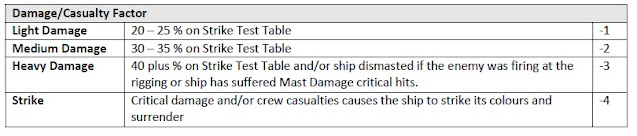
Or if greater, the Disgrace Factor
- -1 if part of a group and she escaped first, or escaped before half of her sisters
- Sovereignty 1: Warships can suffer -1 disgrace in their home waters.
- Sovereignty 2-3: Warships can suffer -2 disgrace in all waters if the enemy side has a lower sovereignty value.
If the enemy side has an equal or higher sovereignty value, they can suffer -2 disgrace in home waters, and -1 elsewhere.
And all the following that apply
- -1 Damage per quarter of basic speed lost, round up.
- +1 Over-matched if her side committed fewer ships per player than the enemy.
- +1 in Home Waters if she carries any cargo.
- +1 Carriage, per level of cargo transported through the gate opposite her entry, or the gate to either side of it.
Captor of Vessel
Hull Value x 5
Less
- Damage/Casualty Factor -1 to -4
Plus
- Cargo Value
The British squadron is calculated thus;
Arethusa 38-guns 6 x 5 = 30 VP
Flora 36-guns 6 x 3 (-2 Value for Medium Damage Suffered) = 18 VP
Melampus 36-guns 6 x 5 = 30 VP
Concorde 36-guns 6 x 5 = 30 VP
Plus the captured and damaged
Resolue (medium damage) worth another 5 x 3 =15 VP
Pomone (light damage) worth another 7 x 4 = 28 VP
Babette (heavy damage and struck) 4 x 1 = 4VP
British Total 155 VP
The French Squadron is calculated thus;
Engageante 32-guns = 5 x 5 = 25 VP
Resolue 32-guns = 5 x 3 = 15 VP
Pomone 40-guns = 7 x 4 = 28 VP
Babette 20-guns = 4 x 1 = 4 VP
French Total 72 VP

So a resounding victory to Commodore Warren, managing to match the historical result with the destruction of the enemy squadron and the capture of the Pomone only lightly damaged, with Commodore Desgareaux at least able to escape unlike his historical predecessor.
Thank you to Tom for a very fun game and a nice way to get back into the hobby for another new year.
The model ships are 1:700th scale frigates from the Warlord Black Seas range, that includes my scratch built corvette model as featured here on JJ's, and the mat is from Tiny Wargames, see link at the top of the blog.