Showing posts with label Alfred the Great. Show all posts

Friday, 29 December 2017

Isle of Athelney - King Alfred the Great's Refuge on the Somerset Levels


When I were a young lad growing up in Somerset, one of my earliest lessons at school I remember was the story of King Alfred the Great, on the run from the Viking army, and hiding out on the Somerset levels, planning his comeback.

The story included the tale of King Alfred being tasked with minding some cakes by a peasant woman and, finding his mind overwhelmed with the task before him, completely forgetting about the cakes and consequently getting a scalding from his host.

As a young schoolboy I seem to remember the cake tale as rather confusing, but not the idea that, had Alfred been taken and failed in his fight back, the history of England would have taken a completely different turn and I might have been having a lesson in a Danish dialect reflecting on what a great chap King Guthrum was.


The extent of the Kingdom of Wessex in relation to the Dane held lands

The school lesson was of course a very simplified tale of the actual events as we have come to know them from the accounts of Bishop Asser.

That said the simplified school lesson version captured the key points which were that since the late 860's the Kingdom of Wessex was for intents and purposes the last remaining vestige of Anglo-Saxon control in what would become England with the rest of the land under the control of the Viking invaders.

The focus of that invasion had now turned towards Wessex and with a series of incursions from London, Reading and along the south coast had seen several battles that saw the Viking host make inroads into the kingdom and cause the death of Alfred's brother Aethelred in April 871 AD following the Saxon defeat at Basing.

Alfred was forced to sue for peace and pay off his enemy leaving the Viking host in control of a vast swathe of the eastern extents of  Wessex.

In 876 AD the period of peace came to an abrupt end with Viking attacks on Wareham in Dorset and Exeter in Devon and despite some luck and careful manoeuvring by Alfred that forced the Vikings to give up Exeter with the swearing of oaths and exchanging of hostages. The Danes soon showed their contempt for such diplomacy and following a period to regroup and replenish in Mercia swooped on Chippenham in January 878 AD when Alfred, who was there to celebrate Christmas, was forced to make a rapid escape, only just evading capture.

Athelney's key position covering the Somerset levels and the Fosse Way through Ilchester
and the Viking held areas to the east.

With most of his close followers killed in the Chippenham raid and some likely collusion between some in his court and the Viking host under King Guthrum, Alfred and his small band of followers made their way to the Somerset levels, arriving at Easter in the fenland refuge of Athelney (Island of the Princes).

This area of Somerset was, in the ninth century a swampy fenland only accessible by selected pathways that rose above the wetland and, with the loyal forces of Somerset and Devon to call upon, allowed Alfred to set up a new defensible line along the River Parrett from the burgh at Bridgwater covering the old Roman Fosse Way through Ilchester and Ilminster.

Of course following their successful  strike on Chippenham, Guthram and his army were faced with a bit of a problem in that the escape of Alfred posed a serious threat that needed dealing with while it was still comparatively weak, but that the newly conquered areas of Wessex would likely have to be left un-policed as the Viking army was forced to call in its garrisons in time to mass for an assault on the fenland strong-point.

It would seem that Guthrum at first pinned his hopes on turning Alfred's position by a landing on the north Devon coast by a force of about 4,000 men in thirty ships under the Viking leader Hubba, or Ubba depending on your account; sailing from what is now South Wales, shortly before Easter 878 AD but, after a successful landing that drove back the Devon fyrd under the ealdorman Odda into a nearby stronghold, the Saxons were able to rally and later sally forth cutting the Viking army to pieces and killing Ubba in the process.

With the turning attempt destroyed, Guthrum was forced to consider a more direct assault on the Somerset frontier and with his forces likely gathering on or close to the high ground of the Polden Hills in preparation for the most advantageous time to attack, namely when the tides induced low water and better access to the fens.

The map shows the figure of '8' shaped island linked by a causeway to the burgh of Lyng

As the Vikings made their preparations, Alfred built up his stronghold at Athelney on the figure of eight island seen in the map above attached by a narrow causeway to the small burgh of Lyng, with the island surrounded by impassable waterways and reed-beds that helped keep the stronghold hidden from Viking patrols in to the area.

The little fortress became the centre of operations as the local Somerset and Devon fyrd conducted a fierce guerrilla war against the invaders, as they built their strength and rallied support from the parts of Wessex under enemy control.

The Time Team dig in 2002 showed evidence on the island of steel production from the slag refuse discovered indicating the likely provision of smithies turning out the necessary materials for the upcoming struggle.

For Alfred the key to victory was, as well as his preparations, to get his strike in before the Viking host was ready to conduct their own, and thus in early May of 878 AD he made his move by riding from Athelney to Egbert's Stone near Frome in Somerset where the fyrd were summoned to meet him.

The army of Wessex, once summoned, and the loyalties of those Alfred could trust confirmed, was ready to take the offensive, which culminated in the Battle of Edington sometime in early May 878 AD and saw, with the defeat of Guthrum and his army, Alfred reassert his throne and gain the breathing space to allow him to build the forces that would see the overthrow of the Dane held land to the north.

https://en.wikipedia.org/wiki/Battle_of_Edington

Our trip to Athelney provided an opportunity to get some much needed relief from the 'cabin feaver' that naturally occurs over this season of festivity as, like Alfred back in January 878 AD, one partakes of the company of close friends and family, mainly indoors and away from copious amounts of fresh air.

Of course any imbibing of fresh air at this time of year and the lower outdoor temperatures that tend to occur, are best experienced after a visit to a welcoming hostelry and the fortifying effects of a well earned hot lunch, and for anyone thinking of visiting, I can heartily recommend the aptly named King Alfred Inn at Burrowbridge where Carolyn, Tom Will and I enjoyed a really great lunch prior to our walk.

http://kingalfredinn.com
The pub is right next door to the Burrow Mump which is an interesting 'motte' built at the juncture of the River Tone and Parrett.

The man-made hill is topped by the ruins of an 18th century church and is now owned by the National Trust, kept as a monument to the men and women of Somerset killed in the two World Wars.

The structure has evidence of Roman presence but as can be seen from its dramatic appearance over the levels is very obviously Norman in appearance and not part of the ninth century landscape familiar to Alfred and his men.


The Mump being right next door to the pub is a perfect way of walking off ones lunch and the climb to the top, although bracing with some icy winds blowing in from the north, provided fantastic views out over the levels to the Polden and Quantock Hills beyond and really enabled us to get a good idea of the landscape.


View east towards the Polden Hills

The two pictures above are looking east towards the Polden Hills beyond which would have likely marked the forward positions of the Viking line, with the low land flooded at this time of year indicating the extent of the fen-land in the ninth century.

View north towards Bridgwater and the Bristol Channel

The picture above is looking north towards the coast and the Saxon burgh of Bridgwater.

View south towards Ilchester

The picture above is looking to the south towards the lower curve of the Polden ridge with the Fosse Way beyond and the diverted course of the River Tone running across the picture, constructed in 1374 as the levels were gradually reclaimed.

View west over the redirected River Tone with the Quantock hills in the background and Athelney out of picture left.

Looking east beyond the Polden Hills where lie the Mendips with a light dusting of snow.

The 12th century St Micheal's Church, Othery seen from the Mump


Graffiti and defacement of monuments and buildings has a long and ignoble history as evidenced by the visitors to the 1793 attempt to rebuild a church on top of the Mump following the destruction of an earlier building during the civil war and Monmouth rebellion.

The rebuild ran out of money and the new chuch was eventually built in Burrowbridge at the foot of the Mump in 1838.


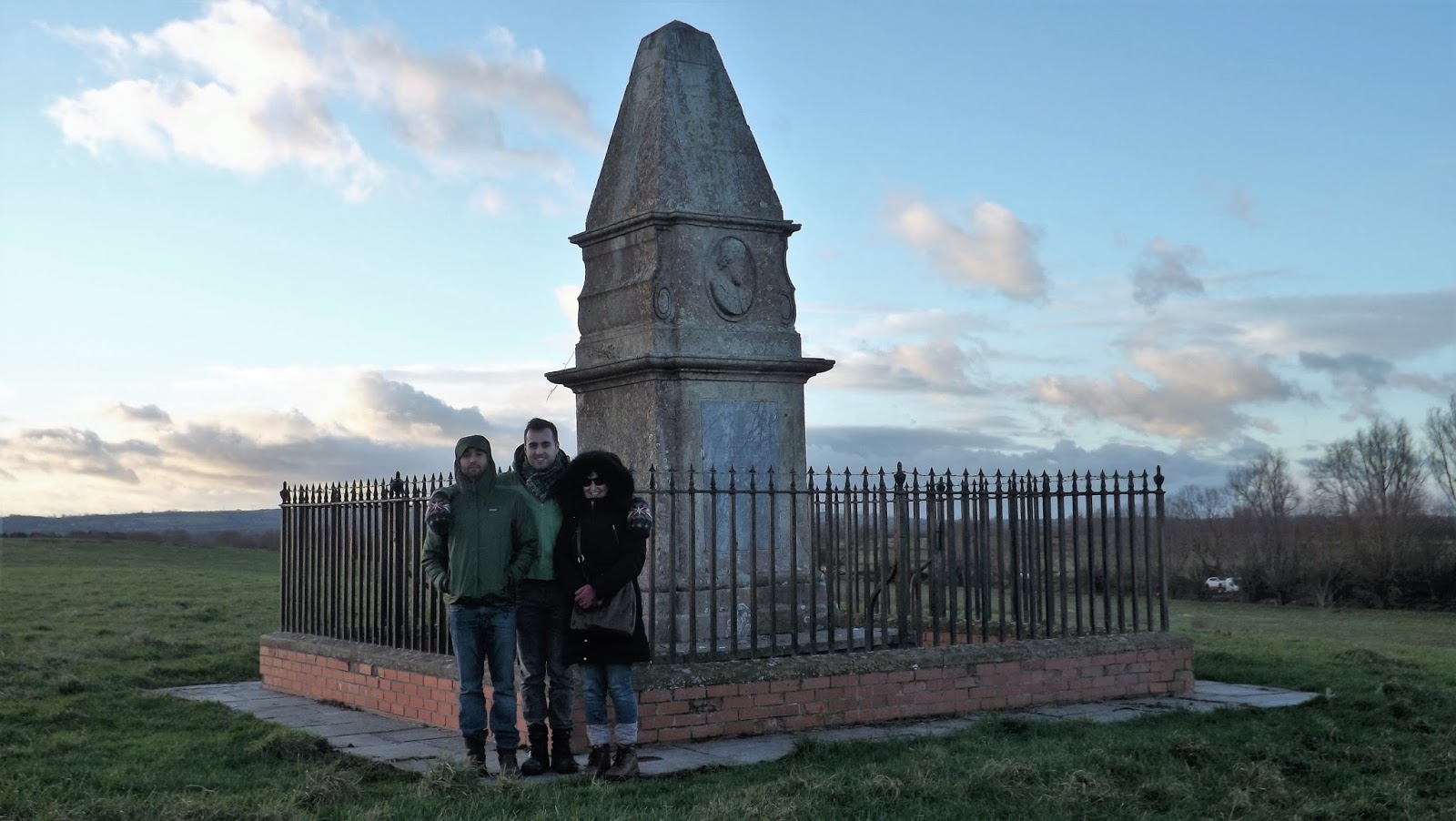
The A361 passes through Burrowbridge heading west past the King Alfred Inn on the way to Taunton and passes the monument to Alfred and the later monastery built on the site of his former church and fortress.

The Alfred monument seen from the pull in on the side of the A361. The rising ground of the former island is easily discernible.
The monument was raised in 1801 and marks the position of the Saxon monastery later pulled down during the English reformation in the early 16th century.


As you might guess from our photos besides the monument the day was getting decidedly colder as the light faded and one can only imagine what a miserable time it must have been for Alfred and his followers when they first arrived.


The picture below gives an impression of the extent of the fortified camp looking west towards the causeway and the burgh at Lyng, with Alfred's church constructed close to the view point and the fortified camp with a wooden wall atop an earth embankment covering the circuit ditch and the marshlands beyond.

The view from the monument looking west through the camp towards the causeway and the Burgh at Lyng as shown on the map at the top of the post.

Sources referred to for this post:
http://celtic2realms-medievalnews.blogspot.co.uk/2016/03/st-athelwin-wessex-and-athelney-before.html
https://en.wikipedia.org/wiki/Alfred_the_Great
https://en.wikipedia.org/wiki/Athelney
https://en.wikipedia.org/wiki/Ubba
https://en.wikipedia.org/wiki/Burrow_Mump
https://www.youtube.com/watch?v=TBQSa4i3APA
Early Wars of Wessex - Albany Major

Next up, fun and games in Mordor, well North Devon actually, a look-back at 2017 and plans for 2018 and hopefully some Vikings to kick of the new year with.

Tuesday, 29 December 2015

Alfred the Great - The Great Heathen Army 871 AD, "Wash Up" and Post Game Comments


Just to conclude the series of posts on our play-through of "Alfred the Great - The Great Heathen Army 871 AD" by Mark H. Sheppard, Steve and I decided to write up our thoughts about our strategy and what we might have done differently now we have the experience of of first game.

As Steve was the victor I think it only fair to let him have the first say, followed by my own thoughts as the humbled loser.


Mr Steve's Thoughts:
So the world is once again free from the tyranny of the West Saxons, however sitting here now with my feet up on a pile of Saxon skulls I am thinking that things could have gone a little differently.

Sometimes I think the most enjoyable games are those played when neither side has any idea about what they are doing as it only takes roughly four or five games of any boardgame before the set moves and optimal strategies kick in and then all future games tend to follow a similar course of events. I certainly had no idea what I was doing and it is therefore possible that I may have made some less brilliant moves than normal so lets review our game .

I think there are three main points I want to look at and after going over each one in turn I will chip in at the end with some minor ones as the thoughts come to mind.

Towns.
The key to this game is occupying towns, to do so as the Vikings you will have to capture them from the Saxons and there are two ways to do this, Assault or by Siege.
Both Jon and I had unpleasant experiences early on whilst assaulting towns and this made us very wary of repeating it but my attitude changed after closer study of the rules. Assaulting towns isn't that hard if you pick your targets and look at the odds, Religious Towns can be breached with a 50% chance and Royal towns on 33%, once inside you will then normally overwhelm the defenders. Without a king the defenders chance of hitting you back in both cases is also only 33% and if you are attacking small garrisons of 5 to 10 then you can usually survive two or three turns of being hit before considering giving up. Sieges take time, a long time and not only that but your individual hexes are open to be attacked whilst doing so. Jon’s assault on London whilst probably worth an attempt was always going to be difficult as he had to throw a 6 to breach the wall of a Castle which is the strongest type of defended area in the game plus he was a little unlucky in that all three of the defensive rolls were hits whilst he was trying to get in.

Supply
Linked to the above, as the Vikings you should spend your time while waiting for the Summer army to arrive by occupying as many easy supply points as possible, this will both deny the Saxons extra troops and will boost your starter army. This was something I singly failed to do and I should have spent most of my early turns moving along the Thames occupying the many supply points that are located in that area.

Battles.
We didn’t have any, not through want of trying on my part, which I suppose reflects to some extent the inherent fear of the “One Big Battle” complex, fine if you win but devastating if you lose, you can see why many Kings /Generals avoided fighting battles unless they had a really big advantage over the enemy, had no choice or were bonkers.

Odds and ends.

River Thames
The river is key for the Vikings, you get free movement along it and after enjoying a pleasant boat trip you still get to move off into the countryside with any of your remaining movement points, when I cottoned onto this I started to dangle out many little single “worms” who by occupying supply points might just get Jon to bite and attack them, meanwhile my army, seemingly well out of range was cunningly poised to sweep down the river and gobble them up if I got a nibble. Unfortunately Jon was too dense to fall into my trap; I will have to be less devious next time.  

Aethelred 
Jon’s original plan was to get Aethelred killed off in order that the much more powerful King Alfred could take over, knowing this I decided that I wouldn’t oblige and deliberately tried to keep him alive. My thoughts on this have changed and if the opportunity now cropped up to do painful things with pointy sticks to him then I would definitely do so. The advantage of having two Kings available as opposed to just one is huge, as far as the actual casualty’s the two Kings themselves cause then the combined total is roughly the same as those caused by one Super Alfred however what they really do is to greatly boost the chances of your warriors and earls hitting in combat, with a king its 66%, without its only 33%. As a Saxon I would try and keep both leaders alive for as long as possible so that I could campaign in two armies rather than just one. I believe Jon has also reached this opinion as well having recently read a reply of his to the game designer, Mark Sheppard.

Could the Saxons have done things differently?

I spent more time reacting to the Saxons rather than scheming for them so it’s a bit tricky for me to say and obviously I was not aware of what their master plan was, if there was one. Jon maximised his supply points very well and therefore increased the size of his army greater than it should have been however I might have considered risking an early battle in order to degrade the Vikings options even at the risk of losing Aethelred. Towards the end when the Great army was sat in front of Basing I think Jon’s decision not to attack was correct as a defeat would have been devastating and it wasn’t as if the enemy could actually threaten anywhere. (My plan was to pin the main Saxon army in place out of the way and that is what happened).
The one thing I would definitely have done differently was at the end when the real threat was Guthram, I would have attacked him with Alfred’s army mustering up everything I could find because Guthram's force was positioned to threaten so many places that couldn’t otherwise be adequately defended and especially as it was the last turn with the Viking’s getting a free go at any points in range. Then use some of the Earls in the Basing army to occupy the empty towns as, given average luck, there wouldn’t have been many surviving Vikings from that army to take advantage of weak garrisons.

What other general tactic do I see for  the Saxons to follow in the game; they need to restrict the Vikings rampaging about and also to try and recapture any fallen towns whilst still maintaining the highest possible supply score however it is tricky to chase someone down who can just jump on a boat and sail away, perhaps Royal towns along the river could limit movement if still held by the enemy but there are many recorded occasions when the Viking longboats coasted past defended burghs and it was only places with bridges that could really stop them so perhaps not.  

Conclusion.
This was a fun game to play and I had forgotten how enjoyable it was waiting for your opponents turn to appear in your inbox. I would imagine that this could easily be played in an evening in around an hour across a table with a few tankards of mead.


Oh yes, don’t abandon Reading at the start like I did and instead make the Saxons fight for it , by adding in a spare King not only are you more likely to inflict casualties more often but it will also attract them like moths to a flame . 


JJ's Thoughts:
Wow! I think Steve has pretty well covered all the areas I was thinking about when I got his thoughts through on the email and then decided that it was so flipping good, what can I add?

So I might as well keep my comments succinct and use them to highlight and emphasise the points Steve has so eloquently covered.

The Villages, Religious sites, Royal Estates and Castles are the key to gaining the advantage in this game as they impact on victory conditions and supply, which are the two factors that will decide if you will win and by how much. The occupation and control, particularly of the defensible "fortified hexes" which are all of the habitations except villages, offers the defender a force multiplier by adding in the potential to inflict casualties on any unlucky sole who fails to breach their defences. In addition their control generates the points that pays for all those troops you will need to replace your losses and to add to your numbers.

I totally agree with Steve's comment about the fun of learning the game as you play and the potential generated from mistakes that more experienced players probably wouldn't make. Thus my taking of Readingum early in the game when Steve vacated it was all part of an early cunning plan to take advantage of his vacating the town and follow that up by grabbing Lundene and shutting down the river to Viking landings and movement. It was a bit risky attacking Lundene with its high defence but if you are going to try, better to try early in the game when you have time to recover any losses incurred with all those Saxon supply turns coming up.

The attack on Lundene didn't come off and I incurred higher than average casualties in the attempt that forced me onto the defensive whilst I rebuilt my forces. Steve wisely recognised the importance of  building his own force during my inactivity which again left me little time to do much about the situation before the Great Summer Army turned up.

I think the forward defence on the river was probably the right strategy, because it forced the Vikings to clear their rear areas before advancing inland, but I made the cardinal error of not putting the King or Alfred into Readingum thus causing them to miss out on really hurting the Vikings when they inevitably broke in over the walls.

I agree entirely that losing Aethelred, particularly whilst the Vikings are still a force to be reckoned with, is a poor swap for getting Alfred the White instead of Alfred the Grey. The benefit of having two leaders able to hype up the combat effectiveness of the troops is really important particularly when the Vikings have five such characters running around the map.

The big battle temptation was close to being taken, and I did seriously think of stripping out all my Earls and King Aethelred from the garrisons to join Alfred in one last hurrah attack on Guthrum at the end. The risk in going for the big battle is that with much riding on the result for me as the Saxons, the Vikings had the luxury of fighting the first round and if there was no advantage to them, retreating back to their stronghold on the Temes or trying to take out the two Saxon Royals for a knock out major victory. Either way, their main force was sitting pretty in Readingum waiting to mop up at the end.

Perhaps the Aethelred of the Sagas might have risked it all on one last throw of the dice, but I think, on reflection that discretion was the better part of valour limiting the overall victory as it did, although I am kicking myself for not putting a forlorn hope force of warriors out on the road to Wilton to stop that final raid.

My final thought, and the one which prompted me to get the game is that I am confirmed in my thinking that herein lies a great little map game to generate tabletop encounters with figures, be they big set piece battles or assaults on walled fortifications and the fights in the towns when the walls are breached. The forces involved would be easily assembled with a few boxes of plastic figures and the game would add that, oh so important, context to the tabletop clash.

I agree that there is much fun to be had from this game and I am looking forward to resuming the struggle over Cyberboard in the next in the series "Alfred the Great - The War in the West Country 876 AD".

If you missed the earlier posts on our play-through, just click on the label "Alfred the Great" at the bottom of this post or in the "Labels" section in the side bar to the right to follow the game.

Lots more fun to come on JJ's with next up our annual Xmas-New Year game in North Devon with Chas, then we're back at Talavaera as Will leads the German Division against Steve M holding the Pajar Vergaga Redoubt and a review of 2015 and New Year Plans.

Sunday, 20 December 2015

Alfred the Great - The Great Heathen Army 871 AD, May Turn Fifteen, Game End


So with the last move of our game, I toy with the idea of going down in a blaze of glory with Alfred wading in among the Vikings and thinning their ranks before they fan out into the countryside, but the risk/benefit profile of that option in terms of still leaving the Vikings with a sizeable force to go forth and grab real or should I say Royal Estate, with the likely hood of not really making much difference.


Alfred returns to Cippenham and I throw in an Earl at Malmesbury rather as a gesture rather than expecting it to make much difference to the outcome.


The Viking response was fairly predictable, free to go anywhere they like in the knowledge that no one will come and get them if they do. On reflection I missed the opportunity to protect Wilton from a raid by Kings and Jarls from Readingum by the simple expedient of putting a warrior road speed-bump in the woods at the junction west of Basengas, but it really doesn't make much difference to a Viking minor victory.


With secure major bases in the south and west it is time to think of raiding all those exposed Viking outposts in June.


Turn 15 last turn

As it happens the Saxons do none of the possible moves I had considered and instead run for cover into Chippenham, this leaves me completely free to go wherever I want without the hindrance of having to fight unnecessary battles.

Malmesbury is an obvious target so I send Guthram and thirty-two warriors to attack it; The Reading garrison spreads out along the river picking up towns as they go. Everyone else grabs whatever towns that have been left unguarded, and there are quite a lot left unguarded!

The Jarls and Kings have ten movement points so this gives me a small but powerful strike force and I look around for viable targets.  Winchester is tempting but being a castle I can only breech the walls on a 6 and whilst the Saxons will only hit me back with a  3 or a 5 , I don’t think I can sustain more then two failed attempts so I decide against it . Fortunately Wilton sitting nice and quiet in the rear area, with its head down hoping not to be noticed, is also just in range so that’s the place to go.

The Malmesbury attack breeches on the first turn so it’s a slaughter, religious Areas like Malmesbury are easier to get into being a 50% chance. The Defenders with no king to help them fail to hit in reply.

The attack on Wilton is a little more stressful, it takes me three goes before I manage to get over the walls however the defenders left leaderless by their betters are not interested and miss on all their combat rolls, once across the walls I take pity on them and only kill them and forgo despoiling their bodies.

Obviously spreading out like I do is because of the game mechanics, I know this is the last turn and that the Saxons cannot strike back at my dispersed armies however I prefer to see it in a different light.

I think a recently discovered passage from the Anglo- Saxon Chronicles puts it better than I can:

The Vikings did gather up all their stolen Horses and rampaged throughout the kingdom, the Saxons cowering in their palaces closed their ears to the cries of the poor and the dispossessed. The King Aethelred cared naught for his people, safe behind his walls he spent his time instead painting small figures and writing epistles. It was not long after that one dark night a hooded figure crept into the Kings bedroom and plunged a dagger into his worthless chest, the Prince Alfred was spared the wroth of the disaffected but there are some that say that this hooded figure was Alfred for he was well happy about being King. 


So that is the end of our game, I hope you have enjoyed the play through as much as we have swapping our moves day to day and trying to bluff each other with the commentary you have seen getting written up during each move. One final post to come with Steve and my thoughts on our game play and overall strategy and then we can think about more fun in the Westcountry as King Alfred continues the fight with King Guthrum in 876 AD.

Friday, 18 December 2015

Alfred the Great - The Great Heathen Army 871 AD, May Turn Fourteen


The weather is starting to warm up and spring is in the air and twenty more Saxon warriors heed the call of their King and arrive at Basengas to reinforce the garrison.


With just two Viking and one Saxon turns left, I decline the invitation to forego the protection of the +3 defence of Basengas, knowing full well that any sally forth by my men would most likely be met by a retreat by the Vikings and then have them descend on me with their full force in the open as I am in my turn forced to beat a retreat back into Basengas in the next turn leaving me weakened and chastened by the experience and the possibility of being unable to resist an assault.

Much better then to reinforce our forward defence in the area that the Vikings have committed towards and to threaten their expansion westward into Wiltunscir with Alfred's force, thus having the Pagans dance to my tune rather than theirs.


Well I can't do much to stop the Vikings grabbing a minor points victory as they have the initiative of the final turn, so any of my troops put out into the wider countryside as village garrisons invite being picked off in detail, and will weaken any defence of Cippenhamm but Aethelred can at least take satisfaction that the strength of the Saxon forces can still dictate a Viking response and is a force in being that would only get stronger over time perhaps allowing a counter offensive later in the year.

So I predict the Viking force near Malmesbury will fan out to the string of four villages and grab those close to the Thames, whilst those at Readingum and Lundene will grab the two villages in the south east and Sashes knowing no further Saxon attacks are possible. So potentially a 23 points - 17 points Viking win.

Making the move with Alfred and reinforcing Aethelred at Basengas was the move the Vikings least wanted to see and has forced them to shift their offensive on Wintanceaster away to Wiltunscir.


It will be interesting to see what the view looks like from the other-side of the shield wall. More thoughts from Ragnar to come as we go into the final move of our game.


Viking Comments Turn 14

Good news the Saxons are still in slumber mode which means I can carry out my plan, first let me go over the previous move.

I have always played with the knowledge that I will get the final move, so to allow me the maximum opportunity’s I need to prevent what the Saxons can do in their final move. I placed my army where I did so as to try and prevent the Saxons from moving their main army, I am quite happy with where they are in Basing as it mean’s that they cannot have much influence over the rest of the map. If they attacked then we would have worn each other down to nothing but would still leave me with a sizable force in Reading. Also if he moved out to attack me then he would have had to have left a garrison of sufficient strength or risk leaving it empty but without knowing what the result of the battle would be.

My plan is to actually seize as many towns as possible in the final move and by using the Viking river movement I can take the biggest clump of points which are clustered around Malmesbury. Therefore I retreat the main army back to Reading and send the Reading army by boat out to the NW and put them in the best possible place to grab as many of those towns as possible in the final turn.

What can go wrong, well I see the following possibilities:
1.      Alfred attacks with his smaller force but beefed up by all the other earls and Kings and attacks Bagsecg. This could go either way and is what I would do.
2.      He detaches his faster moving Earls and attacks my occupied cities in the hope that all my counter attacks fail, probably not going to work as I can really mass figures from Reading.
3.      He garrisons all the cities around Malmesbury calculating that I cannot be strong enough to take them all. Likely.
4.      Desperate attack on Reading with his main army, well they don’t have any other function so that is also likely  and/or heavy garrisons in Clere and Esingum.
 Remember the points total is very close so one well defended town could swing it.
5.      Earl attack on Wallingford, throw every earl he has at Wallingford but again I can retake it with the Reading army.
6.      Earl attack on London, whilst suicidal it would prevent river movement. I must reinforce somehow.

I pull back most of the outlying garrisons, I had a long think about this prior to doing it and I am still 60/40 about it being right. He will have to put his own garrisons into them to prevent me scoring so that means I will then have to allocate sufficient men to take them back and I don’t think I can get some of the old ones back but I am hoping that the Malmesbury area will compensate.

I cannot weaken the Reading army much as I expect to get attacked , I send what I can into Wallingford and King Bagsecg doesn’t really end up with the force I would like but I add in whatever Kings and Jarls I can scrape together.

Just at the end I decide to move my Malmesbury force to a different hex that will also threaten Chippenham however it also allows the Saxons to add in another five warriors if he strips out everyone.

A battle would be between 28 Warriors, 2 kings and 11 earls maximum. Against my 3 Kings 8 Jarls and 34 warriors. I would expect him to place some of the earls into the towns as it would prevent a shattered Viking force picking up easy points. 
If everyone hits then there wont be many survivors.
Last decision is to also strip out the river garrisons to help Bagsecg making it now 9 Jarls and 36 Warriors, as I said previously the Reading garrison can always recapture them with over whelming force if necessary.

I hope that the lure of empty cities might tempt away some of his earls.  

Wednesday, 16 December 2015

Alfred the Great - The Great Heathen Army 871 AD, May Turn Thirteen


So here we are in May 871 AD and the Great Heathen Army is astride the Temes with boats arriving as I write this report bringing in more Pagan warriors set on rape and pillage and the destruction of Wessex and the dream of a united England under one King.

The men of Wessex brace themselves for the final onslaught as the Viking hoard prepare to move on Wiltunseir.


There really isn't much Aelthelred can do in this situation with the two options of sallying forth and offering open battle or worse still attacking Readingum, both of which offer total destruction with an uncertain return in taking many Vikings with them or, the preferred option, to hunker down behind the walls and get ready for the Vikings to make a mess of one of these assaults which they so far have got away with. Their luck must run out at some stage!!

So to reinforce the front line under immediate threat, fifteen warriors from Wintanceaster join the King at Basengas.


Our game enters the last three turns and with the Vikings in a very dominant position, just needing a further two victory points in captured areas, and looking very likely to gain a minor victory at a minimum; needing to kill the two Saxon Royals and take Wintanceaster to snuff out Wessex altogether to claim a major victory. So careful play by the Saxons is still the order of the day.

What did I say about careful play is the order of the day?

So the Viking army with two moves each left has dangled a big hook with a chunk of bait on it right in front of King Aethelred and his large army in Basengas.


So dear reader, you have an opportunity to share your thoughts on Aethelred's next move based on the situation.

In summary, each force currently holds 20 VP/RSP of town/fortified hex areas. The most likely result is a Viking points victory in towns held as they need to kill both Saxon Royals and take Wintanceaster to grab a major victory which is unlikely.

The Viking main army outside Basengas consists of three kings, eight jarls and sixty-one warriors, with a reserve force behind it in Readingum of  two kings, eight jarls and a further thirty-one warriors.

In Basengas, King Aethelred commands three earls, and fifty warriors, with the nearest support being the garrison at Wintanceaster of one earl and a further twenty warriors.

The next and last supply phase is Saxon, so before any action Aethelred can reinforce any of his five garrisons with a minimum of twenty warriors.

If Aethelred sits tight and bolsters his garrison with more men this forces the Vikings to most probably assault the town with the bulk of their two armies and bring on a battle within if they can breach the walls, as a siege will take too long. You will have seen how assaults go, but with Aethelred present all the Saxons will hit at 66% of the time instead of the 33% they were causing in the previous fights.

Off course Aethelred could throw caution to the wind and attack the main Viking force before him with another forty warriors (if we include the garrison from Wintanceaster) and probably die in the counter-attack by Guthrum, but with a 66% chance of possibly taking a fair few Vikings off to Valhalla, leaving King Guthrum facing off against King Alfred and not much time to seal the deal on a major victory.

So the obvious safe approach would be to stick a load of warriors into Basengas and blow raspberries at the Vikings inviting them to come and get us, but that wont look as good in the chronicles as the heroic death in battle following a failed but daring surprise attack which dealt a death blow to The Great Heathen Army.


Ragnar has walked out into the open, in front of his massed warriors, and is staring up at you on the battlements of Basengas and as that unblinking gaze makes eye contact with you and seems to study your every thought, you know what he's thinking;

"So what you have to decide punk is, do you feel lucky? Well do you!!?" - only in Norse.

I have a feeling Ragnar will keep his council until I make a decision, so please feel inspired to share your thoughts.


Viking Comments Turn Thirteen

The Saxons bring up fifteen reinforcements into Basing which is a bit annoying as he has left a sizable force still in Winchester. A siege is out of the question as he can attack any of my six besieging forces with his whole army or a significant part of it and drive me off, one thing I am not sure on is where these forces would end their move, presumably in the combat hex which on first sight looks good for me but it still leaves the problem of getting into Basing and or defending the other towns.

So let’s set a trap, in fact several traps, some for this turn and some for the next, all of which could go horribly wrong.

I move the main army to sit directly in front of Aethelred , 3 kings, 8 Jarls and 61 Warriors. Now as they can move around me and attack Reading (unlikely ) I leave 2 Kings , 8 Jarls and with my re supply this turn , a total of 31 warriors . I also push out another warrior to occupy Clere. Now its 20 points each.

Now, what will he do, If he combines everyone in range then he can get 1 King, 5 Earls and 90 warriors (including re supply) to attack my main army. This is a possibility, and I might lose up to 36 warriors in return for around the same, of course either side could miss on any of their combat rolls and that is something that cannot be calculated however you can retreat after one turn of combat.

He might try and take Reading but will be split in the defence of two key towns.
If he does nothing and just re positions his troops from farther away to get involved for the last turn then that might be interesting and is not what I want him to do.


What you have to understand, is that my putting the army where it is isn’t the real plan. 

Thursday, 10 December 2015

Alfred the Great - The Great Heathen Army 871 AD, April Turn Twelve


With the Vikings busy in the last turn attacking my Temes garrisons they were unable to shut down quite so many of my supply points, by spreading out to occupy the villages. This enabled me to net twenty-eight points of supply which I spent on recruiting the same number of warriors who were distributed among the front line fortifications.

I would have liked to have withdrawn the five man garrison at Dorchecestre (just off map grey hex top centre), but they can't reach Readingum and so will have to do their best in the face of another likely assault. King Eathelred has joined the garrison at Basengas to improve the fighting qualities of the garrison (It really pays to put the Kings and Princes in the front line as the warriors and Earls strike better when they are present, and I realised the error last move, only too late).


In addition to the reinforcements I have fed more Earls into my front line towns to add to their defences. With a Viking supply turn due next, this turn will be a likely turning point in the struggle. If the Vikings flop in front of one of these key towns as my chaps did in front of Lundene then they could be in trouble.


So with a slight delay as the Vikings went off into the woods to build scaling ladders and facines, we pick up where we left off with Vikings clambering over walls and slaughtering Saxon garrisons, whilst fanning out into the wider countryside to occupy as many areas as they can in preparation for the upcoming Viking re-supply phase.


The action for turn twelve has the Vikings consolidate their hold on the Temes by taking Readingum and Dorchecestre. So taking the actions in order.

Assault on Readingum
Attacking with four kings, sixteen Jarls (so much for attacking in groups more than eight!) and seventy three warriors up against a defence of two Earls and thirty-five warriors with a +3 defence factor. The Vikings needed a 3 or a 6 on a D6 to breach the walls and negate the +3 defence and bring on a very one sided battle within the streets of the town. They throw a 6. What !!!! Oh well how sad, never mind. The Vikings wipe out the garrison losing twelve warriors in the fighting.

Assault on Dorchecestre
Not much better here for the forces of Christendom as King Guthrum, two Jarls and twelve warriors go up against my five Saxon warriors and a +2 defence, needing 1,3 or 6 on a D6 to breach the walls. Off course they breach on the first attempt by rolling a 6 and slaughter the garrison without loss.


So to summarise the situation at the end of April, the Vikings now hold the Temes and the following VP/RSP areas; Lundene (4), Readingum (3), Welengaford (3), Dorchecestre (2), Abbendun (2), Wantage (1) Lamburnai (1), Sashes (1) Leobriban (1), Esingun (1) for a total of 19 VP's needing 21 VP for a minor victory with still three turns to go and a Viking resupply phase coming next. So at a minimum they can add a further nineteen warriors to their force next turn.

The casualty lists show thirty-four Viking warriors lost for three Saxon Earls and sixty Saxon warriors.

I had hoped that Readingum would have cost the Vikings more than just the loss of twelve warriors and their breaching on the first turn, with just a 33% chance of doing so, negated my beefed up garrison ready to sell their lives dearly for Wessex. Mmmm, this is going to be even more tricky than first thought and as I predicted, the turn looks likely to be pivotal to the campaign.

As you can see Ragnar is looking a lot more confident than he sounded a couple of turns back and I am sure we will hear the thoughts of the Pagan soon.


Viking Comments Turn 12

Well I got the easy attacks out of the way last turn so now its grit your teeth time as every further attack I make will get harder.

First let’s review the Saxons,
They appear to have gone into dormant mode which is just what I want; there is some more reinforcing of the obvious targets and also pushing the unwanted King into Basengas . Good news all round.

My move is pretty obvious even though I do have a choice on what to do, I could use ship movement and attack Basengas now or I could mop up the two towns around the Temes (its harder than you think to remember not to spell things properly). I have to take Reading to win and I should take it now as it both lets me free up the defenders in London and also lets me max out my army for the tougher battles to come.

A quick glance next at the supply table to see when more Saxons can be expected to turn up; it shows that I will get two turns of attacking before additional forces come on the board plus I get more warriors next go as well. This means he will have to strip garrisons further back in order to beef up the front line and I can bring on the reinforcements anywhere along the Temes to deal with any threats if they occur.

Right then, time to gird my loins and start the attacks. (By the way the position of official Kings Loin Girder is currently available, previously held by Vince the now Handless)

I detach Guthram with a small force to finish of Dorchester, I use the London Garrison to send out one warrior occupying forces to as many supply points as I can reach and the remainder join up with the Horde to attack Reading.

The Reading attack goes far better than I hoped with my first breaching roll being a success and allowing the ravenous horde to pour into the city. In the combat the advantage of having Kings in any fight shows up as I can now only miss hitting the enemy on a 2!  Needless to say everyone hits and the Saxons die to a man in one round but not before taking 12 warriors with them.  Jammy Oiks (this will baffle anyone who is not English)

The assault at Dorchester goes just as well despite it taking two rounds to breach the weak walls, the Saxons fail to hit on any of their defence rolls and so Guthram moves in to start dividing up the loot.

The key is now Basengas as that gives me enough points to win the game, let’s see what he does. I will have to assault it as I cannot get all the way around it to lay siege. (The key hex is 714 and I can only get one man to go in it which he can then easily push out with a sacrificial attack from Winchester.


However he might just throw everything he can into Basengas which would be very nice.


Sunday, 6 December 2015

Alfred the Great - The Great Heathen Army 871 AD, April Turn Eleven


When a massive Viking army comes down the road from London with five Kings and fifteen Jarls there is really only one thing to do - RUN AWAY!!!!!!

Or as we say in the Wessex army "make a tactical withdrawal". I don't have the strength to risk a field battle with the Vikings and my recourse has to be to try and take advantage of my force multipliers, namely the fortified hexes that force the Vikings to fight for their victory points and hopefully lose a lot of warriors in the process.

With just one Viking resupply period left, I have to hope to do enough damage between now and then whilst husbanding my own forces to allow me to still be contesting issues at the end. So with that strategy in place I put the army into garrison throughout Wessex, even sending off forces from Welengaford to occupy the vacated hexes at Dorchecestre and Abbendun to force the Vikings to fight for them if they want the VPs, which I think they will.


My Royals have pulled back into Wiltunscir to form a reserve, hopefully to take advantage of any Viking slip up whilst taking my defences apart.


Well I can't say I'm surprised, but my Temes forward defence took the brunt of the initial Viking attacks. So lets take the fighting one at at a time:

Assault on Walingaford
The five Viking kings, thirteen Jarls and seventy-six warriors hurled themselves at the walls with the scaling ladders to the fore. My brave garrison of one Earl and twenty warriors threw them back twice inflicting twenty casualties before being overcome on the third assault and dying to the last man without causing further losses to the invaders.

Assault on Dorchecestre
The Vikings send in a paltry force of one Jarl and ten warriors to attack the garrison of five warriors, but fail to get over the walls on the first attempt losing four of their warriors and falling back to Walingaford.

Assault on Abbendun
Again one Jarl and ten warriors move in to attack the walls and fail at the first attempt but my garrison fail to inflict any losses on the attack. On the second attempt they successfully scale the walls and in the subsequent fight wipe out the garrison for no loss.

So the balance sheet shows two fortified hexes lost to the Vikings that nets them five Victory/Resupply points and inflicts casualties on the Saxons of one Earl and twenty five warriors for the loss of twenty five Viking warriors and four moves to go.


I think that is a good result for the Vikings as I would have hoped to have inflicted at least another ten casualties in the fighting, but instead hung on to Dorchecestre for another move which might be almost as good. The Vikings will look to replace these losses in their last resupply so I have to hope to do much better in the next set of combats if I am to stay in the game to the end.

There are forty points available and the Vikings need twenty one of them to get a minor victory.

So the Vikings now hold
Lundene (4), Walingaford (3), Abbendun (2) and three villages (3)
for 12 VP/RSP (Victory/Resupply Points)

Whilst the Saxons have
Wintanceastre (4), Basengas (3), Readingum (3), Cippenhamm (3), Wilton (3), Dorchecestre (2), Malmesbury (2) and eight villages (8)
for 28 VP/RSP

Note; The Vikings have to garrison Saxon areas to get the points, whilst vacant areas revert back to Saxon control.

We will see what Ragnar has to say about things, once he has washed the blood off!


Viking Commentary Turn 11

First I would like to answer the hundreds of you that have been asking about the delay in seeing my Turn reports. Because the Vikings move second in the turn and I am also not stupid, my turn report gets delayed until after I have received the Saxon following move. For example, I have just completed my turn 11 move and after sending it back my next action is to write up my thoughts on what happened. When I receive JJs move 12, I will send off my move 11 for adding into the blog.

Well surprisingly the Saxons have completely dispersed sending their army into garrisons, My initial thoughts are that this is a mistake, I know he has another re-supply turn next go so he might be trying to maximise his forces and he has also sent the Kings as far away from my army as possible to keep them safe, lets wait and see.

So I have to attack something. Checking out the garrisons of the Royal Estates leaves me with Wallingford as the obvious target so the Great Horde head that way and attack, The Saxons have also put five men into each of the Religious Sites to the North so I detach two groups from the London Garrison each consisting of a Jarl and ten men and sail up the Thames to attack them as well. I also send out a warrior to re occupy Saches and Leobriban and what I assume is now called Lambourn by using my Thames movement ability.

I have spent a little time considering what went wrong previously in attacking towns and in fact it was more bad luck than anything else. Royal estates are in fact a 33% option for both attacker and defender so it’s not that bad; if I get in of course I have an even greater advantage so it’s got to be worth a punt,

As it happens I fail the first two goes and the defender hits both of his attempts!! I lose ten men each time One more go, hooray, I'm in , as it happens I get lucky/unlucky , my warriors and Jarls hit and just score enough to wipe the defenders out , my army of Kings who really pile up the casualties Miss! on the only roll that could do so. Never mind as I didn't actually need them, The Saxons miss in return so I capture Wallingford.

At Dorchecestre I fail on a 50/50 to get in and the Saxons hit killing six men so I retreat (I think I might have just made a mistake and that should have been only three) Oh well.

The reverse happens at Abbendune, I breach the walls, kill everyone and the Saxons miss.


This experience tells me that I need to disperse my Kings more to make better use of the easier “With a King”  hit table and that having  thirteen Jarls in one group is pointless as the table only goes up to eight plus.