Showing posts with label Rules. Show all posts

Tuesday, 15 November 2016

It's Official - Points Systems Don't Work!

As you know I occasionally like to get controversial and raise a bit of debate and discussion. Straying into the great debates about competition and scenario based gaming is always an area angels fear to tread where fools rush in but I couldn't help but smile listening to the latest offering on the Meeples Podcast.

I have like others have been looking forward to the expected publication of 'Tabletop Wargames' by Rick Priestley and John Lambshead and published by Pen & Sword. I have a deep respect for all rule writers and game designers as, over the years of dabbling and messing about with other peoples rules, I have come to recognise the skill required to produce great rules.

However after reading some of the initial reader reviews about this book I decided to await more comment.


Thus it was with some disappointment that I listened to the Meeples show on Monday to hear my initial thoughts confirmed after they had reviewed their copy for the show.

It was somewhat amusing to hear the description of the chapter covering points based wargaming systems broken down into 'key points' and with the first one stating 'points systems don't work'.

If you think you can hear the wailing and gnashing of teeth in the distance that is probably the sound of tournament organisers and suppliers of Mr Priestley's rule sets, and the many spin off systems that have evolved from the core design, all over the western world crying in their beer at this seemingly blasphemous statement. Only kidding but you have to see the funny side of this. Gerald Ratner and his jewellery business immediately sprung to mind.

There was some amusing stuff covering the 'rule of six' or something like it laying out the principles behind weapon ranges and movement rates (infantry move six inches) that create a holy trinity that allows everything to fit neatly into a six foot by four foot table without any concerns about time and ground scale.

On a more serious point though. I am old enough to have played wargame rules with points systems long before RP and Warhammer were doing their stuff, such as WRG for example. I guess the key thing for me was that in a casual game they were useful as a guide to comparability between forces and that was it, a guide only and these were the days before codex points systems designed to drive sales of miniature figures.

Not only that but I have played about using points to support campaign systems to create ratios of forces that meet on the map needing to be transferred to the table and then, with the result of battle achieved on the table, carried back to the forces on the map. Although I suppose in this case you could skip the points and use numbers of men instead.

So I guess my thoughts would be points systems can work, it just depends what you do with them.

Tuesday, 12 January 2016

Augustus to Aurelian


The ancient collection took a major step forward this weekend following the play test conducted at the Devon Wargames Group.


I have been spending time looking at various rule sets to base the collection on and I feel really happy with these rules following the play through and a now have a better idea about what they have to offer.

Having had time to consider how they played and the look and feel of the game I thought I would highlight what for me makes them a real winner.

The first thing I had decided was I wanted to recreate the divisional (Hail Caesar terminology) formation (AtoA terminology) style of game each with their own commander overseen by superior and/or wing commander.

I really feel that style of game allowing individual players to fight a battle within a battle with four or more units under their command really appeals and suits the look of large 28mm groups of figures. I have to say that that was what drew me to Hail Caesar in the first place.

I was also keen to go for a set of rules that set out to model the period of ancient history I am interested in, namely the Roman Principate and the era of Roman expansion and civil war. Like the horse and musket era I am not convinced with rule sets that set out to be "jack of all trades, and master of none"; in that I feel that the various historical periods are unique one to another and I want rules that reflect that uniqueness in their design concept.

Limited command and control in the Ancient period - encourage the men, oversee the reserve and fingers crossed
Finally I wanted the rules to capture the friction of command and control, that allows the game to model what I believe many ancient confrontations developed into, once the plan was arrived at and the various commands set in motion; namely that their was very little the individual commanders could do but to encourage the men to greater efforts, determine when or if to commit reserves and keep their fingers crossed, by trusting in the original plan and/or their troops abilities to overcome. 

Saturday's game confirmed my thinking that AtoA ticks these three boxes and more. The card deck activation mechanism is a tried and trusted "friction creator" and translates well into the ancient period and the combination of deck design and "Carpe Diem" cards allows enough scope to model the subtle differences between commanding an often ill-disciplined barbarian army and the better drilled Romans. 

The combat and shooting mechanism are straight forward and easily accommodate the few additions and deductions for situation, training, equipment/special weapons and tactics that model the armies of the period. Most importantly, they are fun to play and the card deck adds to that aspect of the game.

From the one play-test I now know that I don't want sheets for each division with each unit and its statistics laid out under the commander. Instead I intend on producing little cards that carry the information for those troop types applicable to all similar units for the players to refer to when needed. All the information about morale, casualties and thrown pila can be recorded on the table with simple but easy on the eye markers, together with micro dice.

Artillery rules will need adapting slightly for my tastes, but nothing major
The rules are loose enough to allow plenty of adaptations and additions according to taste and for my few Dacian siege scenarios I will probably use the Hail Caesar rules for attacking walls, their defenders and the firing of heavy artillery at defences, as I have never liked scatter dice for aiming purposes.

For my Germania scenarios I can quite easily translate the special rules about Priests and Sacred Groves plus use some of the AtoA special rules on religion and treachery to add additional spice to the games.

As you can probably guess I am quite excited after Saturday's game and can't wait to field my own collection based to the rules and it gives me something to really look forward to later in the year. 

Tuesday, 29 December 2015

Deepest Darkest Africa with Donnybrook


Whenever I plan to go up to North Devon for our annual post Xmas pre New Year game at Chez Chas I am never really sure quite what to expect.

Last year we were battling in the American Civil War and recreating events surrounding Stoneman's Raid  at the Danbury Iron Foundry in 1865. This year would prove to be quite something different.

ACW Skirmish Stoneman's Raid 1865

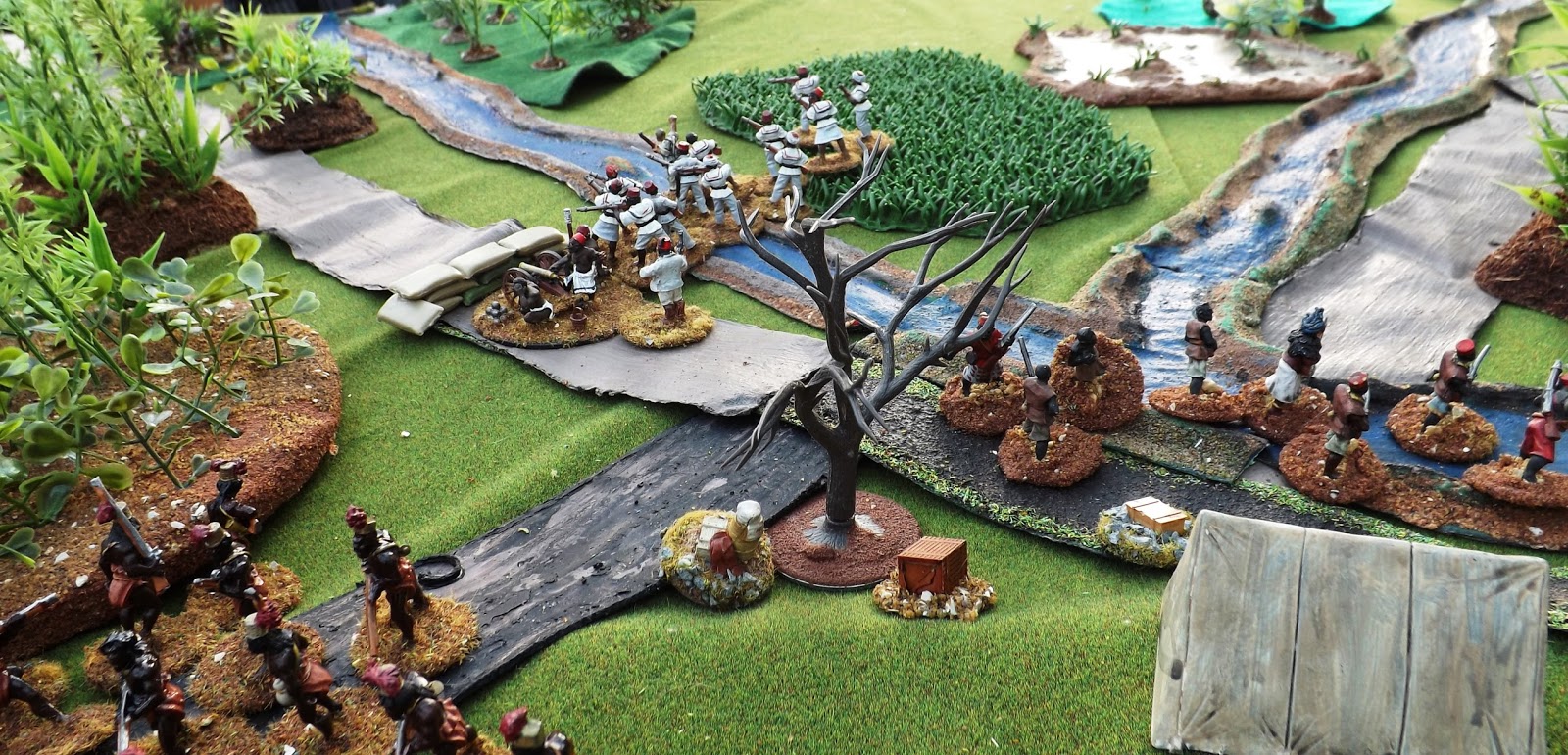
This year our game was set in late 19th century Colonial Africa, deep in the Congo jungle at a tributary of the River Uele.

At this crossroads of narrow trails crossing one of the many small rivers that wind their way through the thick jungle foliage an unholy alliance of Arab Slave Traders, River Pirates and a tribal group from the native Azande people that had been disturbing the peace in their own way had been driven by military columns sent into the forest from the various Colonial Powers that had been subjected to the depredations of these three groups in recent months.


The rules we were using for the day were the recently new set of skirmish rules by Barry Hilton and Clarence Hamilton "Donnybrook" which was my first play through, so I was keen to see how they worked.


The set up below with my annotations should help you picture the scene. The scenario simply had the three alliance players in the centre each with three units of different size and abilities, based on groups of four (excellent), eight (bulk standard regular) and twelve (cannon fodder) figures supported by two to three characters such as principle leaders and in my case as the River Pirate leader, a witch doctor and second warrior leader as well.

The basic idea is that combat from shooting and melee will cause hits on a 6 or more with the better quality, but fewer figured units rolling D10's per figure to hit, the regulars getting D8's and the cannon fodder on straight D6's. Saving throws are similarly structured and the leaders were generally fighting with a D12.


To make things interesting, we had some boxes of contraband and booty in the camp, next to the tent in the centre of the table which we all would have been happy to keep with fewer people to share with, thus an alliance of convenience rather than one of goodwill.

The four roads leading into our camp area were the approach routes of the separate but cooperating Colonial troop columns similarly structured with differing ability units but with much different weaponry, some including heavy machine-gun teams.

In preparation for the arrival of the regular troops we set up some road barricades and positioned some troops outside of the camp perimeter. I chose to put my four man mercenary section on the road barricade to slow the approach of the British-Indian army column, whilst my men manoeuvred for a better position to attack from.

Will making some last minute adjustments to his slave traders set up prior to the arrival of the German column on his road
My four man mercenary team cover the road barricade with the pirate riflemen lining the hedgerow behind
Will's Arab slave trader riflemen together with a light cannon cover the road barricade on the route of the British Naval brigade
Once the perimeter forces were set up the four colonial troop columns edged their way down their respective roads.

The movement and combat is card driven so no Igo-Ugo here and the anticipation and often frustration experienced just willing the right card to come out at the right time just added to the fun of the game.

View of the camp perimeter with the River Pirates nearest camera and their allied band of native club-men centre, by the tent
My best unit and one of the more successful units to still be standing at the game end was my eight man squad of pirate riflemen who regularly fired off five D8's worth of shots at various targets through the game and succeeded in taking out the Indian HMG team and shooting up both British rifle squads as they approached the camp aided by the club-men skulking about in the undergrowth and charging out at the survivors from the shooting, taking out the British commander in one attack.

British -Indian army patrols covered by Vickers HMG placed on the road
German Askaris covered by an HMG team as they approach the camp
All the Colonial Troop columns were badly shot up at game end but the Royal Navy more through luck, I suspect, than planning had managed to keep their Naval squad away from the worst of the carnage. Their card had failed to show up for several moves during which time the two sides had dealt mortal blows to each other.

As the Jack Tars moved  into the camp the Pirate leader could only shout defiance as he leapt over the hedge to join his men as they retreated leaving their ill-gotten gains behind them.

The British Naval brigade column, with Jolly Jack Tars top left
My Pirate Mercenary squad try to ambush the Indian HMG team but whilst getting badly shot up only kill one of the enemy 
Arab slave traders and Azande tribesmen man the perimeter
The River Pirates with their ranks thinned in the fighting pull back observed by Captain "Bunny" Chivers MC, Royal Engineers (centre top), last man standing in the British column and carrying his trusty croquet mallet that he used to dispatch several of my men!
The rules played seamlessly and we were soon able to roll our dice with the basic mechanisms memorised, and I really appreciate rules that work in that way. It is clear that "Donnybrook" have plenty of scope in them to allow you to tailor them as required and I really liked the way they played.

We were using characters like my witch doctor who had the ability to terrorise the enemy on first meeting him thus reducing their to hit potential as they were temporarily memorised by his carrying on.

The Royal Navy in force move into the camp ready to seize the contraband
The German Askari HMG team cover the camp perimeter whilst the British Naval infantry move in to mop up
Personally, I am on the lookout for a turn too skirmish set of rules, mainly for horse and musket eras, and these are now firmly in the frame, possibly alongside Sharp Practice by the Lardies as another option.

Not much left of the Congolese Republic troops as they go through the roll call for the third time
We all had a great day messing about in the Congo jungle with lots of laughs and chat which just made the game play even better. If you haven't played Donnybrook, I would certainly recommend giving them a go.

We played from about 10.30 am to about 15.00 with a stop for lunch with, as you can see, plenty of figures on the table and got a clear result in the time, so these should make a very usable set for smaller games with less time to get a result, very useful for those of us who are often time poor and need a quick game system.

The rulebook is in full colour and like the "Republic to Empire" rules from Barry Hilton that I have are full of "eye candy" alongside a well structured layout.

A deserted camp at the end of the days fighting. The River Pirate Chief is the last man to leave defiantly overseeing his surviving pirates away down the road to regroup and fight another day
The River Pirate Chief shouts defiance (top centre behind the native hut) as the Royal Navy move in from the right
Thanks to our host Chas, and to Nick, Mike, Steve, Vince, and Will for a great day of wargaming.

Sunday, 12 May 2013

Battlegroup Overlord - Thoughts and Impressions

Yesterday I got my WWII collection out to try out the Battlegroup rules that I picked up at Salute. I have posted a report on our game on the club blog, so check it out to find out how the game played.
Devon Wargames Group Blog

I should preface this post by saying that I don't intend this as a review of "Battlegroup Overlord" and the rules. That is because, having only played them twice, I don't really feel qualified to give that kind of assessment.

That being said, I do feel happy to give my thoughts and impressions, as someone who has bought both Kursk and Normandy books and is the proud possessor of the mini rules book, and having played them, set up a scenario with them, and had to thumb through the rule book to find answers to game situations can at least give an experienced wargamers view on how they work or don't.


So Jon, why did you get into this rule set? Well the simple answer to that question is that I was looking for a set of rules that I could play WWII Company level games, in a fast moving set up that was more simulation than game, and that was fun to play.
 
My turn to set of rules for this kind of game has to be I Aint Been Shot Mum (IABSM) by the Lardies, and they just about tick all my boxes, save one. That box is the one marked "fast moving". The card system in IABSM is great for simulating the friction and uncertainty of warfare, but it does slow the game down to a certain extent. I look on with keen interest at the new Chain of Command game currently being tested by my fellow club members Jason, Nathan and Gus, which has been reported on at Jason's Blog, which uses dice instead of cards to capture this friction element. It does strike me as a quicker system.
 
So I am in the market for looking at other games for WWII Company battles and have been happy to try out the Battlegroup rules, and I find myself in the same position with some but not all boxes ticked and liking these rules for different reasons. I think that my view of these rules is "fast moving" YES, "fun to play" YES, "more simulation than game" NO.
 
So why have I rated this game the way I have.
Well as fast moving goes, in both games we have rattled on through the turn sequence with little or no problem all adding the appeal of a game that can easily give a result in an afternoon of gaming at the club. I couldn't always say that with IABSM. 


Gregg Farrell's excellent Orbat creator
Greg Farrell Organiser Builder

Are they fun to play? Emphatically, absolutely, YES. The feel of the game, with the clever use of the Battle rating counters, degrading your force morale over time and occasionally throwing up the odd special event like an air strike or random mine attack is an absolute pleasure and is the "cumin, coriander and turmeric base to this interesting curry".
I recall with a smile, in yesterdays game, as the British players were forced to draw yet another counter from the box due to a well placed German artillery strike, then themselves smiling with glee as they pulled out a Mine Strike counter and were able to cause the German player much concern as one of his Marders reversed over an un-spotted mine.
So yes, fun is something this game has in abundance.

One of my Marders lurking in the hedgerows around Breville
Simulation rather than game? Here lies the rub of the matter for me. I look for the Lardies principle of playing the period not the rules in games systems I like. This principle has been a guiding factor in my choice of rule sets for ever and leads me to question where Battlegroup fits in to the rules I have considered using over the years.

I too, don't subscribe to the school of thought that says, "a good simulation can't be fun". That school of thought tends to point to the Newbury Rules systems of copious factor sheets that one had to work through to decide whether one force could shoot at another at a given range etc, etc.

The Lardies with their clever use of combined morale and casualty results table, and the design principles that reward the historically tactical use of the weapons systems available to the troops of the period. The ability to influence the randomness of the cards system by adding to or taking out cards based on the quality of the command system applicable to your force. All this points to a rule set that can combine a simulation with a fun game.


British Paras under artillery fire at yesterdays game

With Battlegroup I found myself a bit confused with what the designer was trying to achieve.
The rules are trying to be appropriate to play games from Section/Squad level to Battalion. This is a tricky spread of detail to manage, and I found myself wondering why as a Company or Battalion level commander I would be counting up how many rifles, SMGs and LMGs my sections were armed with rather than working in groups of these weapons as most rule sets at the Company/Battalion level tend to do. Thus casualties are based on individual men rather than groups of men, a seemingly low level of detail for a game looking to cover battalion scale clashes. There are arbitrary ammo load outs for armoured vehicles with assault guns and tank hunters having much smaller allowances than tanks.
This necessitates the requirement to record ammunition used by individual vehicles, a throw back to Donald Featherstone and WRG. Surely modern gaming systems have moved on from these kind of rules?

Then with artillery there appears to be unlimited strikes available to troops of guns, where most rules today try to model the restricted access to higher lever artillery by limiting the number of strikes in a game. The lack of rules covering smoke seem strange. Then there is the requirement to place a spotting round when setting up an artillery strike, which can end up being moved 4d6 inches in any direction, possibly ending up with the round moving out of sight of the OP who called it in. This does not stop the barrage going ahead! Surely the whole point of a spotting round was to be able to see where the fire would fall and to, if necessary, correct the fall of shot back onto or nearer the target before firing for effect. The artillery rules don't seem to model the efficiencies built in to American and British systems which allowed multiple assets to be co-ordinated by one OP, or the more cumbersome often WWI systems used by the Axis nations which often forced them, particularly in the later years of WWII to rely more on their mortars for rapid response than their heavier artillery.

These issues with the rules have caused me to think of Battlegroup more as a game than a simulation. The "Game" category, for me includes rules such as Flames of War and Bolt Action. I think Battlegroup are more simulation, less game than them. Many of the aspects I have highlighted are easily changed with house rule adaptions. I, for example, will limit artillery missions in my scenarios. I will allow smoke and design my own rules to cater for this. I will not allow a barrage to be fired when a spotting round is quite clearly out of sight of the OP who called it in. I will allow allied OPs to call on multiple units of artillery in missions.

One final point that is not only applicable to Battlegroup but seems to have become a common omission in most rule sets published today. Please, please, pretty please, can rule designers include, as a matter of routine, a subject index to help speed up the process of finding what it is you want to look up. The new Battlegroup rulebook is a welcome addition and even more so as I found the ready reference card poor given the lack of information on it. However the lack of a subject index can drive one to distraction when you simply want to find out something in particular without wading through the sections in the book.

I plan to play more games with these rules, starting with Pegasus Bridge, next month at the club. Why? Because they are fast, fun and I think adaptable to allow me to make changes to the base system to improve the simulation I want. If you haven't tried these rules yet I would suggest you check them out.


Sunday, 24 March 2013

Rolica 1808 - Carnage & Glory AAR

Today we got to test the Carnage & Glory II scenario for Rolica, a copy of which is available on the scenario links. The game starts with the French brigade under DeLaborde holding Rolica Hill and Rolica village with the four brigades under Sir Arthur Wellesley looking to drive them from the field with minimal loss as per the historical result. The French are required to hold the field for twelve moves ensuring that the Allies do not control Rolica ridge in that time.


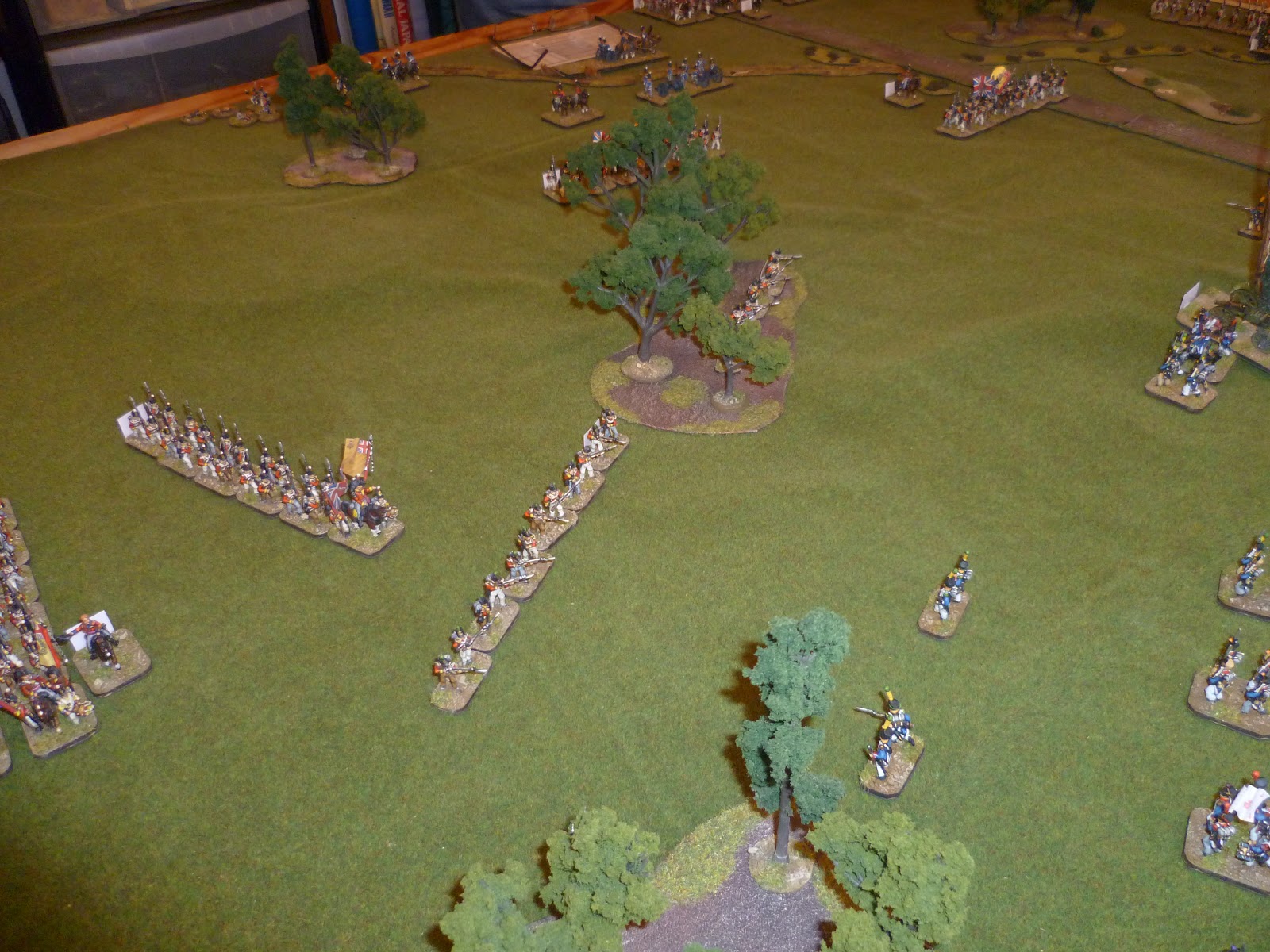
View of the French line based om Rolica and Rolica Hill with the 70th Ligne operating in extended order
Our game saw a canny French withdrawal using the Swiss as a forlorn hope to hold Rolica and its road network. This forced the Allies to march cross country in pursuit of the main force whilst suffering continual skirmish and artillery fire.

Hill's brigade closes in on the French left

Fane's brigade moving on the French right flank

Nightingale's brigade deploy in the centre as they approach Rolica Hill
The plan was working very well up to the halfway point when as the French were pulling back from Rolica Hill with the 70th Ligne in extended order, Wellesley brought up the 20th Light Dragoons to put pressure on the rearguard. The plan nearly worked, as the cavalry cresting the hill found the 1/70th Ligne still in extended order and close enough to be caught by a charge. The French infantry only just managed to form square repulsing the cavalry who fell back to be rallied by Wellesley himself.

As the British close on the French line, they fall back with the guns limbering and pulling out

The French withdraw back to the ridge
The British light cavalry charge had unknowingly derailed what had been an efficient withdrawal back to the ridge in preparation for the final stand. As the French commander ordered the 70th to resume the withdrawal, the battalion refused to break square. The luxury of time was not with the French as the British brigade under Nightingale supported by the artillery crested Rolica Hill to find the French infantry at their mercy.

The 9th Foot, part of Hill's brigade approach Columbeira
Meanwhile the Allied flank columns kept up a remorseless pursuit of the remaining French forces and by turn nine were closing in on the ridge line.


The 29th Foot part of Nightingale's brigade close on the Swiss occupying Rolica
The French force fell back through the passes on the ridge with the bulk of their infantry supported by the guns and Chasseur a Cheval holding the French left. This left just the 3/2nd Legere to hold the French right on the Lisbon road facing the two rifle battalions and the 45th Foot of Fane's brigade.
It was going to be a close run thing with just three moves remaining.

The French prepare their final stand on Rolica ridge

The British assault the ridge
Sadly for General DeLaborde, despite the heroic resistance put up by the guns, light cavalry and the 2/70th Ligne, the 3/2nd Legere were not up to the task of holding off the 95th Rifles who giving three cheers charged up the defile flanking the Legere unit who promptly turned tail and fled down the road.

Fane's Rifle brigade capture the Lisbon road, penetrating the French lines

Nightingale's Light battalion tackles the French guns blocking one of the passes
Frustratingly the game ended for the French force with the collapse of the 3/2nd Legere as this tipped their force morale over the break point on turn eleven, giving Sir Arthur Wellesley a major victory, when the casualties were assessed together with the surrounded and cut off 1/70th Ligne and 4th Swiss.

The Swiss stranded in Rolica as the French main force breaks from the ridge in full retreat

The 1/70th Ligne in square surrounded by the British advance were forced to lay down their arms

The Swiss negotiate their surrender with the 6th Cacadores of Crawford's reserve brigade.
This is our first playing of Carnage & Glory for Napoleonics, and we thought they were excellent. Once the basic sequence is mastered, which takes no time, the game flows seamlessly, with those extra bits consisting of unit reports after combat and reactions to officers joining them. The British players looked somewhat dejected as the 20th Light Dragoons bounced off the 1/70th Ligne's hastily formed square only to smile happily as the system announced the cheer from the rebuffed cavalry as Sir Arthur Wellesley approached them to restore their order.

Many thanks to Steve, Mike, Gus, Jason and Nathan for a great day. Next up Vimiero.

Saturday, 16 February 2013

Rolica Update

The Rolica scenario play tests are underway. Two weekend ago Jason ,Gus, Nathan and Steve gathered in my "man-cave" to play test the Carnage & Glory II version of this scenario. We aim to replay this game and so I have resisted the temptation to give a precise blow by blow account of events, suffice to say that all commanders took the learning from the set up and the way the rules work and are keen to put that experience into play test two.

An overall impression of the terrain with Rolica and Rolica Hill in the centre
For this first test I selected the commanders based on my observations of their style of play and how I thought they might work to the scenario requirements, thus Jason took the role of General DeLaborde, Steve, Sir Arthur and the two central columns, Nathan as General Hill on the Allied right and Gus as General Fane with the Rifle Brigade on the left.

Sir Arthur Wellesley's centre columns under Generals Crauford and Nightingale pursue the French from Rolica
 This scenario will be a classic rearguard with both commanders aiming to out perform their historical predecessors in gaining more time, losing fewer casualties and inflicting greater damage to the enemy.

French troops followed by the 4th Swiss move to occupy the heights above Rolica
Our initial run through suggests this could be a close run affair, but we need to see it run again to give a better impression.

The 3/2me Legere leave Rolica heading for the heights pursued by British Light troops
So I aim to give a second report and offer up this scenario for "peer review" next month. In the meantime I hope you like the pics of our first run through.

The 3/4me Legere occupy the French right on the heights

Wednesday, 5 December 2012

New Year Plans

At the moment I am working flat out in putting my Napoleonic collection together, or rather updating the collection I already had to the rule sets I intend to use.

I already had a collection of AB figures with about 20 battalions of French infantry, 4 Regts of Cavalry and a couple of batteries of artillery, with a similar number of Prussians for the 1813 to take them on. Theses were all based for "Grand Manner" so big battalions of 32 or 36 figures. I also have a similar number of Russians as yet unpainted, together with a second French army.

Grand Manner is a great set of rules but is showing its age, with no command and control as such and rather cumbersome mechanics compared with more modern systems. The system that often raises a few smiles is "routed ground". This was a mechanic to stop units moving across ground another unit had just routed through. You have to imagine the area covered in discarded muskets and shakos with the odd casualty lying around.

So after four years of rebuilding my WWII collection for a Normandy themed company level set up - see the picture of my Juno game in the previous post- I have returned to where it all began for me, the wars of Napoleon.

At first I thought I would pick up where I left off with an 1813 themed collection, but on reflection decided to build a Peninsular War theme as my mid war French were more suitable for that period and I had always intended at some stage to go in that direction.

So having decided on the theme, I needed to work with a set of rules in mind, as I have always been keen on the big battalion look for Napoleonics and the rules would have to cater for that. So after much consideration "General de Brigade", "Lasalle" and "Republic to Empire" I went for two sets, one paper based and one computerised, namely "Napoleon at War" (NAW) and "Carnage & Glory".

http://www.manatwar.es/

http://www.carnageandgloryii.com/

In addition to the rules I also decided to move to a more flexible terrain system as up to now I have relied on my own hex terrain and hex mat, but with the advent of I Aint been Shot Mum v2 and now NAW I have decided to use terrain mats with separate roads and rivers. So terrain purchases are also being factored in to the overall plan.

Having decided on the direction of travel I then decided to set myself some progress goals. So the project started in November 2010 and began with me re basing/repainting my French, so that by May of this year I have completed 12 x 24 battalions of Line, 6 x 24 Legere, 4 x 24 Combined Grenadiers, 1 x 24 Swiss Line, 3 x 12 Dragoon Regts, 2 x 12 Chass a Cheval, 2 x Foot batteries (each 4 guns plus limber team) 1 x Horse battery (3 guns plus limber team, plus 6 x Brigade Generals and 1 x Divisional General.


4th Swiss (AB figures)
In June I set about the British and too date now have done, 11 x 24 Line, 1 x 24 Highland, 2 x 24 Lights, 2 x 24 Guards, 2 x 24 Rifles (60th & 95th), 2 x 24 Cacadores, 1 x Foot battery (3 guns plus limber), 2 x 12 Light Dragoons, 6 x Brigade Generals and 1 x Divisional General.


Combined Grenadier battalion (Fantassin figures)
Those units completed to April this year were rolled out at our club meet that month and can be seen on the blog link.
http://devonwargames.blogspot.co.uk/2012_04_01_archive.html
In the game report I have also given our impression of the rules. As you will see we liked them.

The plan is to add further units through 2013, but with a view to producing a game as the units are completed. So I decided to start with Wellington's first major clash with the French at Vimiero, I will probably do Rolica as a warm up. I then plan to add units to do a time line sequence of games, Corunna followed by Opporto, Talavera etc. As I want to start playing as the collection permits I am looking to put together representative scenarios from these key battles, with the occasional BIG GRAND MANNER game in between, well that's the plan and I am using this blog to hold me accountable to it.

In time I intend to build some Spanish forces, as the early uniforms were great to contrast with the French in their Shakos, and the "anything goes" approach to uniform in the later period make the Spanish a great contrast to the Brits, Portuguese and French. I know the Spanish will be a challenge to field but that's all part of the fun, and with the intention to do Talavera and Albuera I can't leave them unpainted for too long.

So behind all my future adventures in 2013 that I will be recording here will be my underlying project, The Peninsular Collection, and I will update my progress as it goes.