Showing posts with label Rolica. Show all posts

Tuesday, 12 December 2017

Over the Hills (Play-test) - Rolica, 17th August 1808


British involvement in the Peninsular War may be said to have started on the 14th June 1808 when Sir Arthur Wellesley was appointed to command the British expeditionary force to Portugal of 9,500 men. 

His instructions from Lord Castlereagh, the Minister of War, were to support Portugal and Spain in “throwing off the yoke of France, and the final and absolute evacuation of the Peninsula by the troops of France.”

He discussed his task with an old friend, John Coker, and when asked his thoughts on the mission he said.

"Why, to say the truth, I am thinking of the French that I am going to fight. I have not seen them
since the campaign in Flanders, when they were capital soldiers, and a dozen years under Bonaparte must have made them better still..... My die is cast; they may overwhelm me, but I don't think they will out-manoeuvre me. First, because I am not afraid of them, as everybody else seems to be; and secondly because if what I hear of their system of manoeuvre is true, I think it is a false one against steady troops. I suspect all the continental armies were more than half-beaten before the battle was begun. I, at least, will not be frightened before-hand."

The confidence in his and his army's ability to overcome based on his appreciation of French tactics appear prophetic now with the benefit of hindsight; and display a sharp intellect that had led to the young Lieutenant General Wellesley established as a senior military advisor to the British government and now about to begin his association with the Anglo-Portuguese Peninsular Army.

The expeditionary force sailed from Cork on the 13th July, with Wellesley going ahead in the fast frigate Crocodile. They landed unopposed on 1st August at Figuiera de Foz at the mouth of the Mondego River, 80 miles north of Lisbon, and on the 5th, Wellesley’s 9,500 men were joined by an additional 5,000 men from Cadiz under Major General Sir Brent Spencer.

Wellesley's three columns of British infantry approach Delaborde's hill-top position close to the village of Rolica

Once ashore, Wellesley divided his force into six small brigades, each with three guns; he was very short of horses, having only enough to mount two-hundred and forty of his three-hundred and ninety light dragoons and to pull three of his five batteries of guns. But he immediately started to build up his supply system, which would give him a marked advantage over the French.

On 10th August he moved off south towards Lisbon, following the coast road, so that he remained in close touch with the Royal Navy. About this time he received news that his force was to be increased by a further 4,000 men, but as a result, command would have to go to someone more senior. The 39 year old Wellesley would therefore be superseded not only by General Sir Hew Dalrymple, but also beneath him by Lieutenant General Sir Harry Burrard.

When the French commander, General Jean-Andoche Junot, heard of Wellesley’s landing, he sent his ablest commander, General Henri François Delaborde, to delay him until reinforcements could arrive from Abrantes.

On 15th August the first encounter of the Peninsular War for the British Army occurred when there was a brief skirmish at Alcobaca. On the 16th Wellesley occupied Obidos, and the next morning he observed that Delaborde had taken up a defensive position just north of the village of Roliça, some four miles beyond Obidos.


Knowing that he out-numbered the French, but that reinforcements for them were only half a day’s march away, he decided to attack without delay. He divided his force into three columns and tried to outflank the French; but Delaborde saw through the manoeuvre and skilfully withdrew to a much stronger position on a steep ridge a mile south of Roliça.

Wellesley repeated his pincer movement, but the plan went wrong when one battalion attacked the enemy centre prematurely, and he was forced to launch a full attack to support them. The French were finally overrun, and by 16.00 were in full retreat southwards having lost 600 men and 3 guns against 479 British casualties.

Roliça was not a major battle, but it was significant simply because it was a victory.

General Hills column of the 1/5th, 1/9th and 1/38th Foot

The interesting aspect of this particular engagement is in the fighting of what was a common mission in the Peninsular War and wider Napoleonic conflict when a much smaller force was required to conduct a delaying action by forcing a much stronger foe to manoeuvre it out of its position and have to deploy off the march into its fighting formations to do so.

The two battalions of the 70me Ligne supported by the 8 lbr battery of foot guns 

General Delaborde was a highly efficient and experienced commander, so much so that Wellesley's earlier attempts to cause him to withdraw by parading the size of the British army had no effects other than to cause the British commander to close on his enemy to force the situation.

Wellesley oversees the sighting of his guns separating the columns of Generals Nightingale and Fane

Delaborde's skill was in judging precisely the right time to issue orders to his smaller command to revert from a holding stance to an immediate withdrawal; looking to keep just ahead of the advancing British columns and, by turning to face occasionally, cause them to deploy into line or face damaging defensive fire on their march formation whist enduring harassing skirmish and artillery fire.

General Delaborde's view from Rolica Hill with the two battalions of Legere and the 4me Suisse to his right

Wellesley's skill was to cover the ground as quickly as possible with the minimum of casualties by using his columns to pin and turn any French rearguard as the advance pressed and sought to take advantage of any French confusion.


The design of this game required to look at the timings involved to allow the simulation to progress at a similar rate.

This meant looking at creating likely terrain bottle-necks that might delay the Anglo-Portuguese columns whilst also allowing the French to pull back and prepare another holding position as other parts of their force fell back to occupy similar positions.

Two squadrons of the 26me Chasseur a Cheval covering the French left

To work out a scenario time limit required us playing this advance to see if Delaborde could with careful use of his small force delay the allied advance to the two hours it took them to move up to the ridge line, covering ground that could be moved over unopposed in little over an hour and a half.

The forward French position with the stronger second ridge-line position closest to camera

My picture of the ridge-line at Rolica during a visit to the battlefield back in the nineties

With that in mind, the battle for the ridge that would inevitably occur was a much secondary concern as, being familiar with OTH and its combat mechanisms, the success of a French holding action on the ridge would be determined by how well they had performed the first part of their mission by reducing as much as possible the time allowed for any allied attack on their line whilst minimising their own casualties.

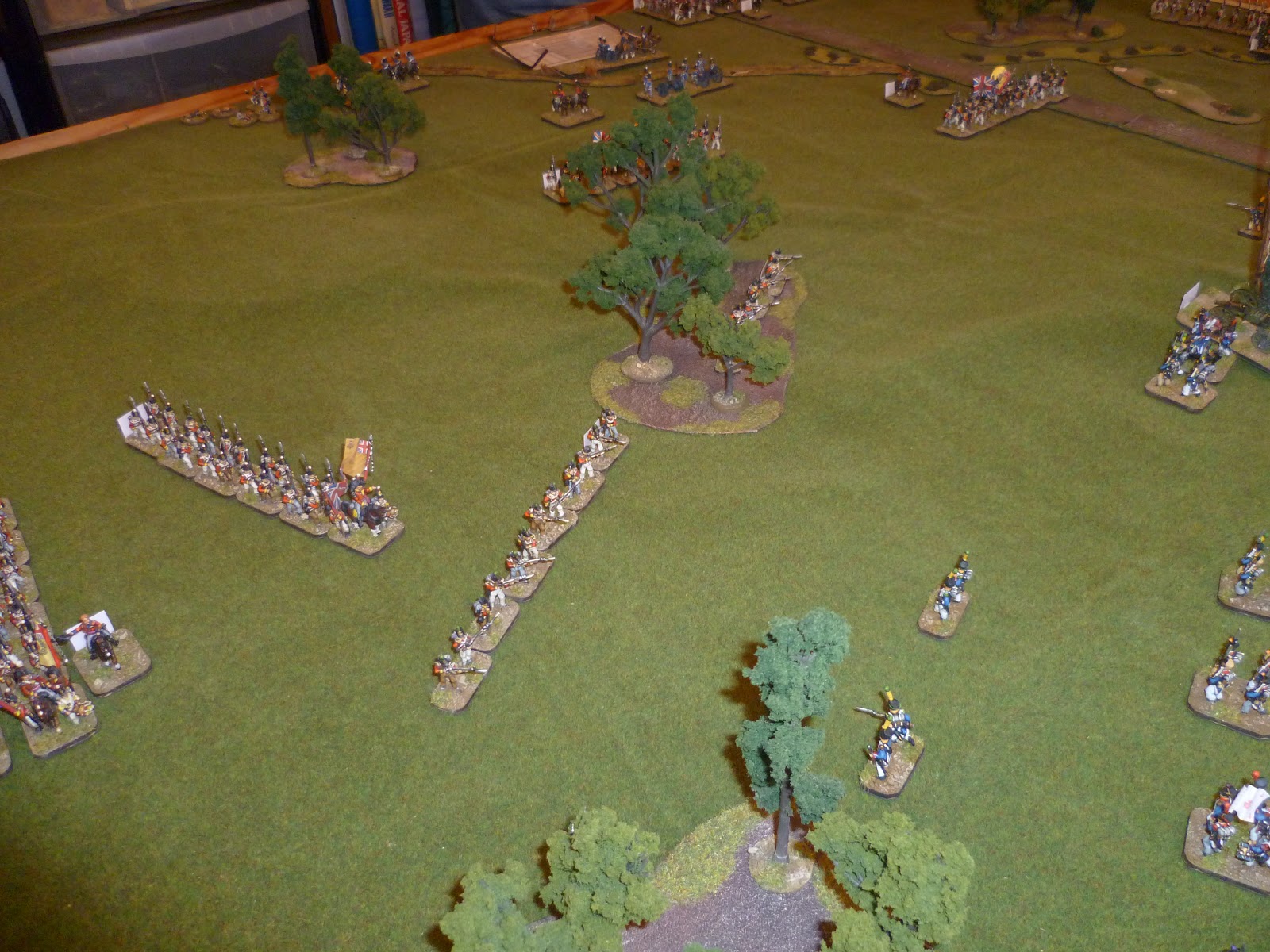
The British columns began their advance on Rolica at about 12.00 on the 17th August 1808

As the French commander my mission didn't start particularly well as my opening shots from my skirmish screen and gun line all missed but to make things worse my guns used up their ammunition in the attempt.

The French open fire on the British advance with little effect

Having toyed with the idea of contesting Rolica for a further turn to delay Fane's rifle brigade having already seen Nightingale's centre brigade waste time by deploying into line, I now decided I needed to put more space between my troops and the allies to allow my guns to replenish and hope to find another delaying point.

Simply looking to delay the British without becoming enveloped and destroyed, the French begin their withdrawal

The French about turned and thread their way down the back slopes of Rolica Hill accompanied by their flanking forces taking a few skirmish hits as they withdrew, but managing this time to return the compliment.

Rolica village is abandoned without a struggle

As the French commander I wasn't quite sure I was right to have pulled back as soon as I did, but with my orders given and my troops on the move had to think about things as they were not how they might have been.

The first elements of the French force enter the second position at about 13.30

It was then that an opportunity presented itself as Fane's riflemen chose to march through the broken terrain in and around Rolica in company column causing their approach to slow and allow my Legere battalions to extend the gap between them and their pursuers.

Every now and then as the British troops became entangled in the various obstacles likely to impede their progress the French would turn to face and cause casualties

Not needing a second invitation, the 3/2me Legere formed line on the road junction south of Rolica and prepared to contest the the allied advance covered by a strong skirmish screen and the deployed foot guns.

Skirmishing and harassing artillery fire characterised the French withdrawal

This manoeuvre felt quite nerve racking as I observed the multiple columns of British infantry threading their way forward down the rear slope of Rolica Hill.

However I felt slightly more assured as I started to move other French troops into the narrow defiles at the foot of the ridge and if we could delay the allies for another turn and get the Legere out we would be tracking Delaborde's performance.

The 70me Ligne firmly in position by 14.00 ready to contest any further British advance via the narrow defiles on the ridge

The next part of the French move went quite well and the combined fire of the guns and skirmishers were able to get several hits on the allied columns although my Legere in line missed, but had at least caused the troops to their front to waste more time deploying to meet them.

The 3/2me and 3/4me Legere supported by the 4me Suisse cover the other defile as the artillery looks to get in position to support

To get the most out of this scenario you really need to play the order issuing mechanisms which only add to the uncertainty of things going horribly wrong when everything seems to be going great. However I can't say it does much for ones blood pressure or stress levels checking everyone is in command and then to see if your couriers have arrived and the orders successfully transmitted.

The 26me Chass a Cheval cover another likely access point on the flank of The French position

So it was for me as having caused another delay in the allied advance and now needing to get all of my force onto and into the ridge line defence position I noticed one of my battalions was now out of command!

Fortunately it was not disastrous as it could have been as it was the 2/70me Ligne who were the furthest way from any potential British threat.

General Hill's column deploys ready to attack supported by the 20th Light Dragoons

The next moment of French stress came with the need to issue orders from Delaborde to his brigade commander Brennier to revert to hold orders otherwise the French infantry would end up marching off the table without any attempt at delaying the allies in such a strong position.

I rolled the dice getting a '4', indicating the orders would be received but with a one turn delay just about allowing my force to get into position and prepare to receive the allied attack.

As Wellesley's other two spearhead columns move in, Crawford'd brigade remains in reserve alongside the British guns atop the rear of Rolica Hill firing in support of the attack.

As with the actual engagement the British columns arrived at the foot of the ridge at 14.00 in readiness to begin the second phase of this little battle.

Fane's Rifle brigade supported by the 1/45th Foot deploy in readiness to attack the left most defile while Nightingale's column closes on the centre.

We didn't fight the final stage of the scenario as the concept of the set up was proven and the last moves of battle would be determined on how well the respective troops came out in the combat within the narrow defiles, with the allied troops well placed to stretch the French defences with attacks along most of the access routes.

The French had suffered on their withdrawal but looked in relatively good shape to make a fight of the last few turns to the scenario end and have a chance of bettering Delaborde's result.

The British attack about to commence at 14.00

As with other play-tests in this series, the playing is always the proof of concept and both Steve and I found this a challenging test of command and, for the British, particularly frustrating, as they attempted to come to grips with their slippery opponents. I could almost detect the eagerness of the allied columns to finally come to grips with the French line at the close.

Next up Market Garden battle sites from our trip to Holland this summer and the combat at Ventosa Farm, the next scenario in this series of OTH play-tests.

Friday, 27 September 2013

Wellington against Junot, David Buttery - Book Review

Ok, so for the second book in my post birthday reading pile, I selected, well what else could it be, given the focus of this blog for the last nine months?

So what are the claims for this book, proclaimed on the back of the dust cover?


  • Compelling study of the opening campaign of the Peninsular War
  • Reassessment of two great Peninsular Generals
  • Vivid reconstructions of the battles of Rolica and Vimeiro  
  • Insight into Napoleonic warfare from eyewitness accounts
  • Covers the guerrilla war against the French
  • Reconsiders the impact of the campaign on the outcome of the Peninsular War
As you can see, it's quite a list, and after reading the book, I think it achieves the claims in the main.

The book consists of nine chapters, preceded by a chronology of events starting in 1750 with the birth of Sir Hew Dalrymple though to the death of the Duke of Wellington in 1852.

There are eight well laid out and clear maps that help illustrate where particular events were occurring together with the battles of Rolica and Vimeiro. In the centre of the book are the illustrations and modern day pictures of some of the main characters involved, the places and events as portrayed at the time or soon after, and specific places mentioned in the text with recent photos of how they look today.

The last chapter, covering "Touring in the Peninsula", contains some handy information about finding your way around some of the main sites in Portugal and what to particularly look out for. I found myself wishing I had had this book with me when I walked around Obidos, Rolica and Vimeiro in the early 90's.

For those of you who want to know on what references the author is relying on when marshalling his facts, there is an extensive list of references listed by chapter with a corresponding number printed in the body of each chapter. I like this and found it straight forward to flick between it and the text to see where a particularly interesting "nugget" was taken from.

Lastly there is an extensive list of primary and secondary sources listed in the "Bibliography" section, followed by a very useful index, all making the book a useful launch pad for further reading.

When I first saw the title of the book, my first reaction was Wellington wasn't involved in the first invasion of Portugal as Sir Arthur Wellesley didn't assume the ducal title until after his victory at Talavera in 1809, and I smiled when Buttery deals with that point in his preface, pointing out that the choice of title is in keeping with the plan to write a series of books on Wellington's campaigns and that he is not the only author to choose this option; Jac Weller's "Wellington in India" for example.

The layout of the book is logical and easy to follow, starting with a description of the events that lead up to 1807 and Napoleon's rise to power in Europe. The text sets up the issues that would lead to the confrontation with the Portuguese, namely enforcement of the Continental System against Britain. The pressure on the Portuguese to satisfy the demands of France, the most powerful nation on land, matched by the demands of their oldest ally Britain, the most powerful nation at sea, upon which Portuguese trade, significantly with Britain and connections with her colony Brazil relied, are covered in detail. The balancing act of being a neutral small country is described as she desperately tried to manage the expectations of both. In the end Napoleon forced the issue by demanding Portuguese authorities confiscate British traders goods and monies as part of their compliance, something that would have greatly damaged Portuguese trade and forced a war with Britain. As is now known, the struggle to placate Napoleon was in vain, as the Emperor had already decided to annexe both Portugal and Spain and plans were in motion to effect that decision.

The story then moves on to consider the leader of French forces selected to spearhead the invasion, General Jean-Andoche Junot. The career of Junot is laid out from his birth in 1771 on the feast day of St Andoche to his meeting with Napoleon at the Siege of Toulon and his subsequent rise through the ranks serving in all three arms, but finding his talents best suited in the cavalry. He was a fighting soldier, fearless in a fight, and totally loyal to his friend and Emperor. It would also be true to say that he was not the brightest of Napoleon's leaders, but his limitations may have been part of the reason for him being chosen for such an independent command, as someone very unlikely to threaten Napoleon's authority and leadership with any political ambitions of his own.

The next chapter covers the march on Lisbon and the events leading up to the occupation of the city.
This made fascinating reading as Buttery describes the harrowing march through Spain with the starving bedraggled survivors staggering into Lisbon. The reputation of the all conquering armies of France cowed the Portuguese capital into submission, even though the men that arrived before their city were in such a poor state and in desperate need of rest and supplies. For the success of this expedition Junot received the title Duc d'Abrantes, although it seems he was disappointed not to get his Marshals baton.

Even at this early stage of the war in the Peninsula the barbaric excesses of the French army when un-supplied and finding forage hard to come by are observed with even their supposed allies, the Spanish, having civilians raped and murdered along the route in their desperate attempt to gain relief from their sufferings.

With the arrival in Portugal the story moves on covering the occupation and subjugation of the wider country with the rise of Portuguese resistance. With this resistance came reprisals and the murderous excesses by both sides are covered. However given the power of French arms at this stage, the brutality of the French against the Portuguese civilians is well documented and with these excesses came the universal hostility threatening the French ability to hold what they had.

General Loison
In particular General Loison became  Junot's "enforcer" leading his punitive expeditions north and south of the capital leaving a trail of death and destruction. He became known to the Portuguese as "Maneta", or "One Hand" a reference to him having lost a hand in battle. Even today the Portuguese have a saying, "to be brought before Maneta" indicating a person in big trouble.

The resistance growing in Portugal and Spain to French occupation began to arouse a response in Britain and the political and public discussions to react to the situation are then covered. The narrative develops the reasons why the British expeditionary force ended up with three commanders, the strengths and weaknesses of the force and the success in choosing one commander who would, in time, stand out above all others as the greatest British General since the Duke of Marlborough.

The landings of the British and the co-operation with Spanish and Portuguese forces bring the book towards its climax as the French forces start to feel the pressure of trying to maintain control of a country growing in hostility to their presence, whilst having to react to the threat of an organised disciplined army arriving in their midst with overwhelming naval support. This, added to insecure supply lines through Spain, and demands from Napoleon to support the forces in Spain. No wonder Junot's reaction to the British landing seems somewhat uncoordinated with his dispatch of General Delaborde to hold up the British at Rolica whilst French forces were massed. The problem of losing control of Lisbon whilst his forces headed north to deal with the British seemed to paralyse Junot's response, and only added to his haste when he eventually chose to act and arrived before Wellesley's army at Vimiero. The brutality of French arms against the Portuguese had one final payback to make, for although the French enjoyed a cavalry superiority, the British enjoyed better intelligence due to the help they received on French numbers and movements. It was Junot who ended up attacking a superior force that he believed to be weaker in numbers.

The book concludes with events following the French defeat at Vimiero and the subsequent evacuation of French forces, together with their loot and arms back to France in British shipping. The Convention of Sintra is covered together with the response in Portugal, Britain and France. The British commanders involved, Dalrymple, Burrard and Wellesley and their actions are discussed together with the enquiry set up to investigate where the responsibility lay and what the various parties had to say about it. In France the reaction by Napoleon to Junot's exit from Portugal was more positive, given the recovery of his troops and arms from what had been a failure. The reaction by the British also helped take the pressure off Junot.

I really enjoyed this book. As the author points out in his preface, there is a distinct lack of recent books covering this early period of the Peninsular War and the problems that were to beset French forces throughout the war are in evidence even at this early stage. Namely French excesses against the civilian population, leading to reprisals and guerrilla warfare, and Napoleon's inability to grasp the issues facing his commanders in this theatre. Starting with his selecting an inadequate force to occupy and subjugate Portugal, his lack of planning to supply that force and then his demands placed on that force to support others operating in Spain. I learnt a lot about the occupation and fighting in Portugal before British involvement and the political events leading up to the invasion.

My only criticism of the text, and its a small one, is in its covering of the battles of Rolica and Vimiero. The description of events were familiar to me from other sources and I don't think there was much new to me in them. However I did feel that other texts have given more information about the forces and their movements. As a war-gamer, I want to know about how the armies set up and fought, and I kept thinking that I was glad to have read Jac Weller's version of events based mainly on Oman to give me a mental picture of how the armies set up and fought on the day. That said, the book having gone into detail about the strategic issues facing Junot at this time, did give me a much better understanding as to why his command abilities at Vimiero seemed so poor on the day.

If you are at all interested in the Peninsular War and particularly the early stages of it then this book is a great read and well worth getting a copy of.

Tuesday, 21 May 2013

British Facings & Lacings for the Vimeiro Campaign

For those who would find it useful, I have put together the detail I have gathered on the colours of British infantry facings and lace, by brigade, for units that took part in the battles of Rolica and Vimeiro.

You can find the PDF in my Resources and Downloads section

Friday, 26 April 2013

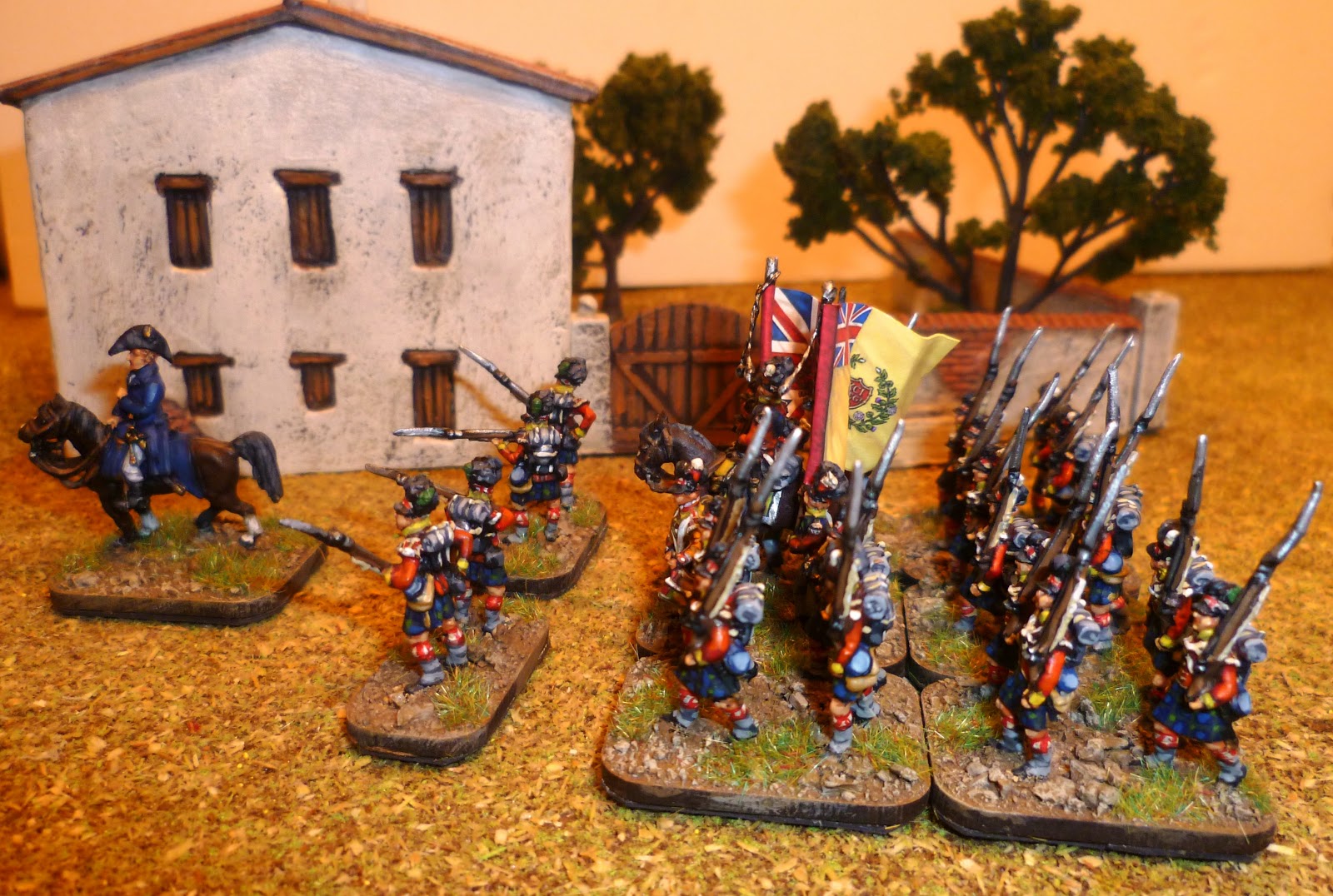
91st (Argyllshire Highlanders) Foot

The 91st Highland Foot was one on those battalions that appeared in the early Peninsular War campaigns of Vimeiro and Corunna, that found itself shipped of to the Walcheren and subsequently ended up not appearing on the British order of battle until much later into the campaign.

For more information on the history of the regiment

http://www.argylls.co.uk/history/the-91st-argyllshire-highlanders-1794-1881/peninsular-war-1808-1814


Being a yellow faced, silver laced battalion they differed in appearance only slightly from their brothers in the 92nd Cameron Highlanders by not having the yellow stripe through their "Government Set" kilts.

The unit is made up of a mix of Fantassin and AB's. I'll leave you to decide which are which.


They have been completed to finish off my British force for Vimiero, next up the 42nd (Black Watch) Royal Highland Regiment, in time for Corunna.


Wednesday, 17 April 2013

Peninsular War Scenario Files

I'm always thinking of ways to improve the blog and make changes.

This post is to let you know that I thought it would be helpful to those that want to use the Carnage & Glory scenarios if I put up a file containing every thing you need to play it using the system.

So starting with Rolica which I have play tested, I have made these changes. So if you follow the link it will take you to a file containing the Scenario PDF, the AAR PDF, plus the Army List and Order of Battle files, and the XL ID tags for the units.

As I complete the other scenarios I will take down the Scenario PDFs and post the full file as above.

I hope you C&GII players find that useful.

Sunday, 24 March 2013

Rolica 1808 - Carnage & Glory AAR

Today we got to test the Carnage & Glory II scenario for Rolica, a copy of which is available on the scenario links. The game starts with the French brigade under DeLaborde holding Rolica Hill and Rolica village with the four brigades under Sir Arthur Wellesley looking to drive them from the field with minimal loss as per the historical result. The French are required to hold the field for twelve moves ensuring that the Allies do not control Rolica ridge in that time.


View of the French line based om Rolica and Rolica Hill with the 70th Ligne operating in extended order
Our game saw a canny French withdrawal using the Swiss as a forlorn hope to hold Rolica and its road network. This forced the Allies to march cross country in pursuit of the main force whilst suffering continual skirmish and artillery fire.

Hill's brigade closes in on the French left

Fane's brigade moving on the French right flank

Nightingale's brigade deploy in the centre as they approach Rolica Hill
The plan was working very well up to the halfway point when as the French were pulling back from Rolica Hill with the 70th Ligne in extended order, Wellesley brought up the 20th Light Dragoons to put pressure on the rearguard. The plan nearly worked, as the cavalry cresting the hill found the 1/70th Ligne still in extended order and close enough to be caught by a charge. The French infantry only just managed to form square repulsing the cavalry who fell back to be rallied by Wellesley himself.

As the British close on the French line, they fall back with the guns limbering and pulling out

The French withdraw back to the ridge
The British light cavalry charge had unknowingly derailed what had been an efficient withdrawal back to the ridge in preparation for the final stand. As the French commander ordered the 70th to resume the withdrawal, the battalion refused to break square. The luxury of time was not with the French as the British brigade under Nightingale supported by the artillery crested Rolica Hill to find the French infantry at their mercy.

The 9th Foot, part of Hill's brigade approach Columbeira
Meanwhile the Allied flank columns kept up a remorseless pursuit of the remaining French forces and by turn nine were closing in on the ridge line.


The 29th Foot part of Nightingale's brigade close on the Swiss occupying Rolica
The French force fell back through the passes on the ridge with the bulk of their infantry supported by the guns and Chasseur a Cheval holding the French left. This left just the 3/2nd Legere to hold the French right on the Lisbon road facing the two rifle battalions and the 45th Foot of Fane's brigade.
It was going to be a close run thing with just three moves remaining.

The French prepare their final stand on Rolica ridge

The British assault the ridge
Sadly for General DeLaborde, despite the heroic resistance put up by the guns, light cavalry and the 2/70th Ligne, the 3/2nd Legere were not up to the task of holding off the 95th Rifles who giving three cheers charged up the defile flanking the Legere unit who promptly turned tail and fled down the road.

Fane's Rifle brigade capture the Lisbon road, penetrating the French lines

Nightingale's Light battalion tackles the French guns blocking one of the passes
Frustratingly the game ended for the French force with the collapse of the 3/2nd Legere as this tipped their force morale over the break point on turn eleven, giving Sir Arthur Wellesley a major victory, when the casualties were assessed together with the surrounded and cut off 1/70th Ligne and 4th Swiss.

The Swiss stranded in Rolica as the French main force breaks from the ridge in full retreat

The 1/70th Ligne in square surrounded by the British advance were forced to lay down their arms

The Swiss negotiate their surrender with the 6th Cacadores of Crawford's reserve brigade.
This is our first playing of Carnage & Glory for Napoleonics, and we thought they were excellent. Once the basic sequence is mastered, which takes no time, the game flows seamlessly, with those extra bits consisting of unit reports after combat and reactions to officers joining them. The British players looked somewhat dejected as the 20th Light Dragoons bounced off the 1/70th Ligne's hastily formed square only to smile happily as the system announced the cheer from the rebuffed cavalry as Sir Arthur Wellesley approached them to restore their order.

Many thanks to Steve, Mike, Gus, Jason and Nathan for a great day. Next up Vimiero.