Showing posts with label Sri Lanka. Show all posts

Wednesday, 21 August 2013

Back from Holiday - Normal Service is Ressumed

Our last day in the Maldives was very special. We had arranged to go out on the boat straight after breakfast to watch dolphins. The day was warm and sunny with very little breeze, giving very flat sea conditions, perfect for dolphins.


Just five minutes on the speed boat and we were on the far side of the lagoon and right in the middle of a large pod of dolphins swimming along side us. Then suddenly the fun started. I have a video button on the camera and switched to that as dolphins started to leap from the water doing somersaults and tail slaps - fantastic!!

 
That was on Monday, Tuesday was a day of travel, starting with a seaplane back to Mali then Sri Lanka Air back to Heathrow, London via Colombo, thirteen hours of flying. We stayed overnight in London and drove back to Devon via Stonehenge in Wiltshire.
 
 
I've driven past this ancient monument for years and never stopped to look at it properly, so as Carolyn and I were still in tourist mode we joined all the other foreign coach loads of visitors and went round the stones to get a close up view of this amazing and enigmatic monument.
 
So home at last and still operating on Sri Lankan time I find myself in front of the computer at 05.40, updating my ITunes, wow I've got lots of great podcasts to listen to, and putting together this post. It's so good to have a half decent internet connection!!

Friday, 16 August 2013

Napoleonic Campaigns - Thoughts and Ideas

Greetings from the Maldives. What a day Tuesday was. Up at 2am driving through the Yala National Park trying very hard to avoid wild animals as big as elephants, quite literally. Then an eight hour drive to Colombo airport with roads getting busier and busier the closer we came to the capital.

The picture above is one of the many bars and restaurants, this one being close to our beach side chalet.

At Colombo we boarded a flight to Mali in the Maldives which takes about an hour. Then boarded a sea plane out to our resort, arriving about 7pm that night.


So now we have seven days of sun, sea and sand plus time to read and feed the mind!


So with an enforced break in the painting schedule, I like many wargamers like to plan future games, army lists and for me campaign ideas.

I think for the Napoleonic player, campaigns are an important aspect of our hobby. The period lends itself perfectly to a series of games linked with a common narrative of forces trying to find one another and bring on a battle to one sides advantage. Once the advantage is gained then it comes to forcing the issue with follow up manoeuvre and final destruction of the enemy.

However most of us are busy people leading demanding lives and for me I want to be able to easily pick up and leave my campaign as and when time permits, but still give me the narrative I am looking for. I am also looking for a system that allows me to play on the Grand Strategy level down to the more local issues of a campaign within a campaign.

I want to abstract a lot of the day to day events that a senior commander would not bother himself with. So, for example, reconnaissance is a vital part of Napoleonic warfare, but I don't need to be concerned with where a particular light cavalry squadron is operating, as the senior Army Commander.

Likewise army attrition is inevitable, so my system needs to incorporate that without tying the play up with endless book keeping. I still have my copy of the Empire III campaign system and it still makes me swoon with its complexity. Perhaps when the Carnage & Glory campaign system is available then I might revisit that level of playing letting the computer take the strain.

I want also to be able to map play battles where that is preferable but keep the narrative to link my table top encounters.

So what have I come up with so far? Well I couldn't see the point or reinventing the wheel so I turned to a very old set of campaign rules "L'Empereur" I got from Tabletop Games, years ago. I then started to add a few adaptions of my own to the Peninsular Campaign module contained in the original set.


In this day and age of computers I can't see the point of having a paper map and I didn't want to use the original hexes so I made two changes, firstly to produce a Cyberboard set and secondly to use an area/node map.

I found a great map referenced from a board game, "War to the Death" highlighted on Rafeal Pardo's Project Leipzig blog, see my favourite blogs links, and combined this with some marker and counter graphics to allow me to monitor progress in the campaign.

The Campaign map set up in the Cyberboard Module

The basic principle behind the system is to enable battles to be fought using any points based set of rules, allowing the results of those battles to be translated to losses in map counters. I have put together a set of rules incorporating the structure from L'Empereur, and adding in some battle set up methods from "Age of Reason" suitably adapted for the Peninsular War.

This little project of mine comes with the usual disclaimers that I make whenever I make available material that I haven't had chance to playtest. However I think the basic system is robust enough to withstand tweaking, which is what I've done anyway. So if you make use of it let me know what you think. Anyway its offered free for those that might want to try it.

There is a link to Cyberboard in my links board to download the basic software. If you haven't used it before, I would highly recommend it as a great utility for wargame campaigns needing maps.

I'm afraid this post is a set up for when I get back to civilisation, as I had intended to post the rules and module with it. The internet connectivity hear is very indifferent, so I will follow up this post next week with the downloads.

Monday, 12 August 2013

Last Day in Sri Lanka - Yala National Park

Today is our last day in Sri Lanka before we fly out into the Indian Ocean to relax on the Maldives. There we will take a sea plane to our final island destination and a bit of R & R to recover from our fascinating but tiring tour of this stunning island.


This is our Silver Wedding as well as our summer holiday so Carolyn is taking a piece of Sri Lanka away with her in the form of a yellow sapphire ring we had made in Kandy. Sri Lanka is famous for its fabulous gem stones from precious to semi-precious.


This morning we were up at 4am to be ready for the morning safari at 5am. This afternoon we will relax and sleep in readiness for getting up at 2am tomorrow to begin our journey to the Maldives - phew!!

What follows is a photo record of some of the amazing creatures we saw in the park this morning and some we saw yesterday afternoon.

The hotel pool area at 5am this morning
The hotel is situated in the national park and with animals moving in the grounds after dark we had to arrange for a guide to take us from our chalet to the vehicle park.

Yala National Park

Sunrise over Yala
The first creature spotted is rarely seen in daylight, the Black-naped Hare.

Sri Lankan Black-Naped Hare
 

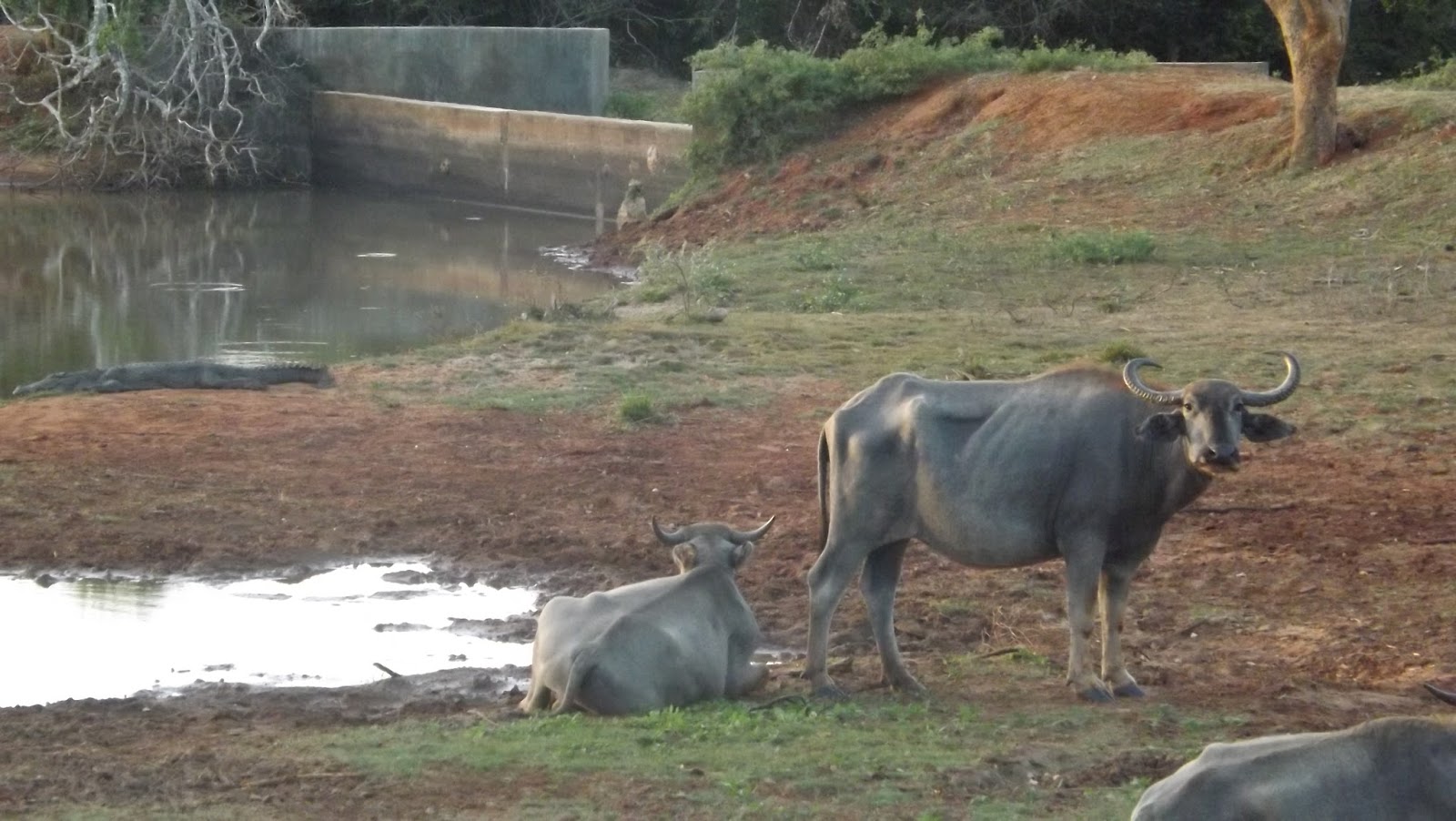
Water Buffalo with Marsh Crocodile behind

Green Bee Eater

Sri Lankan White Throated Kingfisher

Jungle Fowl


A monster emerged from the pond - Estuarine or Salt Water Crocodile
After having been lucky to see two leopards yesterday, guess who showed up this morning. With only about 50 of these creatures in the park some visitors never get to see them at all.

Sri Lankan Leopard
We then moved on to another water hole where the painted storks were taking advantage of the crocodiles driving the fish into the shallows. They were having their breakfast when we arrived, all the while keeping at least one eye on the crocodiles to make sure they didn't end up on the menu.

Sri Lankan Painted Stork having breakfast
Painted Stork trying to avoid being breakfast!!
Small Minavet


The beach area where the old resort was before the tsunami of 2004
 
Yala is right next to the Indian Ocean and was on the receiving end of the 2004 Tsunami.

The hotel we are in replaced the old complex destroyed in that disaster and we paid our respects at the beach side to the people who were killed that day, tourists and guides, just doing what we were.

I have personal memories of that Boxing Day holiday as my brother and his family were on a scuba diving holiday in Thailand at that time. I spent a long time on the phone to the British Embassy in Bangkok until we got a text from them the next day letting us know they were ok. They had been at sea when the wave passed and had only noticed a slight increase in the swell. Their resort and all their belongings were gone when they returned to shore.


Some of the "stars" from yesterday afternoon


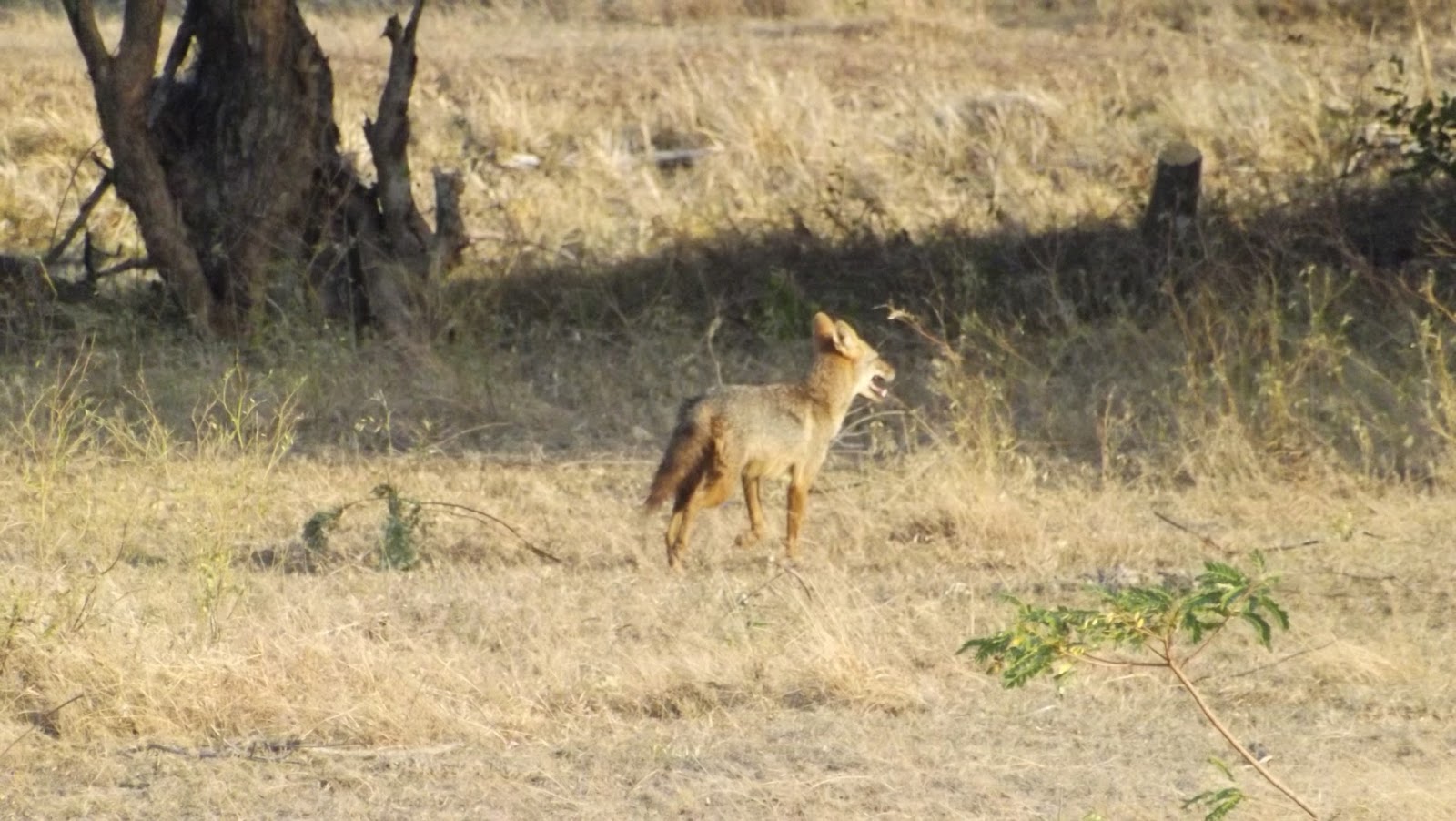
Sri Lankan or Southern Indian Jackal


Ruddy Mongoose

White-Bellied Sea Eagle


Land Monitor Lizard


Someone wants to cross the road now!!

So that concludes the Yala report, next post will be from the Maldives and it's back to the Napoleonic theme with some campaign and scenario thoughts I've been toying with.


Sunday, 11 August 2013

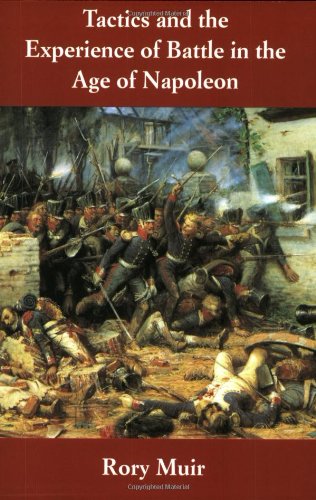
Tactics and the Experience of Battle in the Age of Napoleon - Rory Muir and Leopards!

It has been a busy time with our first week in Sri Lanka completed. We are on a tour of the island seeing all the major sites guided by our personal driver Rana.

Starting in Colombo we have travelled via Kandy to the National Park at Yala, taking in tea plantations and historic sites along the route. Some of our hotels have included some amazing buildings dating back to the days of the British Empire, having strong resemblance to Inverness and the Scottish highlands.

A rare sighting of two leopards we photographed today in Yala National Park - Sri Lanka

On the journey I have finished reading a book I had been dipping into over the previous two months and one I would highly recommend to any Napoleonic enthusiast.

 
Last summer I read Brent Nosworthy's "Battle Tactics of Napoleon and his Enemies" an equally good read and the two books complement each other in terms of understanding what Napoleonic warfare was all about.
 
 
I should start by saying that I like to read to inform my wargaming hobby. The recollections of veterans of the period help to bring to life this period in a vivid dramatic way, and books like these two attempt to capture those memoirs and use them to help illustrate and gain a better understanding of why the men and the armies acted in the way they did.
 
Rather than giving a full review, which has already been done by others since the book was first published in 1998, I thought I would share some of my notes that I made while reading Muir's book which I hope exemplify why I think this is such a good read, particularly for an historical wargamer. Obviously with my focus very much on the Peninsular War I took more notes referenced to that theatre, but I would stress that that is my selectivity, not Muir's.
 
One issue that many a Napoleonic wargamer has had to face is "how strong is a model battalion or regiment on average?" The question is rather similar to "how long is a piece of string?" I took these quotes from Muir regarding infantry and cavalry as a note to self when constructing my next fictitious Peninsula scenario or, as I am working on at present, a campaign module.


 "The basic tactical unit of infantry was the battalion, whose strength in battle ranged widely from fewer than 300 men to more than 1,200 but was most commonly between 500 and 700. At Salamanca the strongest British battalion was the 1/42nd with 1,079 all ranks; the weakest was the 2/44th with 251 all ranks. Of forty-four British and German battalions present (excluding some detachments), five had 800 or more of all ranks, and nine had fewer than 400 with the average strength being 572. Coincidentally a return of Marmont's army dated a week before the battle gives an average strength of 568 officers and men, but this is rather misleading - other battles would show a wider variation in the average strength of battalions in opposing armies, depending on the circumstances of the campaign."


On cavalry the following

"In the main theatre of operations -commonly the battlefields of central Europe, but extending as far west as France and Belgium and as far east as Moscow - cavalry generally amounted to between 10 and 20 per cent of an army's effective strength. In the Peninsula, especially after 1809, the figure was lower, between 5 and 15 per cent, although in each case there were exceptions in both directions."

 
"The nominal strength of cavalry regiments varied widely from army to army, and year to year, from fewer than 800 men to more than 1,500. The effective strength in battle was much lower, commonly averaging around 500 in central Europe, and between 300 and 400 in the Peninsula after 1809 - though these figures are only rough approximations. At Wagram Napoleon's strongest line regiment was the 9th Cuirassiers with 776 officers and men - but the Chasseurs a Cheval of the Imperial Guard had 1,109. His weakest independent unit seems to have been the single squadron of the Prince Albert Chevauleger - 142 officers and men - in the Saxon corps. Similarly, at Waterloo, Wellington's strongest regiment was the 3rd Hussars of the King's German Legion with 875 all ranks, and his weakest was the 2nd Life Guards with 265. By contrast, at Salamanca, Wellington's strongest regiment - 2nd Dragoons, King's German Legion - had only 407 officers and men, and the average strength of his ten regiments of British and German cavalry was only 354 all ranks, while his two regiments of Portuguese cavalry did not amount to 500 men between them." 
 
On cavalry tactics there is a great quote from Wellington on its best use.
 
"In 1816 Wellington explained in some detail his views about cavalry reserves in some instructions to the Army of Occupation in France. He emphasised the importance of reserves, whether to exploit success, cover the retreat after a failure, or even to convert a failure into a success by attacking the enemy when they were disordered. Ideally the reserve should amount to between half and two thirds of the cavalry involved in an operation, depending on the ground and the strength of the enemy. The second line of cavalry should be deployed in line, but the third line - if there were enough troops available to form a third line - might be in column. Ample intervals were to be left between lines when facing cavalry, so that if one line fell back in disorder it would not disrupt the line behind. Wellington stipulated 400 to 500 yards as a suitable interval, arguing that as the supporting cavalry could cover it in a little over a minute they could readily 'improve and secure any success' achieved by the first line. Against infantry and artillery, where there was less danger of a counter-attack, he suggested that the interval be reduced to 200 yards so that the second line could strike as soon as possible after the first. "

"He then addressed the perennial problem of how to contain the enthusiasm which swept British reserves into the charge with the first line:
 
so much in the cavalry depends upon the preservation of order in the second line or reserve, where the first charges, that more precautions ought to be taken to secure it. The rule should be, then, for the second line invariably to pull up to a walk when the first line charges, and in case of the failure of the charge, to continue at that pace till the first line will have passed through the intervals. In case the charge should be successful, the second line would then preserve its pace, and its settled distance of 450 yards from the first. If there should be a third line, it should follow the movement of the second, keeping its distance from it, till the second should become first, by the retreat of the first, and it should then act as above detailed for the second line."


On artillery, the ranges for observation will come in really useful when thinking about using hidden movement and blind markers to add the element of uncertainty.
 
"According to the Artillerist's Manual, 'Good eyesight recognises masses of troops at 1,700 yards: beyond this distance the glitter of arms may be observed. At 1,300 yards infantry may be distinguished from cavalry, and the movement of troops may be seen; the horses of cavalry are not, however, quite distinct but that the men are on horseback is clear. A single individual detached from the rest of the corps may be seen at 1,000 yards. . . ."
 
The firing data also makes interesting reading.
 
"When the target came within close range round-shot would be replaced by canister. Test results show canister being effective at quite absurd ranges: 600, 700 or even 800 yards. If it had been, why was it not used more often.? It amounted to only 15 to 30 per cent of the ammunition carried by artillery, and as the weapon of last resort would be the type of ammunition gunners made most sure they retained in reserve supply in case they were suddenly threatened. At Salamanca Dyneley waited until the French were within 300 yards before opening fire on them with canister; but his guns were light six-pounders, and heavier pieces would have had a longer effective range. It seems probable that canister was generally used at under 450 or 500 yards at most, but again there is too little evidence for certainty."

The snippets I have provided hopefully give you a flavour of the wealth of information the book has to offer and for the serious student of the period or the casual reader I would highly recommend getting a copy.

I hope you like the mixture of wildlife photography and historical gaming. The elephants seemed to generate a lot of interest in the last post, so I thought I would take it to another notch by illustrating one of the top predators in Sri Lanka. These big cats are difficult to see on their own in the wild, so to get two together was a real thrill. 


Monday, 5 August 2013

Keeping an eye out for future paint jobs

We arrived safely in Colombo, Sri Lanka on Sunday after a ten and a half hour flight and started our tour of the island today.

As we were driving to the Elephant Orphanage we saw these guys using the road we were on. A useful reference for future Pyrrhic paint jobs!