If you are an historical wargamer it likely has not passed your notice that this week marks the eightieth anniversary of the start of Operation Market Garden and the ill-fated Allied drive to Arnhem in the forlorn hope of ending the Second World War in Europe by Christmas 1944.
How often that has been heard in the annals of military history, 'it'll be all over by Christmas' and how many regrets have followed such a bold pronouncement?
There is not much celebrating registered on Dad's face on the 18th September 1944, as he sits in the drivers hatch of this Sherman OP tank of 55th Field Regiment, amid very happy Dutch residents of Eindhoven celebrating liberation from the Gestapo and Nazi occupation. He had lost good friends in this war, with his CO, Captain Wilfred Good, killed about a week or so before this picture was taken.
The anniversary this week, no doubt prompted by copious email promotions from several military book vendors advertising yet more new tomes analysing the campaign, not to mention numerous encouragements to build a collection for Bolt Action for Arnhem, brought back a lot of personal memories of time spent with my own Dad touring this part of Europe as a lad growing up in the seventies with only a minimal understanding of what experiences my father's generation had gone through; to a more mature me following the route of Guard's Armoured Division with my own family in 2017 as we visited the places so vividly captured by the army photography team that recorded the deadly progress of the Guards along what became known as 'Hell's Highway', for very good reason, via Eindhoven and Nijmegen.
The smouldering remains of knocked-out Guard's Shermans pushed to the side of the road as the advance to Eindhoven presses on.
In an era where modern generations will struggle to be able to tell you what D-Day was and it's implications for the modern world, it was important to me that both my sons had a thorough understanding about what their paternal grandparents went though and indeed a broader understanding of British history in general, so poorly taught in our educative establishments today.
Before and After, Eindhoven 2017 - 1944
Thus our tour from the Belgian border from Joe's Bridge to Eindhoven and later on up to Nijmegen is an experience I know they both recall very well, and our pilgrimage to Leopoldsburg Commonwealth War Cemetery to lay a family poppy and cross at Captain Good's grave emphasised the privilege that we enjoy in Western Europe having been free from war and tyranny for the last eighty years but that vigilance is needed always and the cost can be high when 'Good men do nothing'.
On the anniversary of our visit to Holland, Carolyn and I drove up to Cardiff to stay with Will and his girlfriend Ollie to enjoy some family time, walking, talking and eating, with a thoroughly enjoyable day exploring the coast from Ogmore on Sea to Dunraven Castle, coupled with glorious weather and scenery, and I reminded Will of our trip back then and the picture of his Grandpa taken eighty years previously to the day, and it was really great to pay our own respects to 'The Greatest Generation' as we were able to enjoy such a lovely day together.
Glorious weather out on the coastal path from Ogmore to Dunraven
Next up: I'm off to Clotted Lard this weekend to run a couple of games of Kiss Me, Hardy among other things, so an AAR of events to follow.
Will in front of the M4A4 Sherman Firefly, 2nd Armoured Battalion, Grenadier Guards, C Squadron in Hechtel, Belgium
I have toured quite a few battlefields in my time but it is quite a different experience when you are following in the footsteps of your father who did the real thing seventy-three years previously. Whilst being very familiar with the route, the plan and the many photos taken at the time, I of course have Dad's voice relating his own experiences echoing in my mind whilst travelling this former battlefield.
This trip was even more personal as, in the company of Carolyn, Tom and Will, we would not only follow the route taken by the Guards on the first day of Market Garden but aim to get a 'Then and Now' picture on the spot where Dad and his tank were pictured on the 18th September 1944 in Eindhoven amid cheering Dutch folk getting ready to party
Following our visit to CWG Leopoldsburg and paying our respects to the grave of Dad's CO, Captain Good;
we headed off up the road towards Hechtel, the Belgian town that was liberated by the Guards after a seven day battle with Falschirmjager (FJ) Regiment 20, together with a Luftwaffe training battalion and Panzerjager Battalion 559 equipped with Jagdpathers.
The bitter fighting to liberate Hechtel in the week preceding Market Garden cost the British forces 623 casualties. The German forces are reported to have lost 150 killed, 220 wounded and made prisoners and 500 unwounded prisoners. During the battle 35 Belgian civilians were murdered by German troops.
The move to capture Joe's Bridge - 10th September 1944
It was during this battle for Hechtel that on the evening of the 10th September the Irish Guards Group moved cross-country between Leopoldsburg and Hechtel and, in a daring attack, stormed and captured the canal bridge at De Groote Barrier on the Maas-Schelde Canal, later called Joe's Bridge after Lieutenant Colonel J.O.E Vandeleur, the CO of the Irish Guards battlegroup.
It was also on this day that General Montgomery had his plan for Operation Market Garden confirmed.
Jagdpather of Major Erich Sattler knocked out in Hechtel and now on display in the Imperial War Museum in London
My picture of Sattler's Jagdpanther taken a few years ago, with the damage easily recognisable in the picture below
From Hechtel we headed further on to Neerpelt and the nearby Scheldt-Meuse canal to search out the start-point for the Guards Armoured attack along what would later become known as 'Hell's Highway' via the bridge captured by the Irish Guards during the battle for Hechtel and christened Joe's Bridge after Irish Guards Colonel John Ormsby Evelyn Vandeleur, known to all as "Joe".
This is not an actual firefly, as the hull has a browning machine gun mounted and is possibly an ex Sherman bulldozer, former Belgian army range target.
The map below is from Richard Clarke's Highway to Hell mini-scenario for IABSM rules featured in the Lardies Summer Special 2013 and using a period map shows the road running up to Valkenswaard from Joe's Bridge with the positions of the forward German units holding the canal front at the start of the attack.
Incredibly and against German standing orders the road was the dividing line between the forward FJ Regiment 6 and Battalion Richter which would enable the Guards to get a good start up the road before encountering Battalion Kerutt.
Map by Richard Clarke for his Hell's Highway campaign showing the set up of German units before Joe's Bridge and the fact that the road was the unit boundary on the canal.
The Guards Armoured Division jumped off at 14;35 behind a rolling barrage from 300 guns and close air support from 100 Typhoons, so vividly captured in the film "A Bridge Too Far"
This massive concentration of artillery support consisted of ten field regiments, three medium regiments and one heavy regiment, contributing 240 25lbr guns, 48 4.5-inch and 5.5-inch guns and 4 155mm guns.
At 14:00 sharp, the massed artillery started a 20 minute preparatory bombardment on pre-arranged targets.
At 14:30 the heavy 4.2-inch mortars of 50th Division began firing on a few known enemy positions.
At 14:32 the field guns, then the mediums and heavies brought down a massive barrage 400 yards ahead of the front line and extending 1,000 yards on either side of the road, but avoiding the road itself so that craters would not impede the advance.
At 14.35, Z Hour the barrage began to roll slowly forward, lifting at 200 yards a minute.
25lbr Guns of the 55th Field Regiment open fire in support of Market Garden from Hechtel heath
These stills are of 55th Field Regiment's 25lbrs, pictured two days before the assault, on the heath between Lommel and Hechtel, that is now a firing range, in the most, for the modern day Belgian army.
I was hoping to get a picture of the heath but it is now a Belgian Army firing range so discretion came before valour.
To make up for not getting onto the heath, a Guards 25lbr on display at the Museumpark Bevrijdende Vleugels
Spearheading the attack on a one tank frontage was 3 Squadron, 2nd Armoured Battalion, Irish Guards.
To get into position the first tanks would have crossed here on this side road leading down to the river alongside the captured Joe's Bridge using a Class 40 Bailey bridge constructed by the Royal Engineers in the week before the attack.
The road from Hechtel leading up to the Bailey bridge at Joe's Bridge. The house with the grey roof and dormer windows is a veteran from 1944
Irish Guards, 3 Squadron tanks pass the house pictured above
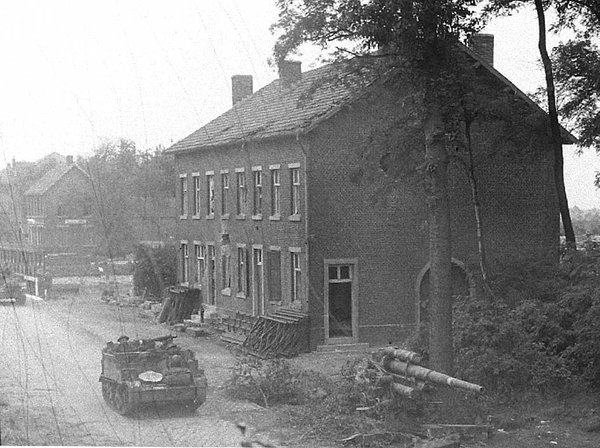
On the other side of the Class 40 Bailey bridge built alongside Joe's Bridge, A Guards Bren carrier passes a knocked out 88mm gun captured by the Guards during the fighting on the 10th September, beside another house that marks the position
Will, Carolyn and Tom on the position of the Bailey bridge alongside the bridge built in 1955 that replaced the 1936 bridge blown up by the Belgian army in 1940. The house seen in the picture above over Will's right shoulder
The road looking back towards Joe's Bridge
To quote Michael Caine " You don't know the worst. The bit we're on now, It's the wide part!"
At 14.35 as the barrage began to creep forward Lieutenant Keith Heathcote in the lead tank of the lead troop of No. 3 Squadron shouted into his microphone 'Driver - Advance'.
With their guns trained left and right, driving at 8 miles per hour the Shermans advanced.
Early casualties as the Irish Guards tanks became victims to roadside ambush
All went well for about ten minutes, then in the space of two minutes, nine tanks, the last three of No.3 Squadron and the first six of No.1 Squadron following behind, were hit in quick succession.
Travellers use the road today, many perhaps unaware of the events here seventy-three years ago
The first tanks to be hit were knocked out by German anti-tank guns that had survived the barrage and Lieutenant Finke's 'Panzerknacker' platoon firing panzerfausts from close range.
The nature of the close range fighting is captured in the picture below. Taken at great risk by Bill Warhurst of The Times, it shows Sergeant Roper's rearmost tank still smouldering from a Panzerfaust hit.
Further along the road on the left is the Sherman of Lance-Sergeant W. Smith also of No. 1 Troop, who escaped from his tank, jumping into the ditch close by, only to find himself attacked by a German soldier who he shot dead not without suffering five shots to his legs.
This picture shows the rearmost brewed-up Sherman, still smoking from the Panzerfaust hit. This particular tank was commanded by Lance-Sergeant Dave Roper of No. 1 Troop. Of the five man crew, Guardsman Bill Moore (wireless operator) was killed and Sergeant Roper and Guardsman A. Saunders (gunner) were wounded
The road to Valkenswaard (CWG cemetery is on the left) is extremely busy with only a few stopping points along the route
Farms like these in open ground along the road were 'brassed up' by tanks and strafed by rocket firing Typhoon fighter bombers
Just after the farm seen above the road into Valkenswaard crosses the bridge over the River Dommel. This small bridge that today's traffic pass over happily unconcerned caused a two hour delay to the advance of the Irish Guards as they reshuffled their lead elements to continue on into the town.
It was getting dark as the lead tanks rumbled into Valkenswaard and the only light was from burning buildings hit by Typhoon rockets and shelling.
No pictures were taken on their arrival as the Guards harboured on the town square with tanks covering the roads in.
The next morning the square appeared full to capacity with Guards Armoured vehicles and with the church of Holy Nicolass in the background gives a timeless comparison between today and events seventy three years previous.
Guards Armoured Division in Valkenswaard town square on the morning of the 18th September 1944
5th Guards Armoured Brigade HQ Sherman to left, 2nd Household Cavalry Regiment Recon scout car
and armoured cars to the right of picture
The Church of Holy Nicolass in the square in Valkenswaard is the same as in 1944, only the traffic is different
Just a few miles up the road from Valkenswaard lies the city of Eindhoven, the intended destination of the Guards on day one of the operation.
101st Airborne Division's landings north of Eindhoven CC BY-SA 3.0, https://commons.wikimedia.org/w/index.php?curid=169817
The city was entered by the 506th Parachute Infantry Regiment of the 101st Airborne Division at 09.00 on the 18th September and taken by noon that day overcoming the resistance of about a battalion of Germans acting as garrison.
The lead elements of the Household Cavalry reconnaissance teams made contact at about 12.30 that day but with the following British armour still five miles away setting out from Valkenswaard at 05.30 and battling their way through roadblocks the Guards did not reach Eindhoven until 18.30, halting that night at Son on the south side of the Wilhemina Canal while the Royal Engineers laid another Bailey bridge over the damaged highway bridge there.
Next day, 18th September 1944, after fighting through Valkenswaard and Alst the lead elements of Guards Armoured Division link up with US 101st Airborne and press on into the centre of Eindhoven. St Catherina Church acts as a good landmark for troops on the ground. These are 2nd Welsh Guards Cromwell tanks.
Being a bit pushed for time with so much to do and see, we veered of the 'Club' route taken by the Guards leading directly to the centre of town, and coming in from the west of town via the modern ring road headed for the landmark that is St. Catherina Church seen here in the pictures from the day.
With British tanks on the street the city goes wild with excitement at being firmly liberated and the party can begin.
Another Welsh Guards Cromwell tank followed by a carrier from 5th Coldstream Guards
St Catherina Church gave us an equally recognisable landmark, if the partying was a little subdued
The church was also our start point for finding our way to a very particular point on the progress of the Guards Armoured Division as close by in Rechtestraat was the place where, presumably my Dad as he is in the drivers hatch, parked the Sherman OP tank pictured below.
I first saw this picture in the early eighties in an Osprey title looking at Sherman tanks in British service and seeing the reference to Dad's unit showed it to him and he promptly identified it as 'our tank'.
Despite the party going on around, Dad stares straight ahead oblivious to the merriment around which seems curious until you realise that Captain Good was killed the week before.
OP Sherman Tank, C Troop, 55th Field Regiment, Guards Armoured Division,
Sergeant H.F. Jones pictured front-right, in the drivers hatch in Eindhoven
The tank is an Observation/Command tank with a dummy gun allowing in place of the gun breach a map roller and extra wireless sets.
The letters 'RC' seen above the unit tactical sign on the stowage box, front left of picture, indicates that this is the vehicle of the observation officer of 'C' Troop, and the Guards Armoured 'Open Eye' badge is visible on the right.
The unusual placement of a stowage box on the front hull, they were usually placed on the rear engine plate, was to allow the storage of extra radio antennae and a pair of cable reels.
Seventy-three years later it was great for Tom, myself and Will to stand on the same spot whilst a few bemused shoppers seemed rather curious why we should be so keen to have our picture taken in front of "Kidz040"; but apart from the change of the shop front, check out the windows above.
Before and After, Eindhoven 2017 - 1944
Tom, JJ & Will without an OP Sherman to hand
I think for me, the best thing to see was that Rechtestraat is now a busy thriving pedestrianised city centre shopping street, quite different from the cobbled street the ghosts of 1944 rumbled along and a fitting memorial to what the Allied forces were fighting for.
I know Dad would have been pleased to see the city today and I am sure it would have given him a greater perspective on the sacrifice made to see it that way.
A busy Rechtestraat, an open road in 1944 now a pedestrian shopping centre
Dad drives off up the Rechtestraat, Eindhoven, next stop Nijmegan with lots of 'unpleasantness' in between
This particular part of our holiday, along with visiting Captain Good's grave at Leopoldsburg, was a visit that will live long in the memory and made even more special to do it with Carolyn and the boys.
If you are interested in following the campaign of Market Garden then you really need a copy of the two volume publication, Operation Market Garden - Then and Now by Karel Margry which is invaluable for visiting these sights and understanding what went on and precisely where.
Much of the time-lines and detail has been taken from these two volumes and are treasured books along with their other publications in my own library.
In addition from a wargamers interest, I would also recommend getting Rich Clarke's 'Highway to Hell' mini-campaign that recreates the battle from Joe's Bridge to Valkenswaard on day one of Market Garden.
Our holiday to Holland this year has, as well as to enjoy the country and time to relax as a family, been an opportunity to make a pilgrimage I have intended to do for many years; which was to seek out the grave of my father's former commanding officer during his service in Normandy and Belgium prior to his death just before the launching of Operation Market Garden and the Arnhem Campaign.
Captain Wilfred Geoffrey Good is buried in Leopoldsburg War Cemetery, run and administered by the Commonwealth War Graves Commission who perform a magnificent role in maintaining this site and the others I have visited around the globe.
As you can see we left a poppy together with some words I read out and left and have shared here.
"Dear Captain Good, Sir we did not know you in life but have come to know you only from the accounts of my father Sergeant Herby Jones who served with you in the 55th Field Regiment, West Somerset Yeomanry, Royal Artillery, Guards Armoured Division, as part of the 21st Army of Liberation. Sparing his family the trauma of war, my father spoke little about his war service, but the little he shared with us, his children, always made mention of you and the high regard and deep affection he had for you and the great loss he obviously felt at your passing. I know that a tank crew, through their close shared living conditions and their shared fears in the face of battle became a very close knit family unit one to another. From his accounts it was obvious that you as the leader of your men in war encouraged a leadership and initiative in them with the warmth and good humour of a father and that is how he described you, as being a father to the crew. As a father myself I can now understand the great responsibility you carried and can only deeply respect the way you carried it out in the face of battle that I , thankfully, have never had to experience. I know he would have wanted you to know that your death was not in vain and that because of your sacrifice and the others in the Allied forces that laid down their lives in the fight to rid the world of Nazi fascism we, the generations that have followed, owe you a deep gratitude for having enjoyed over seventy years of peace, free of other world wars, living life in liberty and freedom. Speaking personally I would like to thank you for being the man my father so deeply respected and loved and to tell you that my family remember you also with a deep affection and have come here today to pay our respects and honour that memory. Rest in peace sir and thank you for your service and your life Jonathan and the Jones Family"
They shall not grow old, as we that are left grow old:
Age shall not weary them nor the years condemn.
At the going down of the sun and in the morning
We will remember them.
Note:
From September 7th to the 12th before Market Garden, Guards Armoured Division were involved in a vicious battle to liberate Hechtel in Belgium and the 55th Field Regiment were usually attached to the Welsh Guards who played a lead role in this battle.
It seems likely that Captain Good was a casualty in this battle that indirectly lead to the capture of "Joe's Bridge" by the Irish Guards, the start point for the 'Garden' part of Operation Market Garden on the 17th September 1944.
Perhaps like many children of parents who served in World War II I find, especially as I grow older, a growing interest to understand more about the experiences they went through; especially after having experienced all the emotions and feelings of the age they were then, but with perspective that being older brings.
In addition that generation were renowned for not talking too much about their experiences, many happy to forget and move on to what they hoped for, and a better period in their lives, bringing up families and helping to build a better world.
I have treasured memories of conversations with both my parents and indeed other family members who served during World War II but am always on the look out for other references that help to shed yet more light on what was an incredible time in world history.
My father, front-right in the OP Tank, C Troop, 55th Field Regiment, Royal Artillery (unit tacsign 74),
Guards Armoured Division in Eindhoven - the ever open eye can be just seen on the right of the front stowage box
I have many accounts and books covering World War II and quite a few covering the experiences of British veterans from most of the theatres, but have only three covering Guards Armoured Division (GAD), particularly.
The Divisional History was purchased in a second hand bookshop quite a few years ago now and is the basic tome that anyone interested in the activities of the division needs to read. In addition I still have my old Osprey Vanguard 9 title covering the history of the GAD by John Sandars. Alongside those histories, I have the personal reminiscences of Robert Boscawen's "Armoured Guardsmen" who served with the armoured 1st Battalion, Coldstream Guards.
So it was a pleasant surprise to discover a memoir by Brian Wilson, recently published in 2014, covering similar ground, but this time from the infantryman's perspective, being a former officer in the 3rd Battalion, Irish Guards.
The various regiments that composed the units of Guards Armoured Division and their tacsigns, as illustrated in the Osprey Vangaurd title
"The Ever Open Eye", the title for the book, references the Guards Armoured Divisional badge of the white eye on blue shield with a red border, designed by the artist Rex Whistler, who served with the division and was killed in Normandy.
The badge was worn as a sleeve emblem by all ranks and as a vehicle sign on the left front and rear of all vehicles.
The book is described by the author in his preface as "an account of a brief undistinguished part played as an infantrymen in North-West Europe in World War II. There are no heroics, no famous battles, and even less of the stirring exploits that enliven more dramatic stories. Instead it tries to portray the day to day life of an infantry platoon commander in the Guards Armoured Division...."
I don't think you should be taken in by this typically understated description common to many of the veterans of this era and with this, Brian Wilson's, account of his and his soldiers adventures as they spearheaded 21st Army's pursuit of the German forces out of France into the Netherlands, where his war was brought short by a very serious injury that had him back in "Blighty"before the Arnhem campaign had concluded.
He took the time to record his adventures early in 1945 as he focused on his recovery and the detail of that account served as the foundation to the book written so many years later.
The book follows a time line of events starting with the authors stalled final higher education, completing two terms at Oxford studying law and thus ensuring him a place to continue his studies post war, leaving in the summer of 1943 to join the army, attracted to the Irish Guards with both his parents hailing from Dublin.
Officer and basic training are covered with the young subaltern having to learn everything from basic soldiering, weapons skills and man management, to use the modern parlance; capped off with the typically British regimental peculiarities and customs which in the Irish Guards meant that second lieutenants were ignored in the officers mess until their first six months were up and they made lieutenant. This was a custom developed to instill in the young officers, many of whom were the sons of very important people, awareness that in the army it was military and not social rank that counted.
The book then plunges off into the war in Europe with the GAD joining the allied forces in Normandy in July 1944 and the young Lieutenant Wilson eventually joining the 3rd Irish Guards in a field close to the village of St Charles de Percy in reserve after being in battle the previous day. The cost to the battalion included the loss of the 2IC of No. 2 Company and their second platoon commander and so Wilson became the new second platoon CO and was soon in action in his first attack at Sourdeval.
What follows is a description of the plan of attack and how the plan soon changed on first contact with the enemy, providing a painful learning opportunity, with the added pain of finding out that the Monmouth and Norfolk battalion had put in a similar attack just previously and had suffered a similarly bloody repulse. The attack left Wilson with just four men from his original command and the overall losses to the battalion forced the amalgamation of two companies to provide the author with a full strength platoon. Twenty eight men were killed and sixty six wounded and Wilson never saw a German the whole of that day.
As well as the battle description and the sights and sounds of war, the human aspects are also covered in the descriptions of the daily interactions with the civilians encountered on the route through France, Belgium and Holland.
I know what an impression the welcome the GAD received from the liberated towns and cities they entered and that it left a life long memory on the soldiers, particularly in Brussels, which my Dad often talked about and where he returned post war to meet with the family that put him up during his brief stay in the city. The pictures I have of him in Eindhoven on the run up to Arnhem showed the welcome the British troops received, but I was particularly interested to read Wilson's description of the overwhelming enthusiasm, that seemed to provide the sound to the black and white pictures of the event some of which I first used when I covered the day describing Dad's War.
Brian Wilson's description of the drive into Eindhoven;
"It was the people of Eindhoven that really moved us. As they heard the approaching rumble of tanks, they poured forth in their thousands, shouting and yelling with joy. At first, we roared back lustily, blowing kisses. But the noise became so terrific that it was impossible to hear yourself speak. Above the clatter of tank tracks, the crowds screamed and bellowed. The long street was packed with people, jostling, pushing, waving, hysterical with happiness. Above their heads was a moving sea of waving handkerchiefs, hats, hands, little flags, streamers. No football crowd was ever like this, and I don't suppose any of us will ever see its like again. From windows and roofs, flags hung down, people leaned perilously out, their mouths moving, but inaudible."
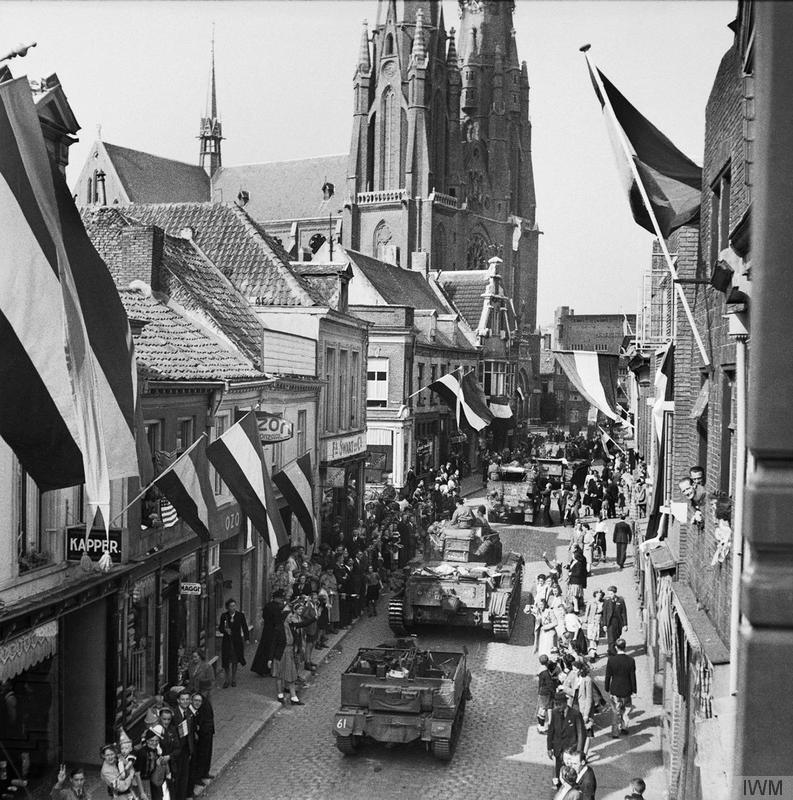
Guards Armoured Division make their way through the happy crowds in Eindhoven, with a carrier from the 5th Coldstream Guards closest to camera (Unit tacsign 61)
"Down the centre of the street ran a narrow clear lane bordered by a heaving mass of people that swelled out in the gaps between tanks and contracted before the next tank approached. The crowds were so close that we could lean down and touch the waving hands. It was a marvel that the tank drivers, down to a snail's pace, managed to keep so straight a path without running over anyone. Little boys leaned out from the lower levels of the crowed and occasionally darted across the road to debatable safety."
Dad's tank makes its way out of Eindhoven, up the bitterly contested road to Nijmegan, during the Arnhem campaign
It was just after the fall of Nijmegan to the Grenadier Guards that Wilson suffered his wounding, that led to his eventual repatriation and a long painful road to recovery. I was really interested to read about his experience of the medical services and the lumps of shrapnel that were left in place to be carried for the rest of his days. My Dad carried two grey shadows under the skin of one of his calf muscles, the shrapnel, possibly remains of the mortar bomb that blinded and eventually killed the much loved CO of his tank.
I know from my Dad and the other members of GAD I have spoken to all felt that the Arnhem campaign could have ended quite differently and their frustration at falling short was clear to hear from their accounts of the bitter fighting up the narrow road to Nijmegan and beyond. Brian Wilson concludes his book by looking at what he considered were some of the key failings in the higher commanders and their decisions that effectively caused the failure of the mission. I cannot say I was surprised and they all had a compelling logic that probably doomed the mission from the start.
This is not a long book, just short of two-hundred pages, with six photographs pertinent to the text, with one very good view of the sunken lane at Sourdeval where the Irish Guards attack came to grief. There are also three maps, one showing the area of operations in Normandy at the time described, another, the attack plan at Sourdeval and a simple map of the route to Arnhem showing the position of the start point at Joe's Bridge.
I found it very readable and informative and doing what the best of these kind of military memoirs should do, namely to put the reader into the time and events described, without having to be concerned about the bullets and shells. A very welcome addition to the history of Guards Armoured Division.
I picked up my paperback copy from The Book Depository via Amazon for just £4.79
Armoured Guardsmen - Robert Boscawen
The Story of the Guards Armoured Division 1941-1945 - Rosse and Hill
British Guards Armoured Division 1941-45 - John Sandars, Osprey
"The first radio contact between the Americans and a patrol of the Guards Armoured Division is made at 11.15hrs and they make physical contact in Woensel at about 12.15hrs. In the late afternoon the army arrives in the southern outskirts of Eindhoven"
"The vanguard of the Guards Armoured Division entered Eindhoven at midday; the main force did not arrive until late afternoon. It was in Eindhoven that the advance was inadvertently hindered by the local Dutch people, who blocked all the streets as they celebrated their liberation".
Dad, pictured front right in the drivers hatch, looking very serious despite the joy of the Dutch. An official from PAN, with the armband oversees the crowd. Note the pennant next to Dad indicating this is the Commander Q Battery. The Markings on the toolbox, front hull RC74 are the arm of service marking, and the Guards Armoured Eye badge is visible below the spare bogey wheel. I wonder if Dad had that placed for when he was driving?
I have on my mantelpiece an original, of what has become quite a well known, picture of an OP tank operated by the Guards Armoured Division during Operation Market Garden. The picture with another of the same vehicle driving off through Eindhoven are held in the archive of the Imperial War Museum, here in the UK. It has an official caption detailing the unit and where the picture was taken.
However there is a further story behind this picture that the Imperial War Museum don't have recorded together with the name of the Sergeant (his tapes are just visible on the bent right arm) pictured in the drivers hatch. That man is my Dad.
In 1943 my Dad, Herbert (Herby) Jones, volunteered for service in the Army and was recruited into the Royal Artillery, joining the 55th Field Regiment, West Somerset Yeomanry, part of the newly formed Guards Armoured Division.
He joined the crew of an Observation Post (OP) tank and started his training in old Valentine Infantry tanks learning the vital role as an observer for the field guns he would be directing in action . I was able to see a Valentine in running mode at an open day at Bovington Tank museum. When I explained my interest to the driver, I got a close up inspection of the interior. The tank was primitive, with cables running through and below the turret step and the minimal of crew comforts. No wonder Dad was so happy when they were issued their new Sherman Vs. He always said that the Sherman would never break down and was totally reliable and that they were more manoeuvrable and faster than their German opponents.
In June 1944, two weeks after D-Day, Dad was part of a forward party that prepared for the landing of the whole of Guards Armoured Division in July and their subsequent baptism of fire during Operations Goodwood and Bluecoat.
I was able to speak to a former subaltern, Dr Tony Bailey, who had commanded a troop of four (Sexton) Self Propelled guns with the 155th Field Regiment, Liecestershire Yeomanry, the sister regiment in Guards Armoured. When I showed him the picture of Dad in Eindhoven, he shook his head knowingly and said what a brave bunch of chaps the OPs were. His regiment lost six OPs in Normandy. He went on to say that one minute you would be scribbling down co-ordinates, and the next it would be just a hissing static as the radio went dead.
Dad (centre) with mates guarding the rations!
Dad, like many of his generation, didn't talk a lot about the war. They were a generation for whom it was considered "bad form" to spend time talking about ones exploits. My childhood memories were of family holidays to the continent, and I remember snippets of Dad's remarks as we drove over the open fields above the old Colombelle steel works near Caen. He remarked about what a bad time they had had in those open fields, with me not really understanding then what I know now.
We were looking at the killing fields of Normandy and the charge of the armoured divisions during Goodwood. The casualties were much less than the Epsom offensive a few weeks before, but the "tankies" paid a high price for the ground they gained in those July days in 1944.
Another memory is of standing with my younger sister and having Dad point to a railway road crossing and explaining that they had had a big battle with a very large German tank on that very crossing. I researched that battle with the help of the Guards Armoured official history and knowing the area was close to Leopoldsburg read about the fierce fighting that occurred there and that Dad's CO and boss on the tank was killed there in that fighting about a week before the photo in Eindhoven was taken.
Captain Wilfred Good was loved by all his men and Dad took his loss greatly, which might explain the very serious looking young man in the picture. I discovered his grave on the Commonwealth War Graves site and remembered that Dad said he was like a father figure to the crew and was greatly missed.
25lbr Field Guns of the 55th Field Regiment, West Somerset Yeomanry, Royal Artillery
The 55th in action
From the fierce fighting in Normandy the Guards were in the vanguard of the "Great Swan" as the pursuit of the German Army into Belgium became known to British troops. The Germans were chased up to and out of Brussels. The advance was rapid and in great contrast to France where the smaller gains of territory was slow and often at great cost. The veterans of Guards Armoured always remark about the welcome they received from the Belgian people and the city of Brussels in particular. Dad stayed with a family there and I remember going to visit them briefly in the 70s.
The tank Dad is pictured on is an OP version of the Sherman V and is armed with nothing more than two fixed machine guns. That fearsome looking 75mm main gun is in fact a section of telegraph pole. I found these pictures, somewhat revealing, of a similar vehicle, used by 7th Armoured Division, knocked out in Villers Bocage during Micheal Wittman's famous attack. The fake gun can be seen lying in front of the vehicle next to the blown off gun mantlet. The blackened hole to the left of the gun aperture testimony to what an 88mm AP round from a Tiger could do to these tanks.
An OP tank on 7th Armoured Division, knocked out in Villers Bocage
The same tank close up with the knocked of telegraph pole gun!
An illustration showing the map scrolls that filled the turret of an OP tank instead of the normal breach of a 75mm or 17lbr gun.
The picture in Eindhoven brings the story up to the 18th of September 1944, and was only identified when, in the early 80's, I happened to show Dad the Osprey book the picture was in, highlighting the fact that it was of Dad's unit. Imagine his and my amazement when he exclaimed, "that's our tank!" I suddenly realised who was staring out at me from the pages of history.
When the film "A Bridge too Far" came out Dad was able to see the part his unit played in a very famous campaign recreated on the big screen. He seemed quite impressed with the level of detail, particularly in the recreation of the initial attack up "that road". The most memorable part of that film for me is when Micheal Caine, playing Lieutenant Colonel J.O.E. Vandeleur orders the advance to begin and, as I think of them, the towed 25lbrs of the 55th Field Regiment commence the creeping barrage that led off the attack.
Order of Battle - Guards Armoured Division. Under the Commander Royal Artillery (third column) you can see the 74 over a Red over Blue square arm of service badge seen of the front of Dads tank.
Joe's Bridge where the run up to Eindhoven started on the 17th September.
Thankfully Dad survived the physical and mental hazards of war and married mum in 1948, she too having an interesting wartime experience after volunteering for service in the W.A.A.F. Her experiences are covered in a posting to the BBC WW2 People's War site. http://www.bbc.co.uk/history/ww2peopleswar/stories/70/a2864270.shtml
After a successful career in sales he later retired to Devon, passing away in 2003.
Mum and Dad in happier days after the war
Needless to say, when I field my Guards Armoured Battle-group and an OP is required the OP Tank with the Captain and Sergeant reconnoitring ahead should now need no introduction. However I made this model a few years ago, and I now see I need to add the obligatory muzzle cover!