Showing posts with label Painting. Show all posts

Sunday, 22 May 2016

Aesthetics in Wargames - Another Aunt Sally?

JJ's Roman's - terrorise not only the Dacian's but some wargamers from getting involved in the hobby- really?
Every now and then "JJ's Wargames" likes to go off on one and start a debate rolling on a theme that is common to most of us in the hobby. Recent examples included the loss and retention of the painting mojo, which seemed to strike a chord with many.

http://jjwargames.blogspot.co.uk/2015/10/the-perennial-problem-how-to-avoid.html

Painting and modelling is an important aspect of our hobby, otherwise we would likely be solely board gamers, and JJ's has always been a blog keen to support other like minds that enjoy that aspect.

Therefore I felt the need to respond to an article by Arthur Harman in June's, Miniature Wargames magazine entitled 'The look of the thing, Artistic licence in wargaming'

Firstly I think I should explain the expression of making the subject of debate an "Aunt Sally" which may not be a term familiar to all, certainly outside the UK. The definition of the expression is as follows.

Definition of Aunt Sally:
a game played in some parts of Britain in which players throw sticks or balls at a wooden dummy.
• a dummy used in the game of Aunt Sally. plural noun: Aunt Sallies
• a person or thing set up as an easy target for criticism. "today's landowner is everyone's Aunt Sally"

I was really surprised to read the article by Arthur Harman in Miniature Wargames magazine, that posed the question;
"whether aesthetics should be allowed to dominate  our enjoyment of a wargame, or deter us from getting stuck in. Is our terror of the roving photographer or blogger to blame?"

I have heard and seen the odd comment that there is a body of opinion that supports this proposition and had always thought it to be a very outlandish idea, and not likely to be taken seriously in the mainstream of the hobby, perhaps I was wrong. If that is the case then I think this idea needs challenging.

As you can see the question has two parts to its proposition:
  • firstly it rather presupposes that the reader agrees that aesthetics already dominates our enjoyment of the hobby.
  • and secondly suggests that we are terrorised by the "wargames fashionistas" who will come and make us feel bad about ourselves because we can't live up to the "Aunt Sally" of aesthetic perfection that it suggests we are all in pursuit of.

Really? The thought that anyone could allow themselves and their approach to their hobby to be directed by what others deemed to be a requirement to take part, I find quite bizarre. I personally wouldn't give anyone the right to make me feel that way and I don't know anyone in the circle of gamers I play with who would. Perhaps this thinking is a symptom of the modern fashion of games systems requiring everyone to use the same rules and figures in the same way, waiting for pronouncements on high as to what the "same way" is.

After reading the question and giving it some consideration my curiosity was fired and I pressed on into the article, which went on to quote Neil Shuck;
"Miniature Wargaming ..... is actually quite a complex hobby..... it's not just about the wargame rules and game, but about collecting, assembling and painting model soldiers...." and that "it could be weeks (or indeed months or even years) before an army is painted and ready to put into the field of battle. This is a huge hurdle, and has surely put off untold numbers of would-be wargamers due to large commitment of time, resources and skills required..."

The author then agrees with Neil Shuck's quote stating that he could think of many campaigns or periods not embarked upon for this reason.

So again let's think about the implications covered in the quote;
  • Miniature Wargaming is quite a complex hobby
  • It can be time/finance consuming, building a collection of figures
  • The skills required and the commitment to complete a given project could put players off from getting involved in the first place.
If we replaced the words "Miniature Wargaming", with "Radio Controlled Model Aircraft building" or "Piano playing" or "Horse Riding" or "Deep Sea Fishing" or dare I say "Model Railway Collecting", those criticisms could be levelled at lots of hobbies some a lot more complex, time/finance consuming and skill set requiring than ours.

Come on chaps, if we are as passionate, as I know from the comments received on this blog that many of us wargamers are, about our hobby, we don't care about the little list of "asks" that wargaming might demand of us to build the collection and run the games we want to play, because we can't help ourselves, we love it and we will move hell and high water to do what we want to do; even if that means learning the modelling skills, rule sets, finding the resources and time and building friendships with like-minded folk who want to play the games we do, and by our example bringing others into this great hobby.

An early 19thC aquatint that is recommended as the inspiration for our games
The web and magazines are full of articles and information out there to help us in our pursuit of wargaming nirvana, something older generations (I include myself) really appreciate as no such quantity of resource existed when we started in the hobby. From my experience there are lots of people out there happy to share their skills and encouragement to help bring new people into it and there has never been a better time to get involved, with the figure ranges, terrain options and great painting/modelling resources available. 

This blog like many others is dedicated to encouraging others to get involved in wargaming at whatever level they choose to, but not afraid to also encourage the pursuit of aesthetics in it as well; and I felt impelled to answer the criticism implied in the article and to offer a much more positive slant than the diagnosis and prescription that followed of rejecting the production of great looking games and collections in favour of the alternative and returning to bare based figures, functional terrain with contour stepped hills and figures all in the same pose. 

Hey, if the latter approach does it for you, you will not hear or read any criticism from this blog, each to their own as I have already stated, but conversely don't expect any support for the idea that great aesthetics in wargames puts people off from getting involved, if anything I believe the reverse is more true. 

I would not have been attracted into wargaming if all the books on the subject in the mid seventies had been in the style of Don Featherstone (God bless him) and Tony Bath with the functional looking games they produced. It was Peter Gilder and his fantastic looking games, that I had no hope of recreating at the time, that fired my enthusiasm and set the goal to emulate. I have memories of the frustration of not being able to get my games to look that good, but also the desire to get better and add to my skills.

That said I carried several Don Featherstone tomes around with me for months re-reading the text rather than admiring the pictures, which I rejected as being what the game should look like for me. Note these statements are personal, and I don't expect others to feel the same way, but likewise I don't think we should allow others to determine how we feel about our hobby and the way we want to do it.

A JJ's version of an early 19thC aquatint
I think the picture of the hobby that is presented to the wider world is important to attracting more people into it and I think the best aesthetically looking collections and games go a huge way to doing that, but also the need to present what wargaming has always been, namely a welcoming, encouraging, supportive community of hobbyists producing great variation on the theme.

I don't think we should buy into the negative way of thinking that says excellence puts undue pressure on individuals to live up to - rubbish! We only put pressure on ourselves if we decide to think that way and a more positive way to think is that I will play the games I want to in my way with people who also enjoy a similar approach and I will decide what I consider excellent and what I want to emulate/copy into my own games.

In addition I don't want to buy in to the mantra of "I can't".
I can't paint, I can't find the time, I can't not help feeling pressurised by others. If you think like that then you are right, you can't. But the good news is that you don't have to think that way.

I regularly hear people on pod-casts saying they can't paint and some even being proud that they can't and don't paint despite being their to promote a hobby that would suggest a modicum of painting being required. 

We don't play board games we play tabletop games with figures and terrain, most of us for the aesthetics of picturing our warrior units in action and performing the heroic deeds we have read about. I say most of us, because Arthur Harman states that he finds the use of figures more as an aid memoir as to what the unit is, although I am not totally convinced when he states that he wouldn't use counters from board games because the counters do not allow him to get "emotionally involved"

The use of the phrase"emotionally involved" is revealing and suggests that the figures in the wargame are more than just fancy game markers as suggested and I don't really buy the idea of producing armies that model the stylised early nineteenth century engravings of William Heath as the justification for ignoring the painting ideas of greats such as Kevin Dallimore.

Kevin Dallimore's step wise approach to painting illustrated in his books, enable and allow wargamers to produce, good, very good or collector standard units of figures depending on what they want to achieve and the level of input they are prepared to make.

Kevin Dallimore has done a lot to help and
encourage great painting to all standards
If I were to make one suggestion that might chime with this "can't paint, won't paint" agenda it would be the rise of the painting competition. Like it's near neighbour the wargame competition, the mere thought leaves me cold and its development in the hobby might explain why some of our fellow hobbyists feel under pressure to perform.

I spend my professional life in competition and the last thing I am looking for in my hobby is more competition; again whatever floats your boat is fine by me, this is just my opinion. I have no interest in competing in wargaming or wargame painting and in the latter I go out of my way in not making judgements about others styles and techniques, with the exception of commenting on professional painting examples in commercial products such as books being sold to wargamers, where I feel it is open to comment in review.

Competition is seeping into many so called hobbies and pastimes. We have TV shows with baking competitions, cookery competitions, singing competitions, activities that many of us considered as worthy of merit purely for the doing rather than being better at than others based on someone else's opinion. This, I think, has probably encouraged a generation of self appointed judges, ready to raise up or put down the efforts of others whether they had decided to be in a competition or not.

In my local club, we have many and different standards of painted collections. The only club rule is that figures brought to it have to be painted and ready to play, ie no "silver surfers". As a club, we enjoy sharing modelling and painting ideas and the games we produce have, I think, got better over the years as we all have improved our skills by sharing and supporting each other. There is no competition, only a desire to produce nice looking games and collections and have fun with our great hobby away from the requirements of our professional lives. Club participants are encouraged to get involved in all aspects of the hobby and we can boast some fine collections within the group which has a well defined spirit of independent thought typical of this part of the UK since the Prayer Book Rebellion of 1549 and before. 

The point is none of us feel controlled by the hobby and are able to make space for all types and levels of games from the simple to the excellent and that approach has, like a rising tide, raised all boats by enabling us as a club to produce more and more aesthetically pleasing games.

So in summary, ignore the "can't paint, won't paint" agenda and embrace all aspects of the hobby in a spirit of getting the most out of it for you as an individual and don't feel you have to go about it according to the "wargame fashionistas" and what they think, say or are able to do.

Importantly, don't surrender to an apathy of I can never produce the games I would like to, so I'm going to tell everyone I don't care. The fact is if someone has already done something then you can to and it then comes down to what you really want and what you are prepared to commit to achieve it, and there are loads of people and resources out there to help.

Happy Wargaming

Saturday, 21 November 2015

British Infantry Painting Tutorial - PDF


As with the French Line infantry Painting Tutorial, I have captured the key stuff in an easy to reference PDF that will be handy if, like me, you keep a lot of this stuff on a tablet for easy reference. Even if you don't use a tablet, then this should be easier than constantly referring back to the blog.

Just look under My Resources and Downloads in the right column for the link.
Enjoy, and good painting.

Wednesday, 18 November 2015

British Line Infantry Painting Tutorial - Part Three

The Victrix illustration shows the shading
approach I want in the final look
British Line Infantry Painting Tutorial Part One

British Line Infantry Painting Tutorial Part Two

Finally the final stage where by adding a small amount of a lighter shade we can achieve greater depth to the colour already applied and help accentuate the detail on an 18mm figure that can start to compete with a larger scale.


I tend to differentiate the better quality jackets on my officers versus the ordinary ranks by using a not quite so orange option in "Vallejo Scarlet".


To accentuate the  roundness of the water canteens I tend to just apply the Vallejo Pastel Blue just to the inner disc, leaver the darker blues around the edge


The Dark Grey can really accentuate the lines of the black equipment and give it a worn appearance. As you can see the other shades and the matt varnish have removed the sheen from the Humbrol base coat.


Use of gold and silver can add brightness to the metal work, and I like to make Shako plates, bayonets and cross belt plates "sing out" a bit.


So that's the 61st Foot completed. I just need to get them based up and then we can have a look at the battalion ready for battle and a bit about its history.


One thing I have noticed that I will touch up prior to basing, and no prizes for those who spotted it, is to add a bit of "Vajello Silver to the top edges of the officers collars and a little for the cuff lace.

As with the French, I will capture this information in a follow up PDF.

Monday, 16 November 2015

British Line Infantry Painting Tutorial - Part Two

Officers of the 31st Foot at Albuera, a similarly buff faced silver laced regiment to the 61st.
Note the buff cross belts and turn-backs seen sported instead of the usual white. 
British Line Infantry Painting Tutorial Part One

So on with part two of this three part tutorial and on with the first highlight. As a reminder, the colour manufacturer code is VJ = Vallejo, CD = Coat d'Arms, H = Humbrol, CT = Citadel. Oh and by the way you've just got to love the names of the new Citadel range, I mean "Pink Horror" and "Emperor's Child", really?

As I mentioned in the tutorial on French infantry, the brush you use is critical in getting the best results and you really do need a brush that will hold its tip in spite of the thrashing it will get over time. You can check out my recommendation here,

http://jjwargames.blogspot.co.uk/2013/04/tamiyas-small-pointed-brush-update.html

This need for a good brush is illustrated in the first highlight I tend to apply which is the Citadel Kislev Flesh. These AB figures have exquisite detail and with careful application you can highlight above the top lip under the nose to bring out that detail - only with a good brush.


One thing I didn't include in the block work from part one, put it down to my age, is the Coat d'Arm Dark Grey applied to the musket slings, which I applied after I had written up the post. I tend to highlight the white lace areas and white straps with Vajello Ivory, and you will see I have started to so the back packs and musket slings, bit have left off the jacket lace. This is because I want to apply the third highlight to the tunic before adding the lace.

Likewise on the Colonel's jacket there is a great set of silver buttons to highlight but I will do those last.


Just with the first basic highlights you can see the depth created to the colours, particularly the black items, shako, back pack, ammunition pouch, scabbards and boots. I often see requests from people to find a good colour to highlight black and the Vajello Dark Sea Blue is a perfect first option.

Remember a highlight is just that and we are not looking to cover up the original base colour but accentuate the top surface where the light strikes and draws the eye to it.


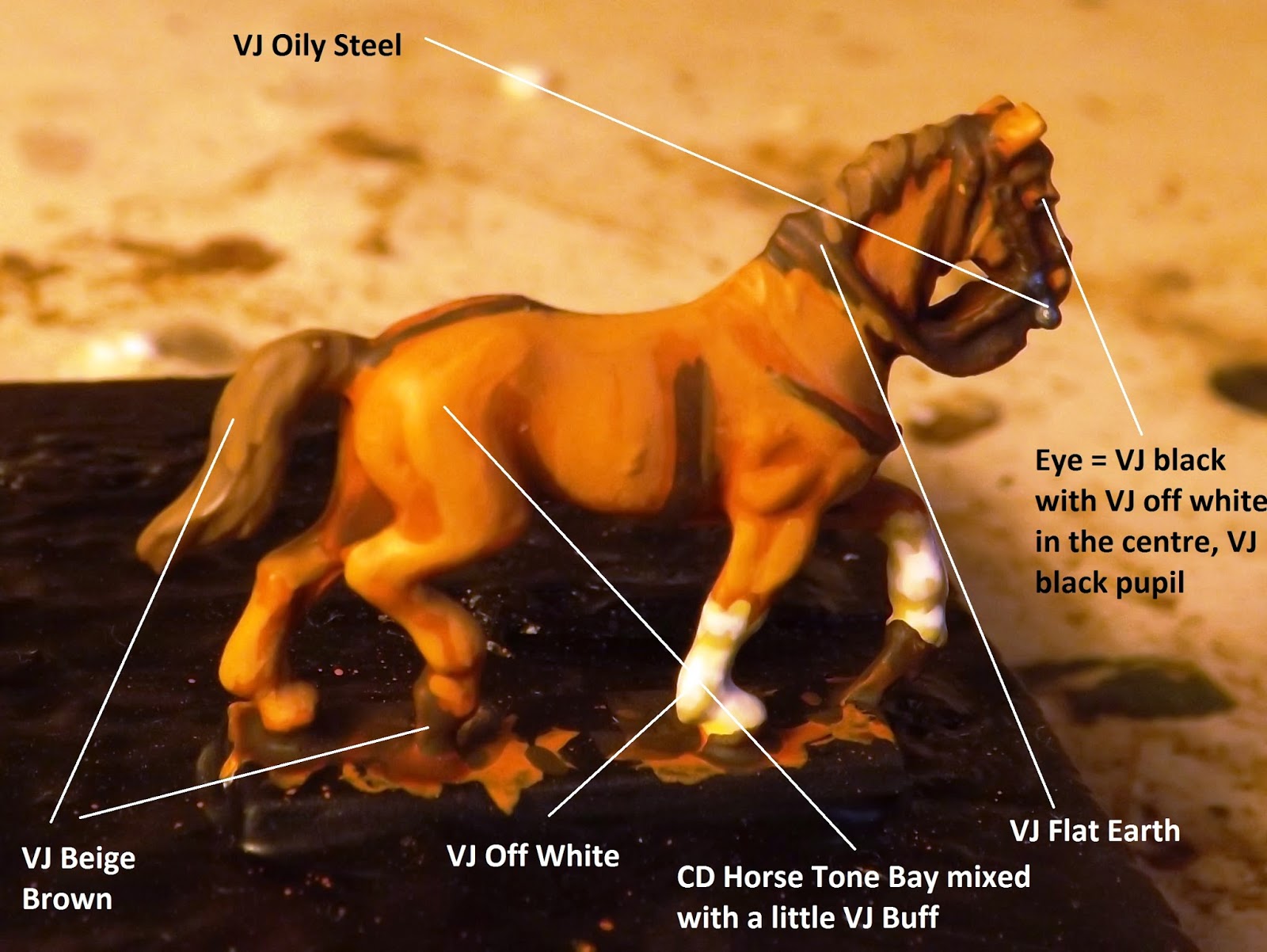
I am quite pleased with the horse tone and wash and think it does produce a lighter effect. I think I will experiment with different shades of wash just to see what the potential is.


I have just noticed that I could have done the straps on the Colonels saddle roll, but will pick it up on the third highlight phase.

So there we are, next up it's time to make these chaps pop and come alive with a third and final colour choice.

Friday, 13 November 2015

British Line Infantry Painting Tutorial - Part One

So, as promised, a series of posts to illustrate the way I go about painting British line infantry, in the form of a tutorial as with the previous post on French line infantry. 


Both these types are liable to form the bulk of any Peninsular War collection and so will probably be the most useful reference. As with the French tutorial I will capture the information in a more user friendly PDF for download at the end.

First thing to say is that I am illustrating a Buff faced battalion here, which in common with most similarly faced regiments would tend to have buff coloured turn-backs and additionally cross-belts and trousers, particularly for parade or best wear. I am of the opinion that campaign conditions would have probably caused trousers to become the normal "hotch potch" arrangement, but that cross-belts would have more likely to have been buff than the more common white seen worn by other facing colour regiments. I will provide alternative colour arrangements for regiments with white accoutrements as we go.

The next thing to say is I like to experiment with different ideas and colours, and for this work I picked up one of the new Humbrol acrylic matt black to try out against my trusty Vallejo. I have been away for a week and thinking I had prepared the black ready to use noticed the glossiness on drying.

Humbrol black needs a really thorough stirring to overcome this tendency and explains a slight sheen on some of the models prior to me spotting it and rectifying the problem. I will deal with it as we go and I don't think it is a major problem and needless to say it will be back to Vallejo for me in future.


So the first of the three stages requires a block painting job and the models illustrate the basic colours so applied. The code is VJ = Vallejo, CD = Coat d'Arms, H = Humbrol, CT = Citadel

The battalion I am working on is the 61st Foot with buff facings and silver lace. My principle reference for the uniform details is Franklin's "British Napoleonic Uniforms".


Most of the colour choices should be fairly obvious and so I have not duplicated them across all the pictures, save to say that British drums tended to have a panel on the front in the battalion facing colour with an appropriate coat of arms, with the rest of the drum in a varnished wood. Thus I have done my drum with the mid stone to the front and chocolate brown to the rear parts with a dark grey applied to the chords.


Note this stage is a basic block painting step and thus I have not picked out certain straps, lace and buttons with a base shade yet, preferring to leave them until after highlighting the bulk of the uniform. I just prefer doing it that way.


Again I am experimenting with different ideas, one of which is to prepare my horses using the Citadel washes to see if I can achieve a lighter shading overall.


So if I was working on a non buff faced regiment, turn-backs and belts would be Vallejo buff for the base coat.


So there we have the basics done, and next I will apply the first highlight colours. If you have any questions on the work, just drop me a comment.

Wednesday, 28 October 2015

The Perennial Problem - How to avoid Painters Block or Lost Mojo


I was inspired to post some thoughts after reading Henry Hyde's post this week discussing the perennial problem of "lost mojo" or as I would describe it "painters block".

http://henrys-wargaming.co.uk/?p=2334

Just like in any artistic pursuit, writing, composing or painting we are all susceptible to self doubt, disillusion and a total lack of enthusiasm about something that many of us would consider a passion. I don't use the word passion lightly, I even include it in the title of my blog; and it is probably worth considering what that word describes

https://www.google.co.uk/webhp?sourceid=chrome-instant&ion=1&espv=2&ie=UTF-8#q=passion+definition

Most definitions talk about a strong and barely controllable emotion, or an intense desire or enthusiasm, and if the mountain of lead most of us have stashed together with all those new and shiny models that we just had to have is any indication, intense desire pretty well defines a big part of our hobby, or as my wife would say "little boys and their toys". Still, I like to nurture the little boy and reward his playful nature now and then, but am conscious that he lacks discipline and self control that the adult me has to apply now and then when I feel his pester power at work and his gnat like powers of concentration.

I think there lies the issue when it comes to applying ourselves to a commitment to work at something that can take time and very often frustrate the hell out of that little boy, or little girl, in all of us. Let's not forget that our hobby is about having fun. We all of us spend a lot of time, often at work, often doing what we need to do to put food on the table, but our hobby is different and it is there to meet the other needs in our life and I would suggest if fun is not part of that equation then we need to find something else to do with that precious time.

Regular followers of the blog will know that I am a keen advocate of the painting aspect of our hobby in the full and respectful knowledge that not everyone is. However given that our hobby requires painted miniatures in one form or another, otherwise we would just go and play board games, it rather seems to me that we have to engage with this aspect of the hobby in one form or another. Of course we could just pay someone else to paint our figures and if the funds are available, why not? However I guess, like many of us, funds are finite and money spent on paying for painting can't be spent on building the collection; and like Henry, I and many others are of that school that thrills in the painting and bringing to the table a collection of figures that carries our signature of turning them from exquisite fishing weights into painted metal warriors. In addition, if we want to play big games with lots of figures, and Napoleonics definitely falls into that category, we will probably need to get painting.

If we don't get control of this strong emotion, the frustration at lack of progress can at best see months slip by with little momentum and having to relearn lost skills and knowledge when we finally get back to it or at worst leaving the hobby and trying to distract oneself with a substitute only to never completely lose the bug and wind up coming back to our first love many years later often doomed to make the same mistakes as before. We all know friends who have had that experience.

The recently completed 54e Ligne three battalions of a twenty four battalion project and no time for block!
I was interested to see that given the time constraints Henry faced with all his other "plates to spin" activities he had come to the conclusion that binge painting was not the answer to overcoming the reluctance to sit down and paint and to get a project done in a few days of full on commitment. His diagnosis of "a little and often" chimes well with my own thoughts, in that given, as stated in my preamble, we are dealing with a very powerful emotive desire, the pursuit of our hobby and its goals requires discipline and good habit forming, not seemingly quick fixes.

I would totally endorse the practice of getting into the habit of putting in an amount of time we can commit to on a regular basis to paint. That could be half an hour three times a week or an hour and a half every evening, time permitting, whatever fits our schedule. The key is to keep doing it until it becomes a habit, and the manual suggests that it takes about a month of repeat behaviour to form a new habit. Bad habits as we know are very difficult to get rid off, so why not reverse the psychology and use that built in unconscious self discipline to develop a habit that will reward us over time.

Oh and the other reward for doing this is, like anything, the more we do the better we get at it and if we can bolt on the odd extra skill set now and then our work will get better and we will develop more satisfaction with it. That word "satisfaction" is important because there in lies another mental reinforcement to keep up the habit.

There are plenty of books and stuff on the internet to help learn better painting, with short-cuts using washes and dips to turn out good looking units in half the time.

My son Tom's recently completed Roman Auxiliaries took a bit of time but progressed continuously throughout his degree year. The new casualty figures inspired Tom to press on and get these done
I too go through ups and downs in my desire to paint but over the years have developed strategies to manage the emotional roller-coaster and one of them is to develop and reinforce this habit, even if I only do half an hour instead of my hour and a half, I can mentally reward myself for having put in some time. Other strategies include painting specific jobs so that when I sit down again I get the mental buzz of knowing that I have already done a particular task and can now add to that and progress the project.

I too keep a painting note book and copious PDFs stored on the IPad of other peoples work to remind me what I should be doing or to inspire me to try out something new, and there lies another mental strategy to encourage the work. The inclusion of a new figure or two into a unit that varies the work from that done previously can really excite the need to come back and work on the project further.

Don't forget our hobby is multifaceted in that we have the history to refer to, with all the reading and battlefield/museum touring that that implies and the inspiration to get back to the painting desk to bring form to the imagination those activities can engender.

So in summary my thoughts are that we are working with a strong emotion that needs to be managed with discipline to channel the passion into a productive habit of a little and often to avoid the frustration and disillusionment with something most of us can't walk away from anyway. We just have to find the fun in what we are doing. The last thing to try is to start a blog and record the progress and use it to help commit to the work and feed off of the enthusiasm of others. I really enjoy talking to fellow wargamers on this blog and others and it inspires me to produce new work and more stuff to talk about.

Keep at it Henry, feed the passion and find the fun.

Sunday, 23 August 2015

French Infantry Painting Tutorial - PDF


Just a short note to let you know that I have pulled together all the pictures together with a few notes on the techniques of the recent series of posts covering how I paint French line infantry.

It's all in a pdf and much more handy for keeping digitally on an IPad or printing out for reference.

Just look in the right hand column under My Resources and Downloads.

Hope that is useful

Saturday, 22 August 2015

Painting War - Napoleonic British Army


Last July I reviewed the Painting War - French Army publication featuring the work of Rafa Perez which made a welcome addition to the painters guide library for Napoleonic enthusiasts.

 http://jjwargames.blogspot.co.uk/2014/07/painting-war-napoleonic-french-army.html

So it was with a certain amount of anticipation that I felt when I immediately ordered my copy of the follow up edition looking at the British, KGL and Portuguese troops of the period featuring the work of Jose Antonio Bustamente.


The book layout follows the format of the previous title, with sections covering a general painting guide to standard parts of the uniforms and equipment, painting horses, doing base work and rank insignia. These are then followed with individual sections looking at particular subjects and the peculiarities involved in painting them.

Subjects covered include:
Centre Company Fusilier 27th Foot 1806
Centre Company Fusilier 36th Foot 1808
Captain 95th Rifles 1808
Sergeant Centre Company 2nd KGL in Great Coat 1811
Sergeant Light Company 3rd Guards 1809
Standard Bearer (Ensign) 43rd Foot 1809
Portuguese Cacador 6th Regt 1810
Brunswick Oel Jager 1813
Portuguese Grenadier Sergeant 23rd Infantry 1814
Fusilier Grenadier Company 92nd Highlanders 1815
Gunner Royal Artillery 1811
Gunner Royal Horse Artillery 1811
British Artillery Cannon 1811
Portuguese Trooper 8th Cavalry Regt 1810
Dragoon 5th Dragoon Guards 1812
Trumpeter, 2nd Life Guards 1812
Lieutenant 16th Light Dragoons 1815
Officer, 1st KGL Hussars 1815
Sir Arthur Wellesley, Duke of Wellington 1812
Aide de Camp, Captain 7th Royal Fusiliers 1814
Sir Thomas Picton 1815
Sapper, 7th Royal Fusiliers 1811
Drummer 2/39th Foot 1811
Drummer 92nd Highlanders 1815
Lieutenant Royal Navy 1805
Royal Marine 1812
Surgeon 57th Foot 1813

I think you will agree a fairly extensive selection which gives a good spectrum of different uniform types, and is good stuff.

An improvement I noticed is that this title has a credit for an English proof reader, Major Michael Koznarsky, which seems to have removed some of the interesting prose of the previous title and makes it an easier read.


I have to say though that I was a little underwhelmed by this follow up title for a few key reasons.

I can't say I was taken with Jose Bustamante's painting style or basing technique. I know this is a personal view and others may find it great, but it didn't have a "wow" factor for me and I feel that is important to grab the reader and get them wanting to dive in and find out more. I flicked through the book and being slightly disappointed put it down and came back to it later to see if I was missing something.

The other issue for me is that British uniforms of this period may seem familiar to the general Napoleonic enthusiast, but there are, as with the other nations, peculiarities, that in 28mm and to an extent 18mm can and, to my mind, should be illustrated.

Firstly, Jose uses a Vallejo base of Burnt Cadmium Red, mid coat Carmine Red/white mix and scarlet highlight for what is described in the general section as the coat. However British infantry officers and soldiers wore different quality coats, with the better off officer version being a more scarlet hue and the common soldier having a more faded orange based cheaper tunic, that faded even more in the peninsula. In 28mm this is easily replicated with the officers and sergeants standing out from the common soldiers with their more deeper scarlet tunics.

The illustration of the 27th Inniskilling fusilier, is ok but fails to show a soldier from a buff faced battalion with his more typical buff coloured cross belts. In fact all belts are described as white, which they were not.

The illustration of the Portuguese Grenadier Sergeant of the 23rd Infantry has him still wearing the early war barretina shako, depicting a soldier of this type in 1814, when the Portuguese stove pipe shako would have been more likely.

I was a bit surprised at the colour shade for the British cannon which looks a bit strange in the light grey and bright gunmetal finish depicted. I would have expected a more bluer grey choice.

The choice of the blue for the water canteen seemed a bit to purple in hue for my taste with a more lighter blue being the colour used on the real examples I have seen

The section on insignia could have covered off the variation in British battalions around their headdress for example. There are lots of various illustration of shakos with small bugle horns above or below the standard Line Infantry shako plate denoting a light company man, or the 28th Foot with the badge at the back in recognition of their stand at Alexandria, or the red hackle carried by highlanders of the 42nd Foot (Black Watch), or the elite company wings carried by all companies of fusiliers.

And finally, with a book covering the British and Allied troops in the Peninsular War, where was the Spanish brown cloth worn by all sides in the conflict? Other than the standard brown Cacadore, not one subject was shown in an item of brown  replacement clothing.

So in conclusion, this new title is ok to a point but I think you will need to look at other material to get a more complete idea of the look of these troops.

Monday, 10 August 2015

French Line Infantry Painting Tutorial Part Three - The Second Highlight

Warlord Games box art really captures the look of French line infantry pre 1812
French Line Infantry Painting Tutorial Part One

French Line Infantry Painting Tutorial Part Two

So finally we have reached stage three which is the best stage in my opinion, as this is where we get to really bring out all the detail and accentuate the character of the figures, helping to show off what the sculptor put into the originals.


The object again is not to cover the two previous shades, but simply to apply small amounts of the highlight to those areas that are nearest to the light. So for instance, note how the Prussian Blue/Off White mix is used along the outer most areas of the sleeves of the jackets in the figures above and by carefully brushing of the folds in the elbows we can show off the creases.

Likewise I have only applied the silver to the bayonets, not the rest of the musket metal work, because in the glint of the peninsula sun, the eye would be drawn to the bayonets of the infantry.


The tops of the shakos and the heels and soles of uplifted boots can be brought to life with a few careful lines of dark grey to draw the eye to these exposed areas of black leatherwork.


The application of the third colour choice can really make the figures pop and take them to another level with very little work. The white straps and lapels have a subtle shading by applying the full white to the tops of the belts and creases thus accentuating the darker shades around them.


With Napoleonic infantry the two things that can really make or break all your hard work are the Colours or flags and the basing. They are like frames to a picture and will repay you in heaps for applying attention to them

Note the shorter edges are cut into to record the outer cut markings, before cutting the longer edges

I really like the GMB range of flags and the French fanions are perfect additions to my second and third battalions.

One thing I have adopted as a habit when cutting these out is to cut in on the shorter end marks, before cutting fully along the long edge. This is because as soon as you cut the long edge, you will loose the guide marks for the short edges and by putting cuts on both sides it is easy to cut them completely, still following the original marks.

Once carefully folded, edge to edge it should look like the one below.


With a little application of PVA glue to the centre the cut flag is easily positioned on the staff and pressed firmly together. The next stage is to apply a suitable wave in the shape and allow it to dry.

One thing that will really let your flags down is not painting the edges. I am always amazed when I see this and in this case a simple application of gold along the edges covers any white paper and completes the look.


I covered off basing and how to do it in a previous posting and the links are below, covering my preferred bases and the texturing of them when I did a regiment of Portuguese dragoons.

My Basing Standard

Basing Tutorial

This process is the final but no less important stage, as a great looking base will show off a nicely painted figure and hopefully the composition of your groups will stand out, having arranged your figures in the order of painting on the sticks, as mentioned earlier.

For example, the figure falling forward has been placed next to a fusilier who is glancing to his right as if acknowledging the shock of seeing his comrade falling wounded. Likewise all the different shades of trousers and greatcoats are mixed on each base to give that uniform lack of un-uniformity.

Figures arranged and glued to the bases
The base groundwork applied and drying
The bases have had all three shades applied and now just need a bit of static grass to bring then to life

Et voilà, the finished battalion, ready for its parade shots and mustering with the other two battalions in the regiment. With better lighting you will be able to see more fully the fruits of the work, so I will be posting the parade shots of this battalion when I look at the role of the 96e Ligne at Talavera.

All done and ready to face their first battle
So this battalion completes the sixth battalion and marks a landmark with 25% of the work on the French infantry finished. I hope these three tutorials are helpful, certainly the feedback would suggest they are. I still have some allied infantry units to do, so I may do something similar for the Spanish and British. Let me know what you think.