

In the last post in this series, we were back on the road, after having spent a glorious time in the Blue Mountains experiencing another part of the 'Australian Great Outdoors', and now we were headed for the wonderful city of Sydney, a city I had been really looking forward to visiting for the first time.
 |
| JJ's on Tour - Blue Mountains, Australia |
Having arrived in Melbourne, Australia from New Zealand, just a few days before New Year 2023, we were already into the second week of January, with so many wonderful places already seen and still quite a few to look forward to, but I was determined to stick to my determination to live very much in the now, giving each new place visited my full and undivided attention so as to really get a feel for the significance of where we were at any given time.
 | |
|
Of course the historical significance of Sydney and its story, that laid the stage for the creation of modern-day Australia, was very much front and centre of my appreciation for where we were headed, and I was keen to see how that history would be reflected today against the backdrop of one of the most exciting modern cities in the Pacific region.
 |
| The Founding of Australia by Captain Arthur Philip R.N. Sydney Cove, January 26th, 1788 - Algernon Talmage, 1937 |
For our few days stay in Sydney we decided to ditch the car, as everything we planned to see was either in walking distance or a short taxi drive away, with the furthest part of our plan being to travel out to Coojee Beach to walk the cliff path round to the world famous Bondi Beach, Point 15, which I plan to cover in a separate post and as an additional separate post I plan to cover my visit to the National Maritime Museum Point 11.
The city map below highlights the key areas and landmarks we visited during our stay with our hotel at position 1 being in the perfect place to easily get our way around the city and well placed to enjoy the many waterside eateries and historic pubs that are a feature and attraction of Sydney.

Walking was a big part of this holiday as both Carolyn and I enjoy just ambling along, working off the calories and being able to take the time to enjoy the places visited with the added fun of just stopping to take in any given place at our leisure; and so we took the next few days getting to know the place by exploring some key landmarks in a radius of where we were staying, including a boat trip out in the harbour to see the city from the water as well.

Our accommodation at the Amora hotel in Jamieson Street couldn't have been more different from our previous billet up in the Blue Mountains, but it made a comfortable change moving right back into the 21st century with fast broadband, a very comfortable bed and room, and stunning views out over the modern city of Sydney out towards the harbour area near the Sydney Harbour Bridge.
 |
| Otherwise known as the iPad Position, Yours Truly relaxing after a hard days touring in our very pleasant room at the Amora Hotel in Sydney |
 |
| A room with a view, out towards the Sydney Harbour Bridge |
On the first day in town we started at the farthest end of Hyde Park, now where have I heard that before?

Anyway this Hyde Park was a lot sunnier and a lot warmer than the other one I'm more familiar with and is the venue for Sydney's Anzac Memorial, Point 9, erected between 1932 to 1934 originally in memory of the fallen in the First World War.

As in similar constructions in Melbourne and Canberra, these memorials are a central focus for remembrance in their respective city's and the Sydney War Memorial, similarly has a combined role as memorial, historical research centre and museum to educate today's Australians about the sacrifice and commitment of previous generations in past conflicts, some still quite recent.


There is a small museum of artefacts from various Australian campaigns, and my I was immediately caught by one particular item that reminded me of another little jaunt we did in 2016.

These NVA helmets are still to be seen being worn in Vietnam, mainly as a cheap crash helmet for moped riders, and I picked up a couple of them during our visit.
 |
| JJ's Wargames - Good Morning Vietnam |
Continuing our progress through the park we could see the Sydney Tower and the twin spiers of Sydney's St Mary's Cathedral, with the foundation stone for the first incarnation of this church being laid in 1821.
 |
| The Sydney Tower is the tallest structure in Sydney and the second tallest in the Southern hemisphere, after the Sky Tower in Auckland. |
 |
| The first St Mary's seen here circa 1845, destroyed by fire in 1865. |
 |
| The current St Mary's Cathedral was started in 1868, but was not completed, with the addition of its two spiers until 2000. |
On approaching the litter bins near the Archibald Fountain we had our first encounter with a city park bird that in time would become all to familiar, as pigeons are to Londoners, namely the Australian White Ibis whose regular habitat of flooded pastureland and tidal mudflats has given way to a more urban lifestyle, finding easier pickings in city parks scavenging for food around litter bins.
 |
| The Australian White Ibis, Threskiornis molucca, a stunning bird when first encountered and quite eye-catching with that long beak and legs stretched out ahead and behind in flight, scudding in between the skyscrapers of the modern city sky line. |
 |
| The Archibald Memorial Fountain, was named after J.F. Archibald, owner and editor of the political and business weekly magazine, 'The Bulletin' and the benefactor for the building of this exquisite fountain in Paris by Francois Leon Sicard in 1926, later unveiled here in Sydney in 1932 to commemorate the association of France and Australia in WWI. |
Walking further on through the park to the King Street exit we came across a rather imposing statue of perhaps the most influential character in the development of Sydney from a British penal colony as it had been established from its first inception to a settled farming community that laid the foundation for the development of the later city, Major General Lachlan Macquarie.
 |
| Major General Lachlan Macquarie, 1762-1824, was the fifth governor of New South Wales, 1st January 1810 - 30th November 1821 |
Macquarie, a veteran of the American War of Independence, and service in India and Egypt during the French Revolutionary War arrived in Sydney from England on the 28th December 1809 with his wife Elizabeth, replacing Captain William Bligh, yes that William Bligh, after the latter had managed to enrage the garrison troops, the New South Wales Corps, later 102nd Foot, by his clumsy determination to stamp out corruption among their ranks and their control of the import of spirits to the colony, later referred to as the Rum Rebellion.
 |
| The arrest of Governor Bligh by the New South Wales Corps, 1808 This rather unflattering propaganda cartoon was designed to portray Bligh hiding like a coward under his bed after having had the their ringleader John Macarthur arrested |
Macquarie brought with him the 73rd Highlanders who relieved the NSW Corps, to be disbanded, after all you can't go around arresting governors just because they start to enforce the law, and thus ending their infamous reign, although in the process was somewhat compelled to leave several of their former officers still able to administer justice in the colony.
 |
| Major General Lachlan Macquarie would be the champion of emancipated convicts, not without resistance from powerful opponents at home, but his support would see him honoured by Australian historians as a proto-nationalist and regarded as one of the more enlightened and progressive of the early governors who sought to establish Australia as a country and certainly one of its 'Founding Fathers'. |
Appalled by the state of the town on his arrival, Macquarie immediately set about restoring some sense of order, ruling that any stock found wandering in Hyde Park would be confiscated, he began a systematic renaming of streets, doing away with the term 'Row' or 'Alley' and discouraging the practice of simply cutting a way through the bush to get from one location to another by widening proper streets to rather encourage their use instead.

Macquarie's tenure as governor heralded a new era of construction despite the refusal by the then British government to fund construction of public buildings in the colony, that left many of the buildings commissioned during his time still to be seen today, as the Hyde Park Barracks, Point 8, above and below, in Macquarie Street, exemplifies, with this building completed in June 1819 to house 600 convicts, later swelled to 1,000 as the privilege to stay outside of the compound became much sought after.
The building became an orphanage after transportation ended in the 1850's, later changing to law courts and legal offices, until its present day use as a museum telling the story of the building and the convicts it once housed, and showing off the oldest clock in Australia, placed there in 1817 by clockmaker John Oatley.
 |
| Hyde Park Barracks built to house 600 convicts in 1819 |
 |
| St James Church, 1823, Australia's oldest church. |

 |
| The Mint, formerly the southern wing of the Sydney Convict Hospital built in 1816 |
 |
| The seated wild boar outside the Sydney Hospital reminded me of a similar beast to be seen in Florence, Italy, and of course the emblem of my Dad's former Corps, XXX Corps, part of Monty's 21st Army of Liberation. The polished nose shows how many rubs for good luck he has bestowed. |
 |
| The northern wing of the former hospital now home to the New South Wales Parliament |
Finally at the bottom of Macquarie Street, we came to the State Library of New South Wales, Point 6, but it was not the building that grabbed my attention but rather the impressive statue of Captain Mathew Flinders, one of the great explorers to follow in the footsteps or perhaps that should be wake of Captain James Cook.
 |
| Captain Mathew Flinders RN, 1774 - 1814 |
The 21 year-old Flinders first arrived in Australia in 1795 aboard the discovery vessel, HMS Reliance as a young midshipman to begin a series of voyages that would see him become the first person to circumnavigate the inshore coast of Australia and Tasmania, proving the latter to be a separate island.

 |
| Captain Arthur Phillip, 1738 - 1814. First Governor of New South Wales, 7th February 1788 to 10th December 1792 |
In September 1786, Captain Arthur Phillip, a Royal Naval officer who had seen service in the Seven Years War and American War of Independence was appointed to command what became known as the First Fleet, with a mission to transport convicts and soldiers to and establish a penal colony in Botany Bay, where on arrival he would assume the duties of captain-general and governor-in-chief of the new colony.
The decision to establish the new colony in Australia was driven by two aspects, the need to find a new territory to transport criminals to following the loss of North America in the recent war with the American colonies and the need for a base in the Pacific to counter the threat of French expansion in the region.

 |
| HMS Sirius, Flagship of the First Fleet. - Frank Allen |
The fleet sailed from Portsmouth on the 13th May 1787, reaching Table Bay, South Africa, via Rio de Janeiro on the 13th October, the last port of call before arrival at Botany Bay, with Phillip transferring to the faster HMS Supply, a naval armed-tender, to lead the flying-squadron of the three fastest transport ships ahead of the rest of the fleet to prepare for their arrival, however only managing to arrive hours before the rest of the fleet turned up, with HMS Supply dropping anchor in Botany Bay on the 18th January 1788, the flying-squadron on the 19th and the rest of the fleet on the 20th.

My particular interest in visiting the Museum of Sydney was to see a remarkable collection of model ships that were built to capture the look of the eleven vessels that entered Botany Bay in 1788.

 |
| The Entrance to Rio de Janeiro, Brazil, c1791 - George Raper, Ink & Watercolour. |
These model ships give a very nice snapshot of the look and appearance of the some 12,000 British naval and commercial vessels plying the world's oceans at this time.

 |
| Convicts embarking for Botany Bay - Thomas Rowlandson, pen and wash drawing |


On the way out I took a picture of one wall showing an illustration of the Sydney skyline circa 1809 which makes for a grand comparison of the skyline that appears in my pictures of Sydney today.

Along the way we planned to also enjoy the Royal Botanical Gardens down on Sydney's splendid waterfront, before wondering back into town to see some more of the historic city, from the height of empire, to the very early incarnation of the city brought about by the efforts of Governor Macquarie.

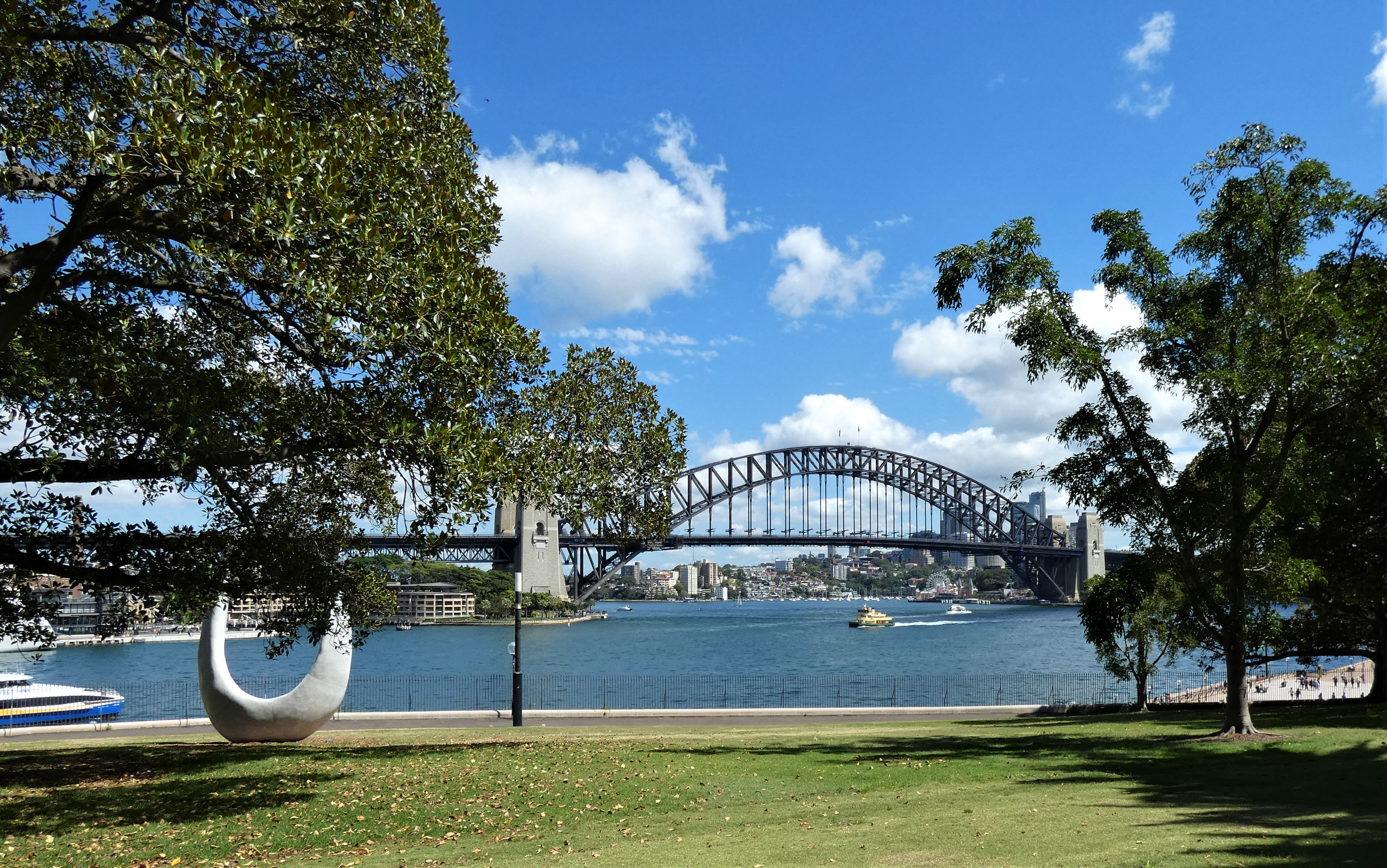
The Sydney Harbour Bridge is a steel arch bridge linking the central business district to the north shore carrying pedestrian, cycling, rail and vehicle traffic, and has the local nickname of 'The Coat Hanger' for very obvious reasons.

The bridge was built by the British steel producer Doorman Long of Middlesbrough under the direction of and using the design created by Australian engineer John Bradfield of the New South Wales Department of Public Works, seeing construction started in July 1923 and its opening in March 1932.

The arch has a span of 1,654 feet and a summit of 440 feet above sea level and is built with 52,000 Imperial or Long tons of steel held together by six million hand-driven rivets.

During our visit we climbed to the top of the tourist lookout on the granite block built south-east pylon forgoing the dubious pleasure of donning the obligatory blue overalls and extended selfie stick to join one of the parties climbing the steps to the top of the arch, preferring instead to watch these intrepid potential bridge painters whilst soaking up equally glorious views over the city and along the river.


Carrying on the nautical theme emphasised in the curvaceous outside shape of the building, the interior public galleries that facilitate performance break areas and access into the several theatres, back out over the water with a design that captures the look of the curved stern galleries of a nineteenth century sailing ship.


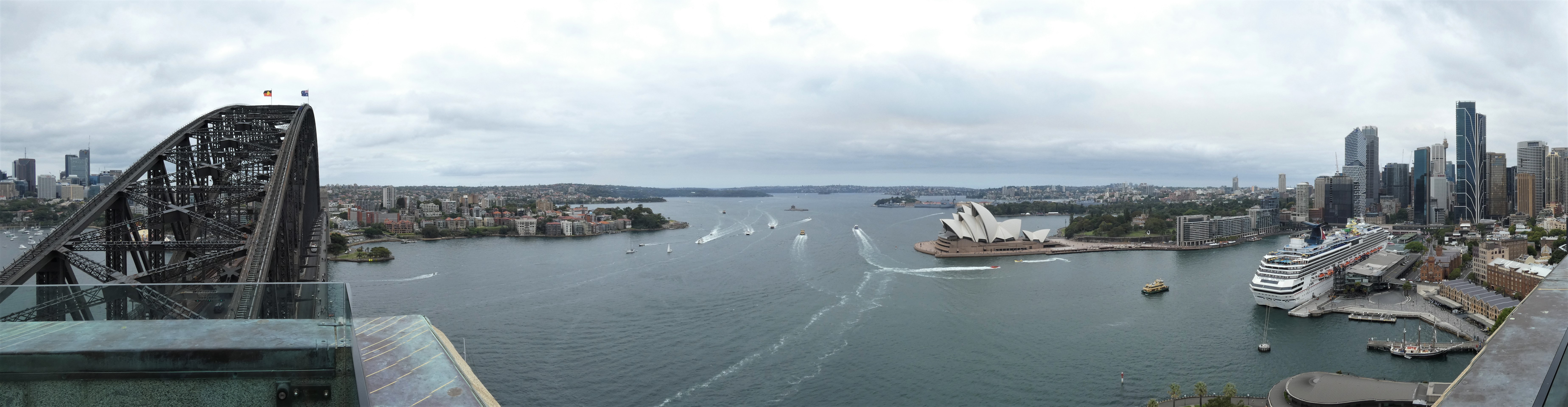
For our visit to the Opera House we had arranged to join a guided tour, and so I quickly changed out of my historical wargamer garb, and put on my arts-loving and architectural-appreciation one, although my new mind set slipped slightly during the tour when brought before a piece of modern art, and asked to imagine it in a way that wasn't the blocks of bright paint, seemingly slapped on in a rather haphazard pattern that it quite obviously was. I guess one man's art is another man's mess that could do with a bit of tidying up!

That said, I love classical opera, and a building with great acoustics and seating, ideally situated in one of the most beautiful parts of the planet, can only add to that experience, something we got a hint off as we passed one of the theatres inside to hear wafts of singing coming from within as the performers worked through a warm up for that evenings performance.

Designed by the Danish architect Jorn Utzon, the building is composed of several large precast concrete shells that formed the sections of a sphere, suspended on precast concrete ribs, with the outside of the shells, designed to create the impression of ships sails, covered in 1,056,006 gloss white and matte cream stoneware tiles.

This together with well thought through and state of the art acoustically designed theatre auditoriums with interior wall panelling and seating completed in locally sourced wood, all designed to surround the listener in sound from the stage, makes for a stunning opera house.

Finding our way back out and enjoying the obligatory ice-cream, we made our way along the harbour front via a slight detour in the the Royal Botanical Gardens that form the back drop to Government House, the vice-regal residence of the governor of New South Wales, built between 1837-1843.
As we walked through the gardens my eye caught sight of a flash of white zooming through the tree canopy, followed by a classic laughing call that announced the presence of perhaps the most iconic of Australian birds after the Emu, and one I caught a glimpse of in the Blue Mountains, but was now here in all its glory sat in the branches above, seemingly about to enjoy a rather meaty looking brunch.
 |
| The Laughing Kookaburra, Dacelo novaeguineae, a rather large member of the Tree-Kingfisher family of birds, this one well named to reflect its unmistakable call. |
The Kookaburra hunts for its prey in a similar fashion to the waterborne kingfishers we are more used to at home, in that it will find a favourite perch to spot a lizard, large bug or small animal, from where it will swoop down to grab the unfortunate creature and return with it to its perch; a technique taken to another level when used to take advantage of one of Australians favourite pass times, the classic barbecue, where a great looking prawn of sizzling sausage makes for a great stand in for the more normal prey encountered in the wild.
You just have to smile, imagining the bird making its classic laughing call and snatching its prize amid enraged shouts from the barbecue chef caught out looking the wrong way.

 |
| An absolutely stunning bird to see in the wild and a real treat during our stay in Sydney |
Passing the gates of Government House, Point 4, we headed back along the waterside facing of the gardens to enjoy the spectacle of some of the amazing plants and trees to be seen in this part of the world.
 |
| Government House, amid the Royal Botanical Gardens in Sydney, the vice-regal residence of the governor of New South Wales |
 |
| Government House - 'The tradesman's entrance' |
They say familiarity breeds contempt, and I'm sure many of the locals didn't give the trees we were looking at, a second glance, but we don't see 'Bottle Trees' like the one below in the UK, and the above ground root structure on the tree in the picture below it, had me imagining how trees would look in 'Middle Earth'.
 |
| The Queensland Bottle Tree, Brachychiton rupestris, used as a food source by aborigines who would eat the starchy roots and seeds. |
 |
| What an amazing looking tree. |
 |
| The walk along the waterfront from the botanical gardens is a lovely promenade. |
 |
| HMAS Warramunga (II) an Anzac Class frigate, the third ship of the eight in the class built by Tenix Defence Systems for Australia and New Zealand, having seen her sister ship HMNZS Te Mana arriving in Wellington in November the previous year, see link below. Here the Warramunga is alongside in Sydney's HMAS Kattabul naval base at Potts Point. https://www.navy.gov.au/hmas-warramunga-ii |
 |
| HMNZS Te Mana arriving in Wellington harbour, November 2022 JJ's Wargames on Tour North Island, New Zealand 2022 |
We concluded our promenade with the pleasure of just taking in the view of Sydney harbour from the famous Lady Macquarie's Chair, Point 5, a seat carved out of a large piece of exposed sandstone by convicts in 1810 on Gadigal or Yurong Point, since named Mrs Macquarie's Point, and recording on it her role in the planning and creation of the road running through the government domain to the point, and having the road named after her.

By most accounts, Lady Elizabeth loved to sit here and admire the view and on the glorious early afternoon we enjoyed, it was obvious why.
The Governor's wife played a crucial role in supporting her husband's efforts in changing the developmental course of the colony, bringing with her books on architecture used by her husband and his lead architect, a convict himself, Francis Greenway, supposedly introducing hay-making in the colony and taking a strong interest in the welfare of women convicts.
 |
| Lady Elizabeth Macquarie, 1778-1835 |
From the waterfront we headed back into town to take a look at a classic building of empire, the former post office at Martin Place, Point 10. on the city map.

Together with post and eventually telegraph and phone via a network of undersea cable, the Post Offices were the hubs of the communication network that linked Britain with her Dominions and Colonies, supported by the ability to protect her sea links via the Royal Navy.

As with the great railway stations of this era, reflecting the growing possibilities for travel and adventure that these palaces to travel represented to the masses, so the post office became the palace of communication with family back home, supplying world news that could affect peace and-or commerce.
This grandeur and importance is reflected in these buildings, although Carolyn and I recognised an even greater emphasis on their role with the examples we saw in New Zealand and here in Sydney than what we see at home, possibly reflecting that need to keep in touch with relatives left behind.


Initially an area of housing developed for arriving convicts, it rapidly gained a reputation as a slum, frequented by visiting sailors and prostitutes, and by the late 19th century home to a gang known as the 'Rocks Push' further adding to its rough reputation.


As regular followers of the blog will know, I am a fan of visiting the odd historic pub now and then, just to imbibe the ambiance as much as anything.
The Lord Nelson Hotel is such a place, when visiting Sydney, being built around 1814-15 by James Dempsey an Irish stone mason, and his hotel now able to lay claim to being the oldest licensed such premises in Sydney.

Obviously after months away from home, and missing the atmosphere of a traditional English pub, the Lord Nelson made this certified Pom feel very much at home with the old admiral's famous victories of Trafalgar, The Nile and Copenhagen emblazoned around the top of a magnificent bar complete with proper pumps and the ale being brewed at the back.
There was even a nod to traditional English ale with some of the various brews on offer, which were ok, but 'not as we know them Jim'.


To round off our exploration of Sydney, Carolyn and I decided to get out onto the water and see the city from a completely different perspective, whilst enjoying some glorious weather.


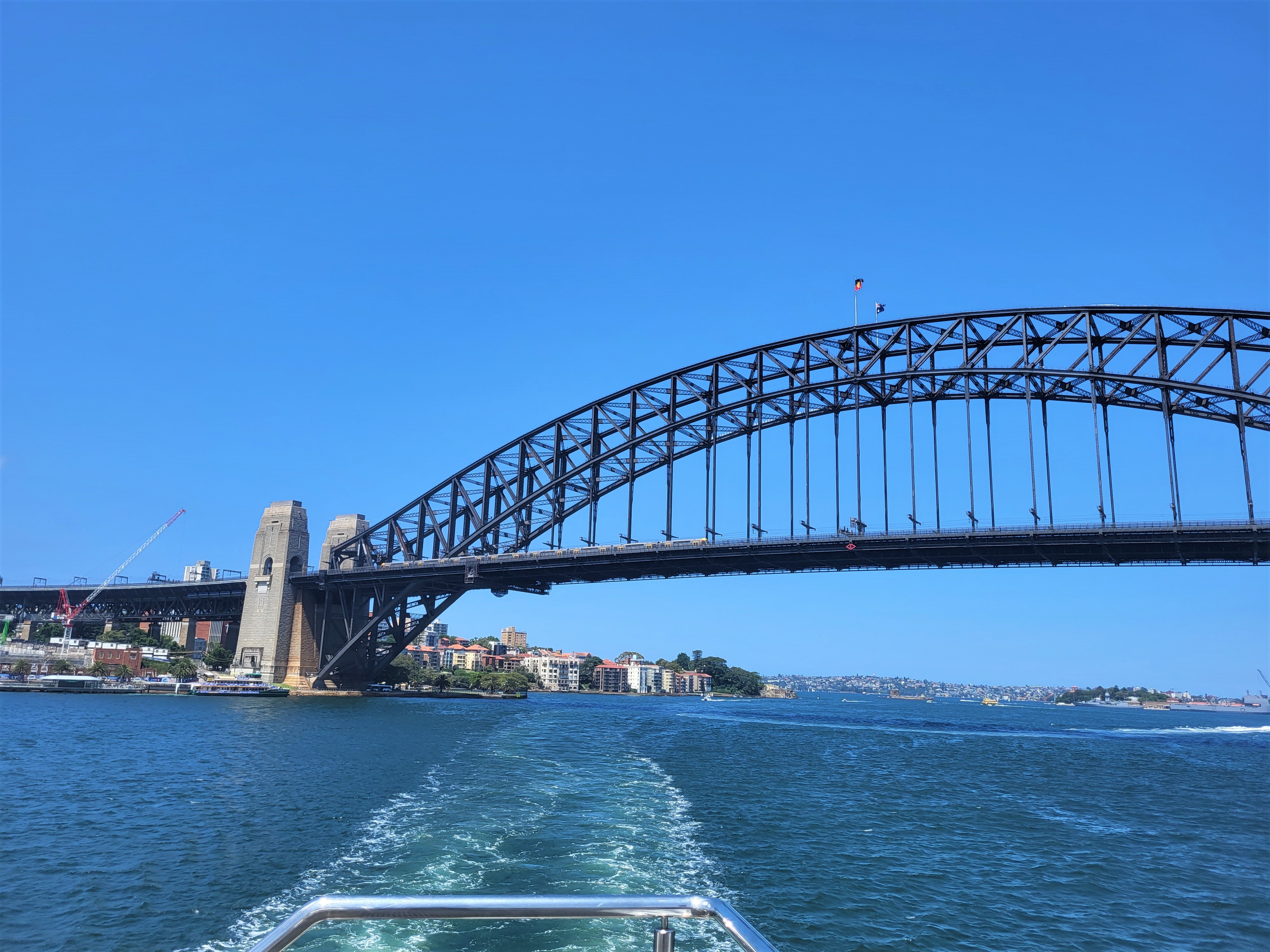
Kirribilli House, seen below is, after The Lodge in Canberra, the second official residence of the Australian Prime Minister, which considering its style and location, not to mention that the British Prime Minister only has one, at Chequers, the Australian package seems to come with some very nice fringe extras.
 |
| Kirribilli House, second official residence of the Australian Prime Minister |
 |
| Fort Denison and its Martello Tower |
 |
| The tripod foremast of the Chatham Class light cruiser HMAS Sydney |
 |
| The light cruiser HMAS Sydney seen here in 1914 with the two submarines AE1 and AE2 alongside off Cairns. https://en.wikipedia.org/wiki/HMAS_Sydney_(1912) |

 |
| Believed to be Midget No.14, this Ko-hyoteki class mini sub was raised in Sydney harbour the day after its two man crew attacked the naval base. The results of the depth-charge attacks looked to have left their mark. https://en.wikipedia.org/wiki/Attack_on_Sydney_Harbour |
After the attack the allies were able to assemble a complete submarine from the wrecks of the two recovered examples, M.14 and M.21, with the third, M.24, escaping the harbour but its whereabouts unknown until its discovery in 2006 by amateur scuba divers at an undeclared location off Sydney's northern beaches.
I had hoped to see the assembled example in Canberra, but no luck so I have an excuse for another visit to include that alongside seeing the Lancaster.
 |
| HMAS Kattabul after her sinking. |
The Japanese attack although relatively unsuccessful, did result in the sinking of the ex-ferry, accommodation ship, HMAS Kattabul after two torpedoes fired by M.21 missed the American cruiser USS Chicago, with one going on to run aground, but the other hitting the breakwater to which was moored the Kattabul and Dutch submarine K-IX, with the subsequent explosion sinking the former ferry.
The two Royal Navy and nineteen Royal Australian Navy sailors asleep on board the boat had little chance to escape, with the sinking resulting in another ten crewmen wounded and several days delay before the bodies could be recovered for burial on the 3rd June.
The naming of the modern day base, HMAS Kattabul, is a very suitable memorial to their loss.
 |
| HMAS Adelaide (III), L01 and HMAS Canberra (III), L02, both Canberra Class Amphibious Assault Ships, known as LHD's (Landing Helicopter Dock) https://www.navy.gov.au/hmas-adelaide-iii https://www.navy.gov.au/hmas-canberra-iii |
The base made for interesting viewing, with the RAN a major force in the Pacific theatre, soon to be raised another level with the British, US, Australian AUKUS programme announced last year, that will see the Australian's operating their own force of eight conventionally armed nuclear-powered submarines.
 |
| HMAS Choules LSD (Landing Ship Dock) L100 https://www.navy.gov.au/hmas-choules |
 |
| HMAS Warramunga (II), FFH 152, pictured above during our promenade along the waterfront, lies alongside her Anzac Class frigate sister ship HMAS Arunta (II), FFH 151. https://www.navy.gov.au/hmas-arunta-ii |
One final place to end this post on had to be the wonderful cuisine to be enjoyed in Sydney, with its seafood right up there with the best to be enjoyed anywhere in the world.
With that in mind and knowing my love of eating fresh fish when the opportunity presents, my eldest lad Tom, who spent several months in Australia as part of his gap-year, recommended we make time to visit the Sydney Fish Market, Point 12, first established in 1872 and running from its current location in Blackwattle Bay since 1966.


Cheers Sydney.

The fun in Sydney continues with a look at the very impressive National Maritime Museum and our day spent walking the nearby coast and beaches between Coojee Beach and the world famous Bondi Beach.


