Thursday, 7 September 2023

Bantry Bay 1796 for Kiss Me Hardy - Preparations (French Troop Transports), Part Two

La Forte, French Armed Transport - Frederick Roux
 
This post follows on from Part One which, if you missed it, can be followed in the link below:

JJ's Wargames - Bantry Bay 1796 for Kiss Me Hardy, Part One

When looking at the development of naval power projection in the eighteenth and early nineteenth century and amphibious operations, the literature that predominates, I suppose unsurprisingly, seems to focus primarily on British operations, and even there the detail surrounding the actual transport ships involved as opposed to the men-of-war is a lot more sparse than you would wish if you were looking to model these fleets for the wargaming table.

If you then turn your attention to the French then you really have to start a bit of investigative digging to come to a firm impression of how to represent these forces.

For the French Invasion of Ireland in December 1796, originally James and then Clowes lists the following French transports that were part of the invasion fleet of seventeen ships of the line, thirteen frigates and six corvettes.


I decided to randomly choose four of these vessels for which I could possibly get enough detail to represent them as a KMH transport ship with a ship record card as seen below. For this kind of work I regularly turn to one of the Rif Winfield reference books, in this case French Warships of the Age of Sail 1786 -1861, which are an invaluable resource for better modelling the relevant ship statistics.


In addition I began scouring the various forums, museum and art gallery listings to find illustrations, models and paintings of as many of these French ships as possible to feed the inspiration for the look of my Irish expedition.

Antoine Roux

Perhaps one of the best resources for period illustrations of French warships, transports, Mediterranean ship types and other allied merchants are the paintings and drawings of the brilliant Antoine Roux and many of his descendants who also acquired the artistic talents, with two seen here from the brush of one of his sons, François Joseph Frédéric Roux, who produced the two illustrations of French armed-transports, to leave us a fantastic resource of the look of ships and boats from this era from a French perspective and with Roux the elder based in Marseille, a unique Mediterranean perspective.

Spanish merchantmen - Antoine Roux
These types of illustration help give a great picture of the likely look of typical merchantmen out on the high-seas.

An 18 to 20-gun French Corvette - Antoine Roux.
Similar in size and look to the small French transports described, less the guns

In addition I also looked at some of the models of French East Indiamen as presented here in a discussion link to Game Labs Forum looking at these types.

Game LabsForum - XVIII Cent Fluyts of the French East India Company


Armed with these illustrations in mind, I decided to create the look of some of these merchantmen with a view to the timing of the campaign to Ireland, being early in the French Revolutionary War and with likely many of these non-warship types still showing the look of the previous decade with the odd lateen rigged mizzen and white lead painted lower hulls instead of the coppering reserved for the warships of a bankrupt French state in the wake of the American War overspend.

As mentioned in my first post, I had already identified the battened-down sixth rates with their lashed quarterdeck guns as the most suitable models to use for the majority of my transports.


To add a little variety to the overall look of this little squadron, I decided to model the smaller of the four vessels as a merchant brig, with the guns removed to capture a better look for the plastic generic brig.
 

So the Justine is listed in French Warships of the Age of Sail 1786 -1861 as:

'(merchant ship commissioned 11.1796, possibly the 309 ton Justine that traded from Nantes between 1785 and 1790 or perhaps a larger ship, carried 1 x 8-pdr, 1 x 4-pdr, 1 x 10-inch an 2 x 8-inch mortars). Captured 30.12.1796 off Ireland by HMS Polyphemus (64), while carrying 465 soldiers, then wrecked and lost with all hands.'


So my translation of the KMH Justine is seen above, simply dividing her tonnage with the builders calculation of 23.1 gives me a vessel of fourteen hull boxes, there or there about, a typical look for a brig which prompted me to have Justine as you see her here, with a typical small ship's crew rated as Average Sans Culottes and with a basic speed of fourteen centimetres which is a bit quick for a two master but I wanted her to not hold the fleet back in the scenario and convinced myself that without the weight of a man-o-wars guns she might be a little quicker over the briny.


Next up we have the Fille Unique listed as follows and converted as per Justine seen above but with her tonnage indicating a larger corvette sized vessel of three masts, similar to the La Lionne and La Forte as depicted by Frederick Roux:

La Lionne, French Armed Transport - Frederick Roux
  
'(Flûte* built at Bordeaux 1783-83 and purchased 1785, 700 tons, 135-150 men, carried 24 x 8-pdrs). Gunnery school at Brest 11.1794 with 26 x 12-pdrs. Renamed Faveur 1.1795, reverted to Fille Unique 1796. Expedition to Ireland 11.1796. Hulk at Brest 3.1797. On sale list 28.5.1797 but not sold, powder hulk 9.1800, BU 4.1804.'

*En Flûte, simply meaning with no guns on board to be used as a transport, mercantile or military.


The Ville de Lorient is described thus:

'(French East India Co. flûte Bretagne built at Lorient in 1787 and requisitioned at Philadelphia 12. 1793 by the French representative there. then bought by the navy, 525/1000 tons, 175 men, carried 2 x 12-pdrs 22 x 6-pdrs and 4 x 3-pdrs. Renamed Ville Commune de Lorient 5.1794, Ville de Lorient No.1  10.1794, Voyageur 5.1795 but reverted to Ville de Lorient. Captured off Ireland with 431 soldiers by HMS Doris (36), Unicorn (32) and Druid (22), then wrecked off Irish coast.'


Finally the merchant ship Suffren, named in honour of perhaps one of the best and most famous French admirals. I decided that given her name and association with India I would have my Suffren looking the part to have sailed with the great man back in 1782:

'(merchant ship Suffren requisitioned 12.2.1794 at Lorient, 600 tons, 194 men, carried 24 x 8-pdrs). Renamed Saisissante 5.1795 but reverted to Suffren. Captured 1.1797 with 202 soldiers on board by HMS Jason (38), then retaken by the French frigate Tartu (ex Uranie), then sunk of Ushant by HMS Majestic (74), Daedalus (32) and Incendiary (14).'


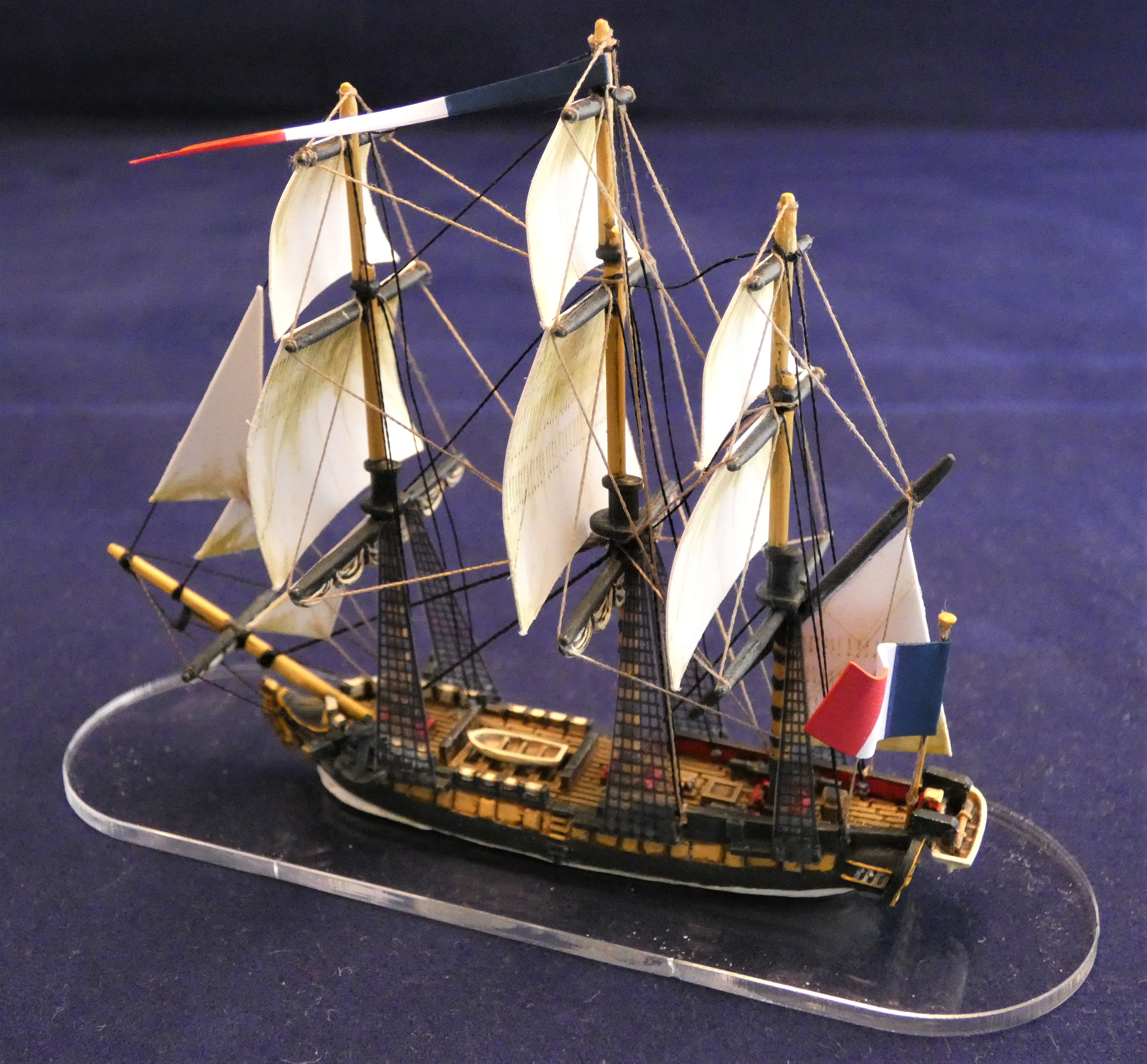


As in most naval wargames, transports and merchantmen used on the table often act primarily as targets, which they will be in this scenario with the added caveat that the French are aiming to get all four of them over the finish line for a decisive victory, but as with the warships, I think it’s worth the effort to go a bit further with these models and try to capture the likely look of these ‘Cinderella’ ships and compliment the aesthetics that age-of-sail naval wargames played in 1:700 scale offer.

Hopefully those aesthetics will be obvious to the eye when you next see these models out on the table amid gun smoke and dice at Clotted Lard.

More Anon
JJ

Lot’s to come here on JJ’s as I look forward to doing a full AAR on the Bantry Bay games at Clotted Lard and the Naval Wargames Society meetings later this month, plus more age of sail to come with the start of my next fleet build project with the first models to be showcased in the rigging yard as I write, together with WWII vehicles on Dartmoor, and the next post in Carolyn’s and my Antipodean adventure to Hamilton Island on the Great Barrier Reef.

Monday, 4 September 2023

The Battle of Talavera, The Afternoon Attack - Tiny Wars Played Indoors


Bill Slavin and friends have concluded their marathon play through of O'er the Hills Peninsular War Scenarios with the 'big-one', 'The Afternoon Attack' (link below to Bill's AAR), the concluding Talavera scenario that recreates Marshal Victor's all or nothing throw of the dice that characterised his full frontal column attack on Sir Arthur Wellesley's line at Talavera, when he unleashed a forty-five minute mass bombardment from his artillery as a prelude to the attack by I and IV Corps, preceded by his pronouncement to his staff highlighting his frustration at previously failed assaults;

"If this doesn't work, it is time to give up the war!"


This scenario can be linked with the preceding one that Bill played back in July, 'The Attack on the Pajar Vegara' which itself was designed to pin Wellesley's troops around the gun redoubt as this, the main attack, went in soon after, but as is often the case, seeing the plan change on first contact with the enemy.

JJ's Wargames - Attack on the Pajar Vergara

Similarly all four Talavera scenarios that Bill has illustrated, starting with Scenario 8, Casa de Salinas, can be linked into a mini-campaign with casualties and morale affects carried forward from one to another.

However if big games are your thing and big Peninsular War games in particular, this scenario should definitely float-the-boat, as Bills table seen below well illustrates.

Looking from French lines - Talavera, The Afternoon Attack.

Everything is here in this classic Peninsular War battle, a three turn pre-attack French grand battery bombardment of the British line, mass columns of veteran French infantry, the victors of Austerlitz, Jena, and Friedland, supported by massed ranks of French cavalry, foot and horse guns, up against British and KGL infantry, guards and riflemen, backed up by British heavy and light dragoons and Royal Foot and Horse Artillery gunners, having to rely on their steadiness to brave the shot and shell to deliver counter-charges, cannister or a steady volley followed up with the bayonet to see whose will-to-win breaks first.

Bill's British and KGL hold the line at Talavera for his recreation of The Afternoon Attack.

This is not the classic Anglo-Portuguese defensive battle that would come to characterise most of Sir Arthur Wellesley's early encounters with the French, lacking most obviously in the benefit of a complete front covered by a reverse slope position, and thus the British commander has to carefully manage his infantry, artillery and cavalry assets to hold areas of the line that are most heavily pressed making best use of combined arms tactics to compliment those of the British redcoat.

The French columns press home their attack

For the French it is a matter of pressing hard and reinforcing success quickly to unsettle a likely formidable British line, using the rapid manoeuvring capability of the French infantry and cavalry backed up with guns that can come up in support to win where it counts.

Having played this scenario and the full battle of Talavera many times I found myself recalling the euphoria of French commanders unleashing what looks like an unstoppable force, after dishing out the hurt from massed heavy foot guns, and the stoic determination of British commanders relieved and with confidence boosted, as a British line rises to its feet, delivers a crushing volley followed up by a cheering charge in the wake of several recoiling columns, but with a game not over until it was that last throw of the dice moment when concession by one side or the other was inevitable.

https://standtogames.co.uk/shop/ols/products/oer-the-hills-rules

From Bill's account of his game it was really great to see the scenario create the same drama for another set of players and it has been a real pleasure and privilege to follow Bill and his friends progress through the book.

Thank you Bill for sharing your tour-de-force, it has been great fun to follow.

JJ

Saturday, 2 September 2023

Adventures on Dartmoor - Fernworthy Reservoir, Stone row and Stone Circle

 
With the weather a bit of a mixed-feast this summer here in the south-west of the UK, that started fantastic with wall to wall blue skies and sunshine in late May into June, but then turned rather wet, cloudy and distinctly chilly in July, Carolyn and I have had to grab the moments when they arrive to plan our walks up on Dartmoor.

JJ's Wargames - Dartmoor, Scorhill and Shovel Down

Just check out the weather we had for our walk to Scorhill and Shovel Down back in June to see how well the Dartmoor walking season was shaping up


Thus with the day we chose earlier last month looking cloudy, but brightening up as the day progressed I grabbed the Footpath App and pulled out one of my pre-planned Dartmoor adventures, this time a fairly easy jaunt around Fernworthy Reservoir, near to Scorhill on the east of the moor and offering a five mile walk with a bit of a climb up through nearby forestry plantations, taking in the Fernworthy stone row and stone circle before descending back to the reservoir shoreline and the walk on the opposite bank to the wall of the dam before climbing back up to the nearby carpark.

Our walk, close to Chagford around the Fernworthy Reservoir

The route planning map from Footpath using Ordnance Survey walking maps and showing bottom left a handy guide to the incline to be experienced along the route, with the main climb early on as we head away from the reservoir up through the forest at Point 1. As indicated the area is surrounded by ancient bronze-age archaeology with stone huts, rows and circles in abundance. 

We got to the car parked up at about 12.30, grabbed our small back packs and made our way along the reservoir shore line until we crossed a small brook, one of many that feed Dartmoor stream water into this catchment area taking in the fresh air and bird song of this magical part of Devon.


The Lowton Brook was our first check point for progress

The walkways close to the reservoir are all nicely maintained making it a pleasant simple walk just to go around it.

The shoreline at this part of the walk is relatively open with views of the treeline and forestry on the slopes above.

Not exactly the Strangler Figs we got used to seeing in Queensland but the lattice work of these climbers against the old weathered trees with their thick coat of velvety moss caught my eye and reminded me of our holiday. 

Fernworthy Reservoir providing fresh water for Torquay, Totnes and Brixham

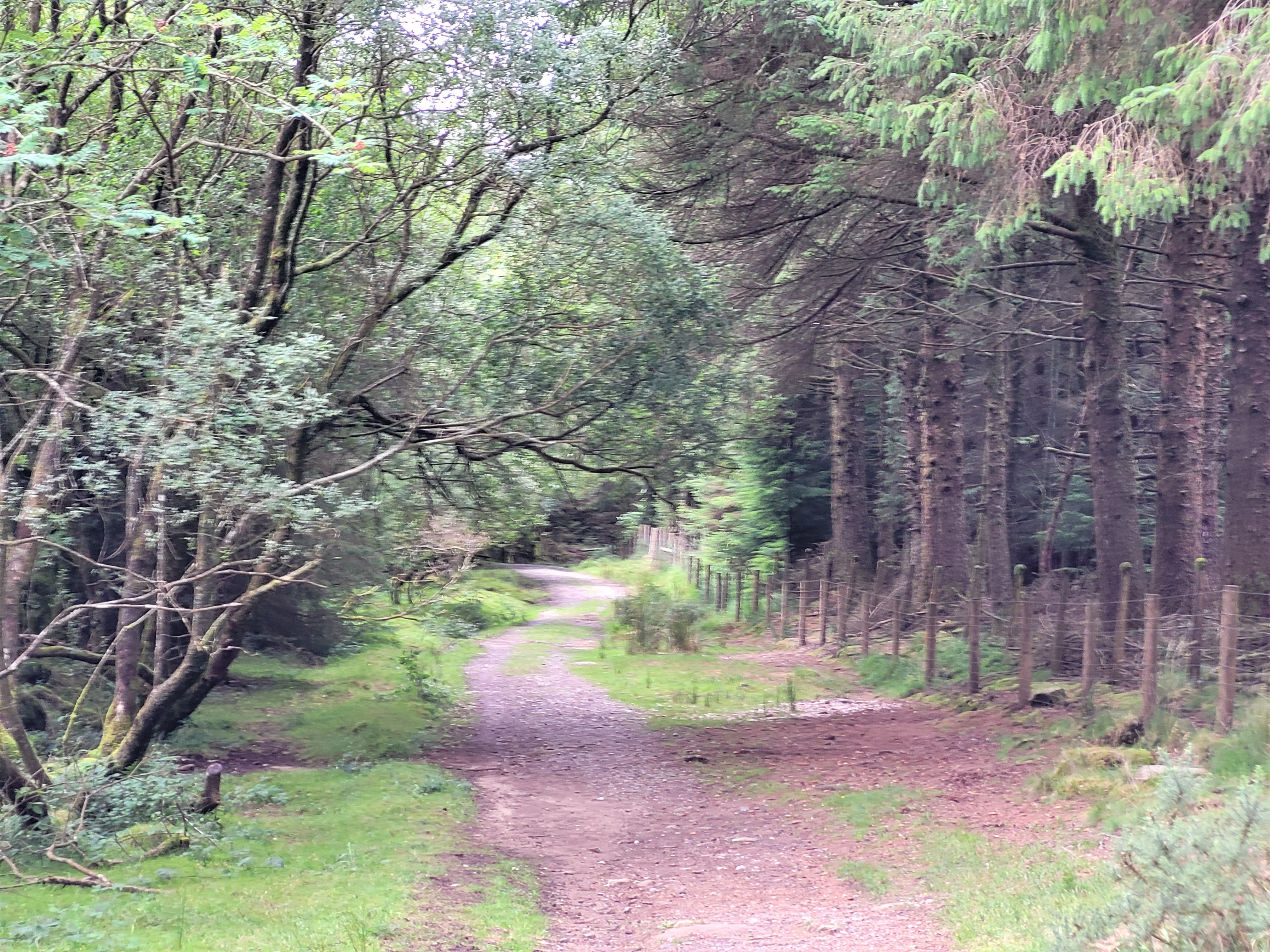
As we approached the lower end of the reservoir, towards Sanderman Bridge, we turned away from the shoreline at Point 1 to begin our climb up through Fernworthy Forest, with some parts of the track proving interesting, given the heavy amounts of rain we had in July but with most of the broader forestry tracks and breaks easier to make the climb up.

The lower part of the track leading up through Fernworthy Forest at Point 1 on the map.

Starting to get a bit soft under foot

The good, the bad and the down right ugly. What at first appeared to be damp but traversable ground 
gave way underfoot, to result in my boot sinking in mud just up to the top of the boot,
which was a result as we say in the walking world. Needless to say Carolyn let me go first on this bit.

Once we got to the top, the stone covered tracks became much more easy to walk on and the weather responded with some sunshine to go with the sweat we had developed doing our climb.

Once past Point 2 on the map the track flattens out somewhat and leads one inevitably towards Fernworthy stone row, the stone circle and a cairn close by, Point 3, situated near a crossroads in the track amid a wide open clearing in the forest.


Fernworthy or Froggymead as it is sometimes referred to is a Bronze Age monument consisting of twenty-seven granite slabs or blocks and was excavated by the Dartmoor Exploration Committee in 1897 and they reported a layer of charcoal within it but no other finds.

Our first view of the stone circle

The picture below was taken in 1907 and shows how the scene has changed since the planting of the Forestry Commission plantation.


The avenue leading up to the circle with another similar one on the opposite side has remnants of the original stone row that lead up to it that once consisted of a double stone row.

The cairn seen below was found to contain a bronze knife, flint knife, beaker and shale button.

Set off to one side is this burial mound or cairn, likely a significant person to be interred so close to the monument 


Following the track down hill back towards the reservoir and Point 4 on the map, close by to the dam, we came across this interesting meadow or Rhös Pasture consisting of Purple Moor Grass and rush and home to the endangered butterfly species, the Marsh Fritillary, but sadly we didn't see any flittering by on the day we walked through.


Fernworthy Reservoir was constructed between 1936 and 1942 behind a dam built of concrete faced with locally supplied granite slabs and covers an area of 76 acres and is 64 feet deep at its deepest point when full; providing fresh water for Torquay, Totnes and Brixham.


When the water levels are really low, the remains of numerous stone hut circles and the ancient small granite clapper bridge at the western end, that once crossed the South Teign River, can sometimes be seen.


Just as we got back to the carpark the skies turned leaden and the rain returned so we certainly got the best of the day for our walk and finished off with the obligatory Dartmoor fish and chip supper to put the cap on it.

Next up on JJ's - The French transports are done in time for my Bantry Bay Scenario, more adventures on Dartmoor with a visit to the 1940's Weekend show at RAF Harrowbeer and I've started a new project, long in the planning, for a naval battle I've always fancied bringing to the table.