Saturday, 20 July 2013

French 20th Dragoons - AB, Part Four

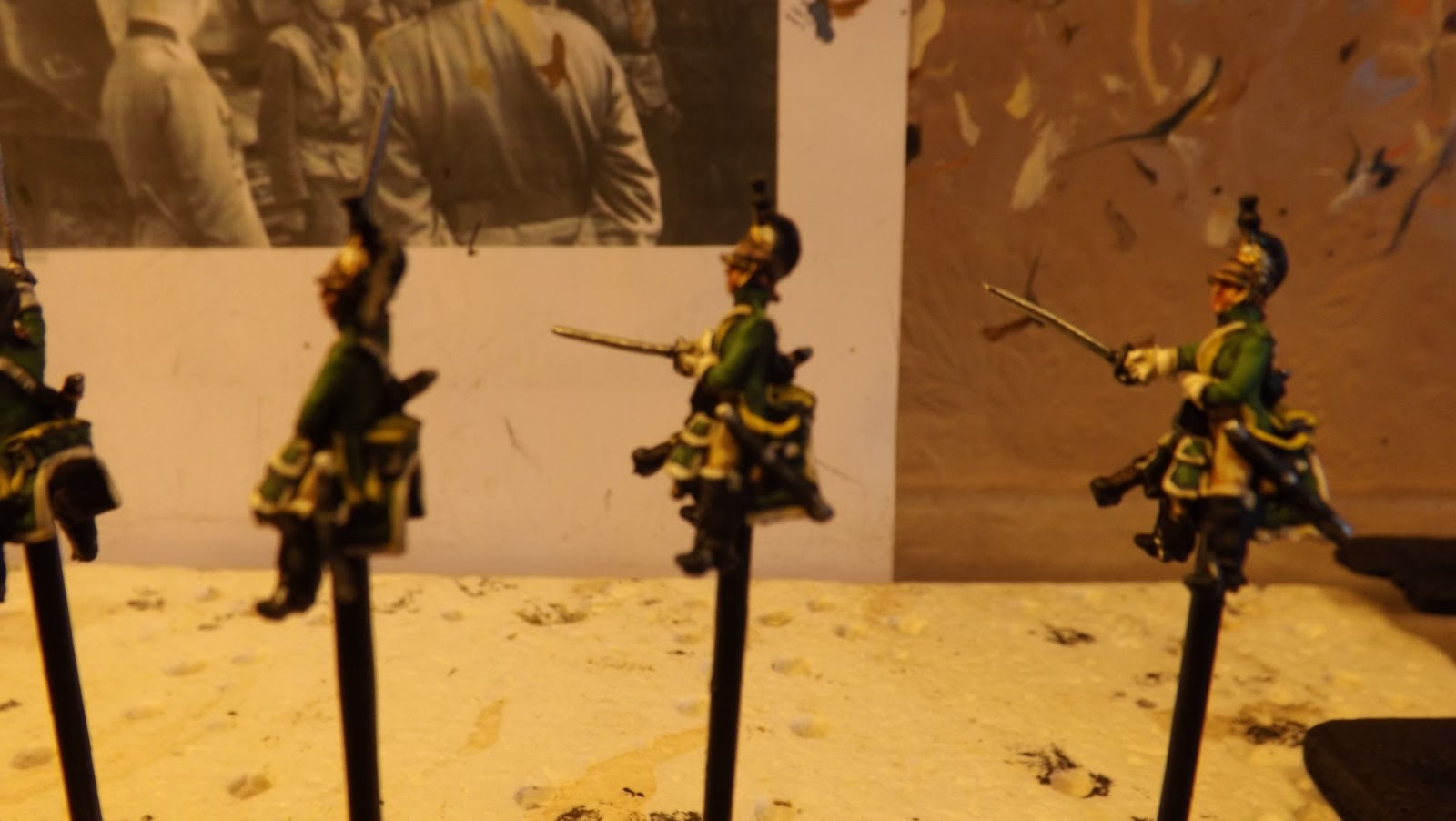
With Saturday morning I am now into day 6 of this project and having completed about another hour and half on the horses last night, the following three shots illustrate where I'm at 7.45am.

I'm really on the home lap now. Last night I completed all the tack, manes, tails, hooves, eyes, white areas and coat highlights. The French were in the habit of using black leather work for their tack so painting French horses uses one less base colour.


As I paint I like to try out ideas occasionally. One idea I have started to adopt is highlighting the horse after the oils have dried. I quite like the look of block painted horses you see illustrated, in the way the detail of the musculature is accentuated. The use of artists oils achieves a much more subtle version of that technique. I have found that by applying a watered down top coat of the original base coat I can raise the detail of the horse, without losing the subtlety originally achieved.


So onwards and upwards - I will add to these first three shots before I post to show where I got to on day 6.

A big thanks for the comments guys. I've really enjoyed the feel of having a conversation as I paint. It has given me a great opportunity to think more deeply about the process.


09.10am
So the horses were finished off with highlights added to the black and white work. The metal work, bridles and buckles have been added and light hooves for the trumpeters white done, allowing me to bring the horses and riders together.


I look to marry up riders and horses before painting begins. The last thing you need is to struggle pushing a rider on to a horse only to find that in the process of wriggling and nudging the rider in place you've gone and damaged the paintwork on the horse. I know, I've done it and to quote my school teacher "it's not big and it's not clever", and "it's only your own time you're wasting!"

Off course to make sure the right rider goes with the right horse I arrange everyone in the same order on the paint desk and put them back in the same place as I paint. Simple but effective.


So I can now leave these guys to stick and go and get the bases ready. I have prepared laser cut mdf bases arranged for "Napoleon at War" rules but that work equally well for what I think are becoming my preferred option "Carnage and Glory". I have had these cut by the lovely people at Warbases and I like to apply magnetic tape to the bottoms, which I get from the equally lovely people at Magnetic Displays,  so I can transport my models safely in their metal tool case.

In addition I will varnish the models whilst still on the painting wood and hope to get them on the bases this afternoon ready for the groundwork to commence.


 "Et Voila" one regiment of French dragoons ready for groundwork and parade shots

Friday, 19 July 2013

French 20th Dragoons - AB, Part Three

Hi all,

So here we are on day five of this project having started on Sunday, I have finished the riders last night and have started work on the horses.

There is method to madness here, in that by leaving the horses to last I am allowing the artist oils to dry thoroughly.


Please excuse the quality of these "on the paint table" shots as I am simply trying to illustrate progress. I will post some "beauty" shots at the end so you can see the full effect.

Both Paul and John have highlighted a common issue among us who paint, and that is the speed we are able to turn things around and get jobs done. Obviously this comes down to time available and our ability to discipline ourselves to get on with things. I don't think this is easy as there would be a lot more painting going on than there is.

I am quite pleased with the leopard skin effect on the Officers helmet

The first thing I would say, is "hey guys don't beat yourselves up", at least you are painting which from what I see puts you in the 20% that do. The other 80% are watching or paying someone else to do it. If I achieve anything with this blog, I would really like to inspire and encourage all wargamers to paint their own figures and proudly get them out on the table. I thing it's a big part of our hobby and you miss out if you don't get stuck in.


The other thing is about working on the "psychology of painting", which comes to my point of building self discipline. If you don't paint regularly it might be because you don't have a habit. I seem to remember the training books suggest that to get a new habit you have to do something continuously for thirty days to "embed" it in the behaviours, and that it takes another thirty days for it to become an unconscious habit.


As well as building the habit I have my own personal mantra that helps me deal with a problem that's common to all of us toy soldier collectors, boxes and draws of unpainted lead. I always tell myself that no matter how lovely a figure sculpt looks, it's just a glorified fishing weight until I put paint on figure and get that baby on the table.

As you can see, my method of painting is stage driven and I find this also helps to reinforce the habit by giving me "lines in the sand". I get a great feeling of achievement when I sit down in the evening knowing I have completed another stage in a painting project. This is only reinforced when I sit down to the project the next day and delight at the work done with so much less to do.

I think it's also worth saying that I produce my figures to a plan. Again the training speak says, "Fail to plan, plan to fail". Any plan worth its weight is always written down, and so before any painting, I plan the armies I want to create and write it down, ticking off the units as they get put in the tin.


These are some of the strategies I have used to enable me to move seamlessly from one job to the next, week after week, and start to build forces of multiple units. This process also has to be managed in the time we have available. I am now at the stage that I feel guilty if I don't paint at some time during the day. However I am a family man and time with the ones I love takes precedence over my hobby every time so I paint most evenings at home but always finish off early in the evening to spend time with my wife.

I would end by saying that I find painting a great way to relax after a day/week of work and I don't find it a chore. I think this is important because why would you want to do something if you don't find the fun in it. Most of us have that in our lives anyway when we are at work.


I hope these thoughts are helpful and provide food for thought. I don't for one minute want to suggest that what I do would suit everyone else. We all have to find what works for us, but I do believe that a lot of the stuff that gets in the way of us painting more, more often  is common to all of us. I hope some of my ideas might help you to get the job done.


So back to the 20th Dragoons. I am still on target to get these guys done this weekend so if you have enjoyed the journey so far, stay tuned for the finale.

Wednesday, 17 July 2013

French 20th Dragoons - AB, Part Two

A good day yesterday, with a successful mid year appraisal out of the way at work, and my wife and younger son away in London visiting Kings University, I was in the mood to get stuck into painting while the house was quiet.

So I decided to get the riders first highlight done and the first colours on the metal work. I started at 7pm with a break mid evening to have tea and watch a "D-Day as it happened" programme I recorded from last month with my eldest son, I painted through to 11.30pm. Thus I post the results this morning, Wednesday 17th July.


Ok so, all first highlights done except the white stuff, which is showing as buff in the pictures. The tricky stuff with these figures is working out the shape of the sabre hand guards when held in the gauntlets, the various straps bracing the muskets and sabre scabbards.

After setting up the last two figures on the right I suddenly realised that what I initially thought were sabre scabbard straps were in fact the coat tails flying backwards in the breeze as this chap commits to the charge. This required the addition of extra yellow to highlight the turn backs that are exposed.


These chaps are in the pre 1812 uniform changes and are on 1801 saddle furniture and using the model 1801 sabres, hence a lot of the metal work is more towards steel rather than brass.

The plan is to have these guys "in the tin", by this weekend with the next two units primed and ready for work next week. I have ten battalions of Xan infantry on their way in the post as I write this, so there's no time to waste. So much to do, so little time, what fun!


Stay tuned for more updates

Monday, 15 July 2013

French 20th Dragoons - AB, Part One

I already have three regiments of French dragoons in my collection, but to play some of the scenarios I have planned I will need at least six possibly eight. The first of these scenarios is to put the Vimiero battle as a whole on to my table, see my Vimiero full fat scenario in the down load section. This game will require six regiments and so I am into putting together the next three.

I have decided to model my French units on those that spent much of their time taking on Wellington's army. Thus the next Regiment of Dragoons will be the 20th, one of the regiments at Albuera.


I thought it might be interesting to show this unit coming together as with the Portuguese I painted earlier in the year and so I will record the process as I go.

The "block painting" begins with the dark base coat applied to the riders and the base horse colours to their mounts

AB figures are a work of art and lack no attention to detail. This requires a bit of homework before starting if you want to get the best from them. I turn to my own library of reference books and colour plates, such as Rousselot where I can make sure I know what each part of the figure is before painting.

However with the resource of the Internet available to most of us, there is no reason not to spend the time getting familiar with the subject.

The Officer and trumpeter get their horses in stand out colours with the bulk of the regiment in chestnuts and browns

I am using the Coat d'Arms range of horse colours for my base colours. I have been really pleased with the coverage and colours.

Picture taken in the evening with all the block work done and ready for the first highlight colours

The great part about three colour block painting is that once you have the foundation colours in place you get a psychological boost knowing that the fun bit, applying the highlights, is coming next and that the models will require less paint as you move through the stages.

Getting into a "painting groove" is all about managing the mind. I try to explain to friends, who have difficulty sitting down and painting, that you have to begin with the end in mind and then get motivated by the completion of each stage. The first stage for me is always a bit laborious, but as I get ever nearer to completion, I find myself getting more enthused imagining how the models will "pop" as the next colours are applied.

AB figures are full of detail that require close attention to get the most from it

The horses after the artists oils have been applied. They will need at least 24 hours to dry thoroughly before further painting

So to summarise the work so far:
The Dragoons, Dark Green coats, saddle furniture, Dark Yellow facings, turn-backs, tops of riding cloak on the valise, trumpeter's coat, Mid Stone, riding breeches, Buff, gauntlets, cross belts, waistcoats, tops of boot leggings, trumpeter's helmet horse hair, Chocolate Brown, muskets, helmet turbans, leather work of saddle, Black, all metal work on helmets, swords, scabbards, boots horse hair main on helmets, chin scales, gilt ornaments on officers horse furniture, trumpeter's trumpet.

For the horse colours just refer to my Portuguese Dragoons post.

Sunday, 14 July 2013

Napoleon at War in Devon and Scenarios

The Napoleonic collection was in action yesterday at the club with my Frenchies taking on Chas's Austro-Prussian collection in a Napoleon at War summer scrum. There is a full report of the game at
Devon Wargames Group

The French cavalry en masse in Exeter yesterday
This was a "What shall we play next month" game that required a scenario for the day and found me yet again turning to Charles Grant for inspiration. If you are a follower of my blog you will know that I like to play scenarios, that give a background as to why the forces are where they are and what on earth has decided the commanders to fight on this particular ground. If there is an historical story behind the game, even better, because then we can savour comparing what the game produced as to the actual historical events.

In this case I chose the "Reinforcements in Defence Scenario No 15" from CG's book "Scenarios for Wargames".


I have played this scenario several times before and always enjoyed the sometimes nail biting too and fro game it has often produced. The Devon report gives an overview of the scenario, so refer to that for the information about it.

Having chosen the set up, I then wanted to give the players an historical reason for this battle and given that the Austro Prussians really only came together in late 1813 I rummaged through my Napoleonic library for a setting for the game. This led to me reading up the events following Napoleon's victory outside the walls of Dresden.


Following their defeat, the Allies fell back towards the sanctuary of the Bohemian Mountains pursued by General Vandammes Corps sent by Napoleon in pursuit as he turned his attention back to the North and Berlin. The pursuit was not like the good old days of 1806 and the Allies were able to regroup and destroy Vandamme's Corp at the Battle of Kulm three days later.

Our game had the Allied forces attempting to hold a town at the entrance to one of the few passes into Bohemia to allow their main force to fall back and regroup. The French were obviously seeking to prevent this. One could imagine several meetings like this between the two forces during those days in 1813 and so our scenario took its place in the historical canvass.

If you don't own a copy of "Scenarios for Wargames", I would sincerely recommend getting one as it offers game setups for players right through the many periods we play from Ancients to Moderns and everything in between.

I often find the generic scenario set ups contained in most modern rule sets today a bit bland and lacking in period flavour. Not being a lover of points in army creation I prefer to build my forces like Grant and the Generals, selecting units by type to deal with the suspected enemy formations and the terrain and assessing forces on troop strength versus that of the enemy in ratios rather than points. I might change that approach when I find a reference to Napoleon or Wellington referring to the points value of the force they were up against.

Thus ending on that controversial bomb shell, I invite your comments.

Next up, "French Dragoons, fousands of em"! I have three regiments of lovely AB Dragoons to paint to get ready for my big Vimiero game in the Autumn. I will be away in Sri Lanka and the Maldives for three weeks in August celebrating 25 years married to Carolyn my lovely and very patient wife so am planning to break the back of these before I go.

Friday, 12 July 2013

Greek/Italian Hoplites for Pyrrhic Army

This week I've been working to complete the next unit in Steve's Pyrrhic army, Greek/Italian Hoplites. These figures were quite a change from my Napoleonics, being a true 15mm and with much less clearer definition on the detail, they were quite challenging to paint. Still I think they have come out ok and once based up should make an attractive unit.

The move up to 18mm for me is a confirmation of the plan to have large armies on the table but with figures having detail to compete with much larger scale figures.


Saturday, 6 July 2013

2e Legere, Xan Miniatures - Peninsular War


I currently have six battalions of French Legere in my collection and, with planned scenarios requiring twelve battalions, I decided to take advantage of the excellent range from Xan to build up my force.

2e Legere, Xan Miniatures, mounted Colonel, AB and the colours GMB

My other units are AB and I find the Xan range fit in perfectly with them. The mounted colonel in the pictures is an AB figure.


I chose to model the 2e Legere specifically as this was a unit that spent a lot of time in the Peninsula fighting the British and has an illustrious record of battles attended for the war.

The Xan range are available from Empress Miniatures in the UK and I have included a link in the Links bar.


 2e Regiment d'Infanterie Legere
Regimental History
1788: Created 2e Bataillon de Chasseurs Royaux de Dauphine(formed from the following)
2e bataillon de Royale Italien
1791: 2e bataillon d'Infanterie Legere(2e bataillon de Chasseurs)
1794: 2e Demi-Brigade d'Infanterie Legere(1st formation, formed from the following)
2e bataillon d'Infanterie legere
9e bataillon, Volontaires de l'Isere
Bataillon franc de la Republique
1796: 2e Demi-Brigade d'Infanterie Legere(2nd formation, formed from the following)
21e Demi-Brigade d'Infanterie Legere(1st formation)
Compagnie franche de Seine-et-Marne
Eclaireurs 23e Demi-Brigade d'Infanterie Legere(2nd formation)
1803: 2e Regiment d'Infanterie Legere

Regimental War Record (Battles and Combats)
1792: Nice
1794: Nijmegen
1797: Ponteba, Tarvis, Hundsmarck, Leoben, and Bruck
1798: Alexandrie, Le Caire, and Pyramides
1799: El-Arisch, Saint-Jeand'Acre, Nazerath, and Mont-Tabor
1801: Lesbeh and Alexandrie
1805: Ulm, Wertingen, Hollabrun, and Austerlitz
1806: Iles de Wollin and Usedom
1807: Dantzig, Weichselmunde, Heilsberg, and Friedland
1808: Obidos, Vimeiro, Rio-Seco, Gamonal, and San-Vincente-de-la-Barquera
1809: Lugo, Elvina, Corogne, Braga, and Oporto
1810: Busaco, Prierro, and Lombieres
1811: Sabugal
1812: Arapiles and Saldana
1813: Vittoria, Bidassoa, and St- Jean-de-Luz
1813: Lutzen, Wurschen, Katzbach, Dessau, Leipzig, and Dantzig
1814: Montmirail, Dannemarie, Mery, Arcis-sur Aube, Fere-Champenoise, Craonne, and Paris
1815: Ligny and Waterloo
The combat record was taken from The Napoleon Series which has a very extensive collection of articles on the period.