Sunday, 20 November 2016

Warfare 2016 - Wargames Association of Reading

Excellent modelling displayed by the Earlswood Wargames Club and their Ardennes themed game
This Saturday I spent a very pleasant day in the company of Steve M and Mr Steve attending Warfare 2016, the annual show put on by the Wargames Association of Reading.

This is the third visit to the show which has grabbed the end of year spot in my wargaming calendar and as well as having some interesting and inspiring games to see also boasts a good turn out of traders and new products.

The show has from my experience also been well supported by visiting gamers and the pictures below shows a very crowded and busy trading hall when we arrived at about 10.30 am.

Crowds fill the hall, great for traders not so much for the crowds in a limited space
This level of interest is obviously great for the traders but as an attendee not so much, as the sports centre venue seems to me to fast becoming a not so ideal site to stage this popular show; as getting around amid the crowds, many carrying rucksacks and bags, me included, is not a pleasant retail experience, to use the parlance.

Not only that but the car parking, in a very busy sports centre, on a weekend, is not really adequate for the added pressure created by the wargaming visitors and we like many others were forced to drive around a nearby trading estate looking for somewhere to park.

If the internal tannoy was anything to go by some visitors didn't bother looking too far away for parking opportunities and I heard several calls for owners of various makes of vehicle together with identifying registration plates to come to reception to move their said vehicle.


I should say that the crowds fell off dramatically after lunch and it seems to me that shows like Warfare may need to come up with ideas like the Penarth club with Crusader, where guest speakers are invited to present on historical subjects that encourage punters to stay on and potentially spend more afterwards which is really important for traders who, with some I chatted to, had travelled as far away as Lincoln and Hull.

I offer these comments in a constructive way as I know a lot of work goes in to organising shows like Warfare and ideal venues with plenty of parking, particularly in the London area are not easy to find, but the problems described are not likely to decrease over time and I would be keen to see shows like Warfare prosper going forward.

Prototype MDF Roman Villa buildings on show at the Warbases stand
Any way on with a look at what was on show at the show, together with as usual the games that caught my eye.

The first item on my must see list were the promised examples of some 28mm Roman Villa style buildings being developed at Warbases that I believe should be available next year.

The precision of these laser cut masterpieces was something to behold and with the Dacian War collection in mind something that would really grace the table for the games I have in mind.


I didn't linger to long in the traders hall, fearing falling over would likely mean I wouldn't be getting up. However I picked up some much needed magnetic tape from Coritani and the AWI Scenario Book 3 from Caliver Books, plus a dice bag and some mini dice.

Wargaming supplies replenished I headed for the game displays and was immediately attracted to a fine model of a Typhoon laying it on thick with the 60 lb rockets, I'm sorry but I didn't note the organisers of this game, and I am assuming from the list of displays that it was the Huntingdon and District Wargames Society.


There was a distinct 1066 theme at the show, rightly so, given the 950th anniversary of that momentous year in British history and the Malvern Old Wargamers had a very fine table representing the Battle of Fulford, using the Armati rule set.


Hordes of Vikings seen in Reading yet again, very fitting in memory of the Great Heathen Army tying their boats up in the town in previous times.
I am currently starting a Dark Ages collection, based with our club Dux Brit. game in mind, but being the typical wargamer that I am, it is the big clash of shield wall kind of game that interests me most and a decision on what basing to what rule-set will need to be made going forward, so I like to see what others folks do in this respect.


What follows and heading up this post are the pictures of my game of the show, this fantastic Chain of Command game by the Earlswood Wargames Club representing the 505th/101st Airborne Division's, Easy Company's attack on the town of Foy during the Ardennes fighting and so memorably staged by HBO in Band of Brothers.


The attention to detail in this game was something to see, including the use of spray can tops covered in material to represent the classic snow covered hay stacks as portrayed in the TV show.

Screen shot from the series to remind you of the detail captured in this game

The attention to detail in the terrain was matched by the figures with some great snow cammo effects achieved on vehicles and men.


Some of these pictures make me cold just looking at them!


I think you will agree, a superb looking game, and having featured a few on this blog over the years, well up there with the best.


Spot the LMG team in wait in the roof cavity
Next up yet further inspiration from another presentation I don't have details for, even in the show guide which has three clubs showing games not confirmed by title or period, so I can't even make a guess.

I do know from Steve M that two of the chaps running the game were former "boot-necks" otherwise known as Her Majesty's Royal Marines and therefore having spent some time down in our local parish.


With my own 28mm collection for the Dacian Wars percolating in the background this scene could quite easily replicate a Dacian War struggle on the Danube frontier with the Roman navy and the Limes frontier post.


Lovely looking game chaps, and great inspiration for us fans of early Imperial Rome.


As announced in the preceding Wargaming media, Gripping Beast were rolling out their new set of ancient/medieval rules 'Swordpoint', demonstrating the game with a nice little display of Teutonic Knights going at in a suitably snowy set up.


These rules are a possible contender for my Dark Age big battle set and I found the interview about them on the recent Meeples Podcast most interesting as well as recent magazine reviews . However I am not in a hurry to be an early adopter so I will wait to see what further reaction develops about them.


Did I mention 1066? Well you would be surprised not to have seen the 'Hastings Set To' not represented and here is King Harold's line in all its glory facing off multiple attacks from Duke William's Norman cavalry and infantry.


Having just reviewed and enjoyed our own game of 'Over the Hills' Napoleonic rules it was a pleasure to meet the authors in person, Adrian McWalter and Quinton Dalton, putting on this Austrian vs Bavarian display game.

http://jjwargames.blogspot.co.uk/2016/10/over-hills-napoleonic-rules-play-test.html


As you would expect there was plenty of information detailing the game and Steve M got himself a mint copy from Caliver Books whilst we were at the show.


This little 'cribbage board' caught our attention as these were the first prototypes of a potential option for recording brigade,/divisional/army morale other than just writing the scores down.

We had a discussion about potential price points going forward, and with the some ideas forming on doing some Talavera scenarios with the rules I really like this way of recording fatigue hits.


With all the chatting about the rules, I nearly forgot to share some close ups of the game, which would have been a shame as the chaps had brought along some nice figures and terrain to show how things get played using 'Over the Hills'.


If want to know more about the rules you can also go to the Over the Hills Facebook page, join the group and see what others are doing.

https://www.facebook.com/groups/1819455724949749/?fref=nf


Continuing the Napoleonic theme, close by was this very nice Napoleonics in Egypt game presented by Steve Deeprose.


I am sure I have featured Steve's game on another show report, but for me you can't have too much of the look of this early period in the Napoleonic/Revolutionary war as the uniforms are great especially against a desert  style background.


And last but by no means least I present this participation game about the Raid on Schweinfurt carried out deep into German territory by the US air-force on October 14th 1943 which finally disproved the idea of the self protected bomber group making deep penetrating daylight raids without fighter supremacy.

Again I am guessing this was put on by the Staines Wargames club as they are the only game down as a 1/144 aerial combat game, although I fancy the bombers were closer to 1/300th.


I really enjoy getting the planes out on the table and have a large Battle of Britain collection stored at JJ's Towers but 1/144 scale models only add to the fun. The German fighters were particularly attractive and the terrain board was simple but very easy on the eye designed to represent the terrain from high altitude.


So there we are another Warfare seen and enjoyed.

Thanks to all the folks at the Wargames Association of Reading. I could see everyone involved yesterday were busy helping the visitors have a good day out and looking after the traders .

And thank you to Steve M and Mr Steve for their company on the day.

Next up, well loads of stuff, as the day job has been getting in the way of posting. So we still have Vikings to come and the Spanish 2nd Cavalry Division which is now finished awaiting parade pictures together with the last regiment of Dragoons, the Almanza Regiment, and a special project announcement.

Tuesday, 15 November 2016

It's Official - Points Systems Don't Work!

As you know I occasionally like to get controversial and raise a bit of debate and discussion. Straying into the great debates about competition and scenario based gaming is always an area angels fear to tread where fools rush in but I couldn't help but smile listening to the latest offering on the Meeples Podcast.

I have like others have been looking forward to the expected publication of 'Tabletop Wargames' by Rick Priestley and John Lambshead and published by Pen & Sword. I have a deep respect for all rule writers and game designers as, over the years of dabbling and messing about with other peoples rules, I have come to recognise the skill required to produce great rules.

However after reading some of the initial reader reviews about this book I decided to await more comment.


Thus it was with some disappointment that I listened to the Meeples show on Monday to hear my initial thoughts confirmed after they had reviewed their copy for the show.

It was somewhat amusing to hear the description of the chapter covering points based wargaming systems broken down into 'key points' and with the first one stating 'points systems don't work'.

If you think you can hear the wailing and gnashing of teeth in the distance that is probably the sound of tournament organisers and suppliers of Mr Priestley's rule sets, and the many spin off systems that have evolved from the core design, all over the western world crying in their beer at this seemingly blasphemous statement. Only kidding but you have to see the funny side of this. Gerald Ratner and his jewellery business immediately sprung to mind.

There was some amusing stuff covering the 'rule of six' or something like it laying out the principles behind weapon ranges and movement rates (infantry move six inches) that create a holy trinity that allows everything to fit neatly into a six foot by four foot table without any concerns about time and ground scale.

On a more serious point though. I am old enough to have played wargame rules with points systems long before RP and Warhammer were doing their stuff, such as WRG for example. I guess the key thing for me was that in a casual game they were useful as a guide to comparability between forces and that was it, a guide only and these were the days before codex points systems designed to drive sales of miniature figures.

Not only that but I have played about using points to support campaign systems to create ratios of forces that meet on the map needing to be transferred to the table and then, with the result of battle achieved on the table, carried back to the forces on the map. Although I suppose in this case you could skip the points and use numbers of men instead.

So I guess my thoughts would be points systems can work, it just depends what you do with them.

Sunday, 13 November 2016

Fun and games at the Devon Wargames Group


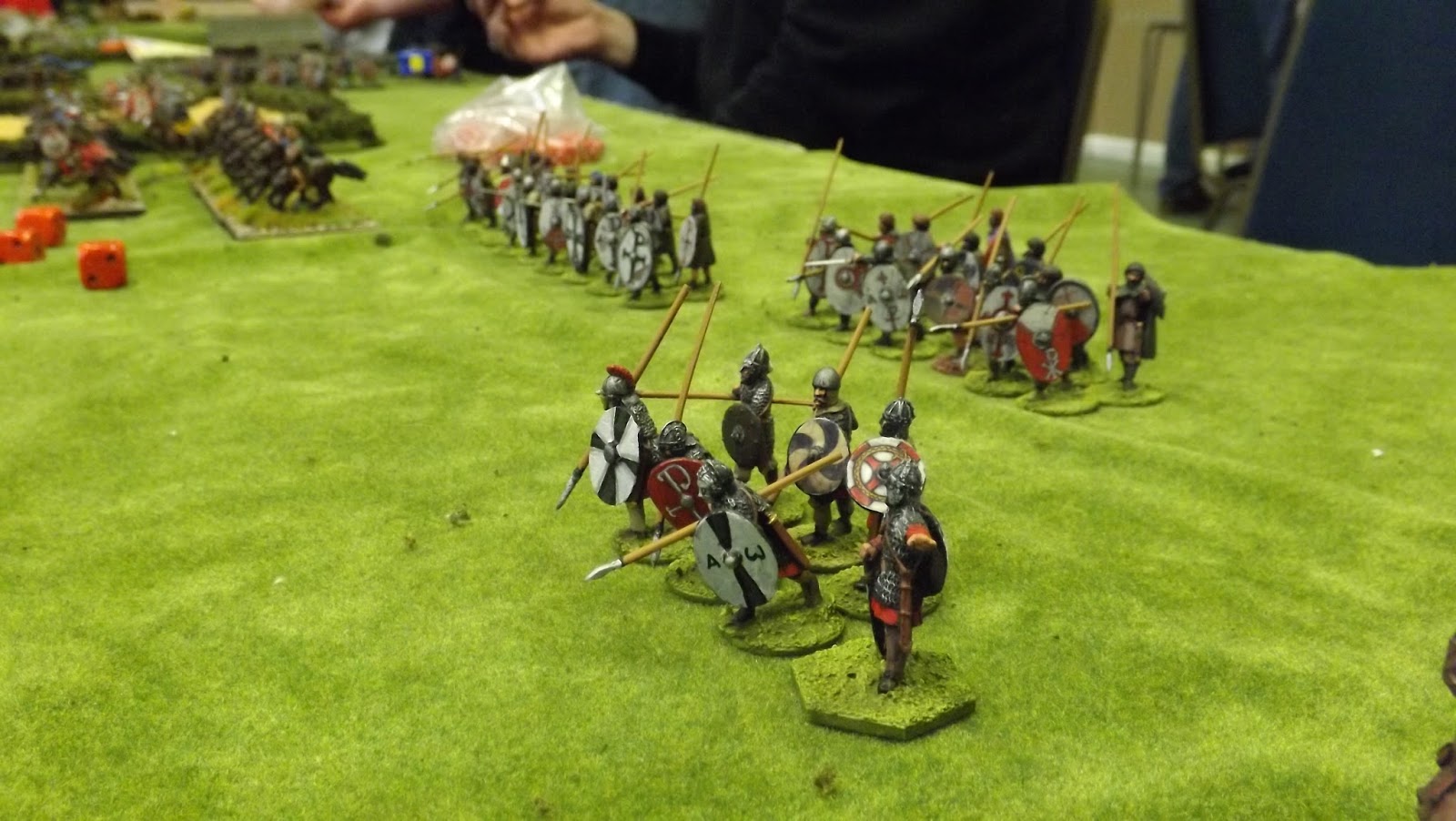
Since the summer Tom and I have been working on Dark Age figures to contribute to the big end of year game at the Devon Wargames Group.

Yesterday was a play-test of the Dux Brittaniarum rules we have chosen to use for our game.


These are just a sample of the pictures I gathered of the members collections out on the table and they give you an idea of the look of our game next month.


Needless to say much fun was had by all so if you would like to see more then just follow the link to the club blog.

http://devonwargames.blogspot.co.uk/2016/11/a-gathering-of-ravens-at-littleham.html

Friday, 11 November 2016

JJ's Dark Ages - Saxon Warband Part II


It was back at the end of September that I posted on the start of the Dark Ages collection and King Penda with his theigns.

http://jjwargames.blogspot.co.uk/2016/09/jjs-dark-ages-saxon-warband.html

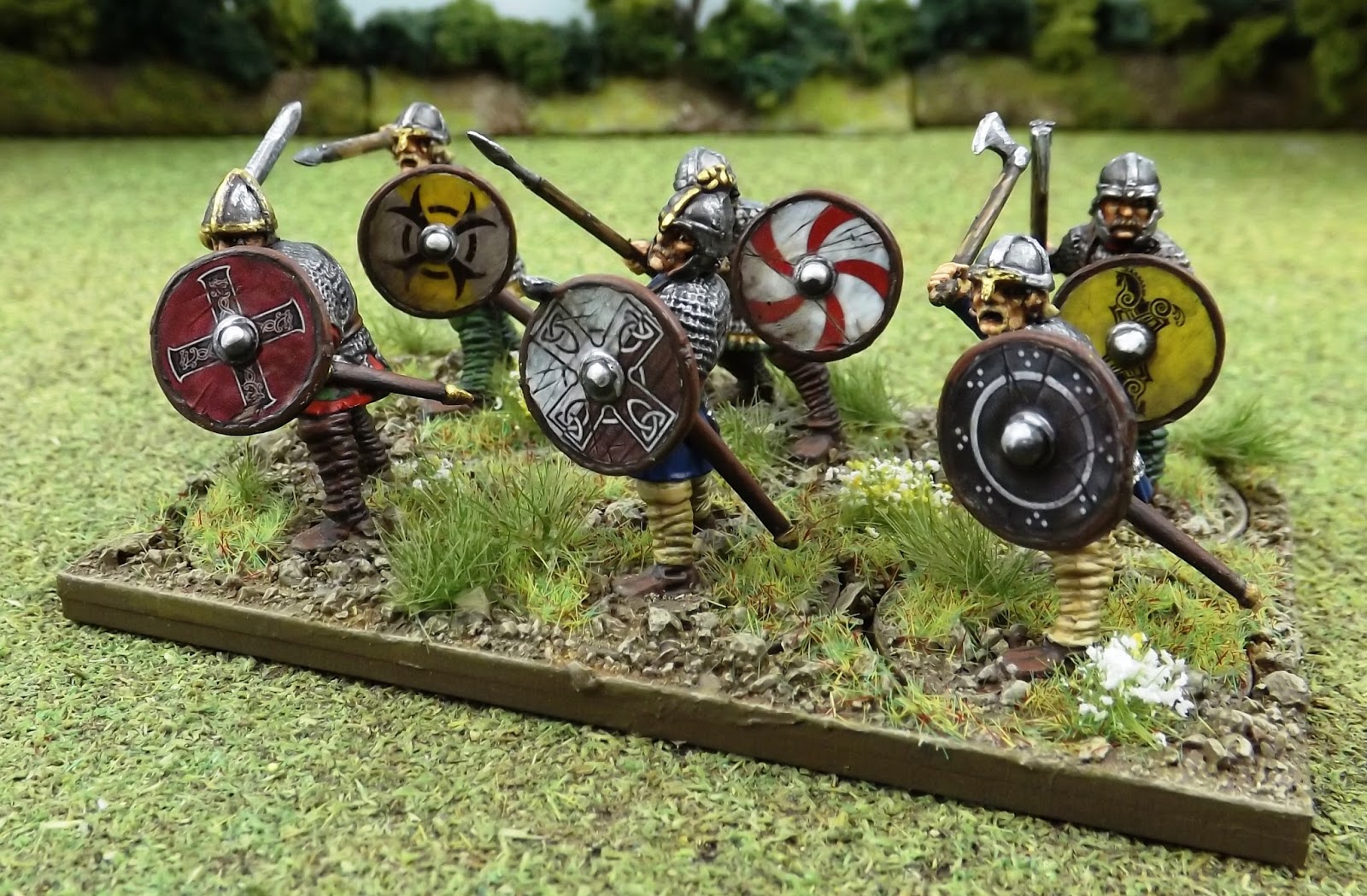
Since then Tom has got back from Australia and needing to warm his painting technique up after a long lay off from the brush, I suggested he got stuck into half a dozen of the Gripping Beast Saxon plastics.


Timing is everything and these chaps should get a run out this weekend at the DWG as we have a series of warm up games planned to get everyone up to speed with 'Dux Brit' for the big Xmas game.


Not bad Padawan! The Saxon Warband now stands at eighteen figures ready for the big game. I can't wait.

Now he has got his eye back in I have set the young Jedi back to his task of working up the Roman collection whilst Pater gets the Talavera collection finished off.

Next up Steve M's Vikings and the Spanish 2nd Cavalry Division with the completion of the Almanza Dragoons and General Albuquerque.

Friday, 4 November 2016

Spanish 2nd Cavalry Division at Talavera - Pavia Dragoon Regiment


2nd Spanish Cavalry Division - Lieutenant General Duque de Albuquerque
Infante Cavalry Regiment
Alcantara Cavalry Regiment
Pavia Dragoon Regiment
Almanza Dragoon Regiment
1st & 2nd Hussars of Estremadura

It doesn't seem that long ago that I was celebrating the 100th post to the blog, presenting my effort at recreating one of the many bell towers that were a feature of the Oporto river crossing.

This post marks a bit of a landmark as the 500th to the blog and it is the Spanish Pavia Dragoons that grab the honour. Thank you to everyone who has joined me on this e-journal of my gaming and other historical, be they military or natural, activities. Here's looking forward to 1000th posting. It will be fun looking back to see where things have progressed to.

So on with the blog and specifically the Pavia Dragoons.

In 1803 under the Godoy reforms the corps of dragoons were disbanded and the regiments converted into hussars and mounted chasseurs, but in 1805 Prime Minister Godoy realised the folly of this decision and reestablished the eight regiments, instructed to wear yellow coated uniform with red turnbacks, with regimental colours displayed on the collars, cuffs and cuff-flaps.

This change took time to complete and several illustrations like the one below and the Suhr Brothers illustrations of the Villaviciosa Regiment in Hamburg in 1808 depict regiments still wearing the 1803 uniforms three or four years later.

http://www.napoleon-series.org/images/military/organization/Spain/Suhr/Suhrspanish13b.jpg

3rd Almanza Cazadore (right), subject of the next post, in the pre-1809 uniform
before the Cazadore's reverted back to Dragoons dressed in the familiar yellow
The first reference I have for the Pavia Dragoons shows them assigned to the Spanish Army of Aragon being put together in May of 1808 with a cadre of men listed in the February of 1809

Spanish Army of Aragon, May l808 - February l809

                                           Assigned
                                               or
Force                                   Raised     Force        Observations
Dragones de Pavia                   -             14                  2/09

Source: Gomez de Arteche Y Moro, Guerra de la Independencia, Historia Militar de Espana de l808 a l8l4


However other references shown below have them at a strength of three to four squadrons attached to the Army of the Centre in and around Madrid as they fell back before the French offensive in the November of 1808. Ah the joys of researching the Spanish!


In June 1808 following the Spanish insurrection, Oman lists in detail the forces on hand with a list of the available cavalry regiments and their strengths: Note the dragoons are still listed as Cazadore's.

Cavalry (---H) - number of horses
lst Rey Heavy Cavalry Regiment (5)(38/634)(467H)
2nd Reina Heavy Cavalry Regiment (5)(4l/668)(202H)
3rd Principe Heavy Cavalry Regiment (5)(42/573)(434H)
4th Infante Heavy Cavalry Regiment (5)(42/6l5)(494H)
5th Borbon Heavy Cavalry Regiment (5)(42/6l6)(450H)
6th Farnesio Heavy Cavalry Regiment (5)(39/5l7)(359H)
7th Alcantara Heavy Cavalry Regiment (5)(42/589)(490H)
8th Espana Heavy Cavalry Regiment (5)(39/553)(358H)
9th Algarve Heavy Cavalry Regiment (5)(42/572)(455H)
l0th Calatrava Heavy Cavalry Regiment (5)(44/679)(369H)
llth Santiago Heavy Cavalry Regiment (5)(44/549)(370H)
l2th Montesa Heavy Cavalry Regiment (5)(40/667)(259H)
lst Rey Cazadore Regiment (5)(40/577)(l85H)
2nd Reina Cazadore Regiment (5)(42/58l)(42lH)
3rd Almanza Cazadore Regiment (5)(38/598)(479H)
4th Pavia Cazadore Regiment (5)(42/663)(507H)
5th Villaviciosa Cazadore Regiment (5)(35/628)(448H)
6th Sagunto Cazadore Regiment (5)(39/499)(l89H)
lst Numancia Hussar Regiment (5)(4l/630)(327H)
2nd Lusitania Hussar Regiment (5)(42/554)(409H)
3rd Olivenza Hussar Regiment (5)(37/558)(468H)
4th Voluntarios de Espana Hussar Regiment (5)(34/548)(460H)
5th Maria Luisa Hussar Regiment (5)(40/680)(394H)
6th Espanoles Hussar Regiment (5)(38/692)532H)


By the October of 1808 the Pavia are listed as part of the Army of Castile under General Pignatelli which formed part of General Castanos' Army of the Centre joining forces at the end of that month.


Army of Castile - Source Oman
Division: General Pignatelli (Cartaojal after 30/10/08) 
(ll,000)
Cantabria Infantry Regiment (2)
Leon Militia Infantry Regiment (l)
Grenadiers del General (l)(new levee)
Cazadores de Cuenca (l) (new levee)
lst, 2nd & 3rd Volunteers of Leon (3)(new levee)
lst, 2nd & 3rd Tercoios of Castile (3)(new levee)
Tiradores de Castilla (l)(new levee)
Volunteers of Benavente (l)(new levee)
Volunteers of Zamora (l)(new levee)
Volunteers of Ledesma (l)(new levee)
Cavalry (3,292 on 29 October)
Farnesio Cavalry Regiment
Montesa Cavalry Regiment
Reina Cavalry Regiment
Borbon Cavalry Regiment
Olivenza Cavalry Regiment
Espana Cavalry Regiment
Calatrava Cavalry Regiment
Santiago Cavalry Regiment
Sagunto Cavalry Regiment
Principe Cavalry Regiment
Pavia Cavalry Regiment
Alcantara Cavalry Regiment


In January of 1809 the regiment is shown as part of the Army of the Centre now, following the dismissal of General Castanos, under the command of the Duke of Infantado and based around Cuenca threatening the eastern approaches to Madrid

Spanish Army of the Centre, llth January l809
Cavalry: (l,8l4)
Reyna Cavalry Regiment (276)
Principe Cavalry Regiment (l4l)
Borbon Cavalry Regiment (ll9)
Espana Cavalry Regiment (342)
Santiago Cavalry Regiment (74)
Tejas Cavalry Regiment (l3l)
Pavia Cavalry Regiment (428)
Lusitania Cavalry Regiment (l58)
Dragones de Castilla (l25)
Farnesio Cavalry Regiment
Montesa Cavalry Regiment
Calatrava Cavalry Regiment
Sagunto Cavalry Regiment
Alcantara Cavalry Regiment

At some stage that I have been unable to determine exactly when it happened, several cavalry regiments were, including the Pavia Dragoons, detached from the old Army of the Centre to join the newly formed Army of Estremadura.


The Pavia are not listed with Cuesta's Army that was defeated at the Battle of Medellin on the 24th of March and, as Andrew Field mentions four regular dismounted cavalry regiments being sent to the area around Badajoz to gather remounts, I assume the Pavia Dragoons were part of that group.

As well as tracing the movements of this regiment, another challenge for the prospective modeler is getting a reliable reference on the look of the regimental musicians. The only dragoon trumpeter illustration I have been able to track down is the one below of the Reina regiment.


Nafziger describes the Reina regimental facings as 'Carnation' (light red) whilst the Pavia are described as  'Carnation' (red). Interestingly Chartrand has the Pavia with yellow facings for collar, cuffs and cuff flaps, but I cannot find any other references that agree with that so I am sticking with Nafziger.


Thus my Pavia trumpeter sports a red outfit similar to the Reina illustration below and I am reserving artistic license when it comes to the Almanza Dragoons which both Nafziger and Chartrand agree on Sky Blue facings.

Trumpeter from the Reina Dragoon Regiment
illustrates the facing colour worn by musicians
My Pavia Dragoon Regiment are composed of figures from AB supplied by Fighting 15s and are the fourth regiment completed as part of 2nd Cavalry Division.


Next time we will look at the last of the two dragoon regiments, namely the Almanza Regiment, and we will get to see the division as a whole with General Albuquerque at its head, but before that we will have some more 28mm Dark Age Saxons from Tom and some Vikings from Steve M.

References consulted:
Talavera - Wellington's First Victory in Spain, Andrew W. Field
Napoleonic Armies - Ray Johnson
The Armies of Spain and Portugal - Nafziger
History of the Peninsular War - Sir Charles Oman
The Spanish Army of the Napoleonic Wars(1) Chartand & Younghusband (Osprey Men at Arms)
http://www.eborense.es/batalla_talavera1809_indice.html

Tuesday, 1 November 2016

North Devon Delights - Lorna Doone, a Clapper Bridge and King Caratacus

Feral goats that inhabit the Valley of the Rocks at Lynton
This weekend was spent looking forward to Carolyn's birthday next week with a trip up to and a night away in Lynton in North Devon.


The north of the county is quite different to the south with a hilly countryside bordering the uplands of Exmoor and a rugged coastline of steep cliffs looking out towards the coast of South Wales across the Bristol Channel.

On arriving at out hotel we dropped off our luggage and headed off to the famous "Valley of the Rocks" a valley that runs parallel to the coast with an assortment of Devonian rock formations that tower over the valley and sea and is populated by wild goats that must be some of the surest footed creatures you are ever to see, if the animal in the picture above is to go by. That rock he is perched on must be a hundred plus feet from a sheer drop into the Bristol Channel.

https://en.wikipedia.org/wiki/Valley_of_the_Rocks
http://www.lyntonandlynmouth.org.uk/attractions/item/53-blank-valley-of-rocks-1

God's own country looking at its best
We put in a good four mile walk, up hill and down dale inhaling plenty of sea air and delighting in the glorious views of this beautiful part of the county. Needless to say we had developed a great appetite when we got back to the hotel and were really looking forward to dinner.

Just taking a breather as I contemplate the very steep climb on the route back to the hotel

The next morning following the traditional full English breakfast we walked down the cliff path into the twin village of Lynton, namely Lynmouth which lies at the mouth and confluence of the east and west channels of the River Lyn with a gorge 700 feet below Lynton and connected with a cliff railway that is powered by gravity and water-tanks.

This beautiful Devon seaside village was devastated in 1952 by flood waters from the uplands of Exmoor following nine inches of rain falling in 24 hours; that flooded down the valley on the 15th and 16th of August carrying boulders and debris that destroyed about sixty buildings and killed over thirty people.

Following this disaster the mouth of the river was widened and deepened with the high wall seen in the picture below designed to protect the village from future down-pours.

The river valley was looking particularly stunning with the trees in their autumnal hues.


http://www.visitlyntonandlynmouth.com

After mid-morning tea and teacakes we were off into the Exmoor National Park with a trip back to the troubled times of the Monmouth Rebellion of 1685 and the fictional story created around it by Richard Doddridge Blackmoor, and his story of Lorna Doone.

Doone Valley looking at Devon from the Somerset side of the valley
Carolyn and I first visited the little hamlet of Oare and its famous church before we got married and it was fun retracing our steps.

The novel is centred around the area of the East Lyn Valley on Exmoor and specifically around Badgworthy Water, Malmsmead and Blackmoor weaves his plot with the historical facts and characters that featured during the tumultuous time of the Duke of Monmomouth's invasion and his defeat at the Battle of Sedgemoor.

I covered the battle and the events around it in my post from December 2014
http://jjwargames.blogspot.co.uk/2014/12/a-day-out-in-sunny-somerset-battle-of.html

Carolyn stands in for Lorna Doone outside the 900 year old Oare Church, where Lorna was shot marrying John Ridd
This area marks the county border between Devon and Somerset and I seem to remember a scene from the BBC TV version of the story back in the eighties of the two county militias being sent to deal with the Doone gang once and for all and ending up shooting at each others force as they met in a fog that is so characteristic of the weather on Exmoor.

The heights of Exmoor seen from the front of Oare Church
Given that the area and the places that are mentioned in the book are real I suppose some people can be forgiven for not knowing that the characters are fictitious. Next they will be suggesting that Sherlock Holmes didn't live at Baker Street!

Plaque in the church honouring the famous author

Looking towards the alter where John Ridd married Lorna Doone

The window through which Carver Doone shot Lorna


Badgworthy Water, Malmsmead

Even the local pub was getting in on the theme
https://en.wikipedia.org/wiki/Lorna_Doone

After our journey to Doone Valley we were off across Exmoor to discover some real historic sights that take the visitor much further back into British history.

The use of clapper bridges are common in Devon with several examples to be seen on Dartmoor, but here on Exmoor the Tarr Steps are something really special being the longest bridge of its type in the country with seventeen spans that cross the River Barle a tributary of my home river the Exe .

This stone bridge is thought to date to 1000 BC but no one really knows. Those stone slabs can weigh up to two tons each which it pretty impressive for a piece of ancient architecture.


Needless to say I wanted some decent pictures to have a go at modelling a bridge like this to go with the Roman collection.


After all this touring and sight seeing it was time to pop to the nearby pub for refreshments and I happened to spot that we weren't the only ones enjoying the local cuisine.


Well waste not want not as the saying goes and the Chaffinches and Great Tits were taking full advantage of the leftovers.


https://en.wikipedia.org/wiki/Tarr_Steps
http://www.exmoor-nationalpark.gov.uk/__data/assets/pdf_file/0005/116096/tarr-steps-from-dulverton.pdf
http://www.exmoor-nationalpark.gov.uk/enjoying/tarr-steps

With the clocks rolled back to "Scottish Time" the afternoon was turning 'dimpsey', as we call it in these parts and it was time to head home, but not before checking out our final sight on Exmoor, namely "Caratacus' Stone" a scheduled monument since 1925.

This rather unprepossessing monument lies just off the main road after leaving the Tarr Steps and is thought to date back to the 6th century and is inscribed with a Latin script 'CARATICI NEPUS'
or the grandson of Caratacus; possibly a reference to the King Caratacus who resisted the Romans between 43 and 51 AD.

The Latin script is just visible with the 'C' at top

https://en.wikipedia.org/wiki/Caratacus_Stone
https://www.exmoorher.co.uk/hbsmr-web/record.aspx?UID=MSO8534

A very enjoyable weekend exploring the local area and a nice way to celebrate a birthday.

Next up - back to the painting and those Dark Age figures promised and the Pavia Dragoons