
 |
| The impressive East Gate of Deva as it might have appeared in the Roman era - as depicted in the Grosvenor Museum, Chester |
This post follows on from my first covering our trip to Chester this year and specifically looks at some of the Roman finds in the city now housed in the Grosvenor Museum, following my look at the archaeology still to be seen in the city itself.
Deva Victrix (Roman Chester Part One)
As outlined in the first post Deva became one of three permanent military bases for the Roman legions operating in the island and the Grosvenor Museum is the home of all things Roman in the city of Chester and derives its name and its existence from the generosity of the public and the Grosvenor family otherwise known as the Dukes of Westminster.
The Grosvenor family association with Chester goes back to the Norman invasion and the first duke, Hugh Lupus Grosvenor, who was appointed as the King's representative in these parts, but the family name is perhaps more famous for the major land holdings they have, particularly in London.
http://grosvenormuseum.westcheshiremuseums.co.uk/
Hence places familiar to me, having lived in the metropolis instantly chimed, such as Grosvenor Square former home to the US Embassy and the Canadian High Commission.
The building is a classical Victorian edifice modernised but still retaining its original features and charm
http://grosvenormuseum.westcheshiremuseums.co.uk/about-us/history-of-the-museum/

The Roman theme is established on entry with the centrally placed manikin in the foyer. A good start for us Roman fans, but if I was forced to be slightly critical I think the effect could be improved if he was modelled hunched behind his scutum preparing to punch with it and stab with the gladius rather than the cutting pose as seen.
Having visited a few Roman museum exhibitions, one familiar theme used to confirm a Roman presence is pottery and particularly Samian pottery; that glossy glazed, earthen red, decorated table ware imported into Britain from Gaul and expensive enough to indicate the presence of wealthier Romans in the area.
Of course wealth in the Roman world tended to be concentrated rather than spread about and in the extremities of the empire, much of the wealth at the lower strata of society rested on the legions and their bases, because soldiers had regular money and spending power and so tended to become the centres of the local economy.

The Romans made this pottery using plaster molds with some lovely intricate designs that could be massed produced using a very runny clay mix that was poured into them.
The plaster had the effect of drawing out the moisture from the clay mix and causing it to shrink as it dried which released it from the mold.
Excess clay was then poured away leaving a much thinner plate or cup than could be achieved by turning thicker clay on a wheel.
One added effect was that simply baking the items in an oven left them with this classic glaze that is so typical of the look.


Alongside the more expensive table ware, you would expect to find the less expensive locally made kitchen ware used for storage and cooking and mixing, equally attractive to my modern eye simply for its more rustic appearance.


The amphora is the classical Roman storage vessel, designed for capacity with its long almost tubular design with narrow pouring handles purposefully made that way to allow mass storage aboard ships whilst allowing the contents to be decanted into smaller vessels as required.
The tops would have been sealed either with a large piece of cork or sometimes a disc of pottery sealed with mortar.
The contents could be almost anything from oil, wine, nuts, grain, fruit and, a particular Roman favourite, garum, a strong smelling fish sauce made from anchovies.


As discussed in the first post, see the link at the top, one of the first Roman buildings discovered in Chester was the Head Quarters building or Principia and this fine model gives an interpretation of the scale and look of this imposing building at the heart of the fortress on the crossroads at its centre.
 |
| The Principia main entrance on the Via Principalis (see the map below) with offices surrounding a courtyard and the basilica or main hall seen at the back of the courtyard. |
The Principia was the centre of operations for the garrison where the offices for day to day management could be found surrounding a large courtyard.
At the back of the courtyard was the basilica or great hall used for gatherings and ceremonies with a tribunal (raised platform) at one end where the officer commanding could make announcements from.

In the first post we looked at the part of this building on public view, to be found in Hamilton Place, where the strongroom and shrine room above it are on display.
As can be seen in the map of the fortress superimposed on the modern city layout, the ruins of the Principia must have been a major obstacle for the later medieval developers of the city as evidenced by the road plan still to this day dog-legging around the corner of the Roman Principia at the crossroads now marked by the market cross.

I mentioned in the first post that much of the in-situ remains of the Roman buildings uncovered in the city are now to be seen by arrangement in the basement of present day buildings.
The picture below shows the remains of the massive column bases that formed part of the Principia.

Roman public buildings and particularly fortress buildings were as much about statement as they were functionality.
 |
| Map of the layout of the Roman fortress of Deva - 1. Principia (Head Quarters Building), 2. Praetorium (Legionary Commanders Residence), 3. Centuriae (Barrack Blocks), 4. Horrea (Graneries), 5. Fabrica (Workshops), 6. Thermae (Baths), 7. Valetudinarium (Hospital), 8. Elliptical Building (Purpose is unknown - possible market area, work on it abandoned before completion) |

The antefix seen above with its Legionary title and wild boar motif together with the roof tile below clearly show that the XX Valeria Victrix (indicated with a combined VV to for a W) were the principle garrison of the fortress.
The XX Legion Valeria Victrix was one of the oldest legions in the Roman army seeing service in Spain, the Balkans and Germany before coming to Britain.
 |
| Boudica launches her attack up hill towards the awaiting XX Legion - Peter Dennis, Osprey |
The title 'Valeria Victrix' stood for 'Valiant and Victorious' and may have been an honorific awarded to the legion for its leading role in defeating Boudica's rebellion at the Battle of Watling Street in 61 AD.

The diagram below shows how this and other roofing materials would have appeared on buildings like the Principia.

Of course we should also remember that the Romans liked a bit of colour in their public buildings and the interpretation below gives an idea as to how some of these decorations may have looked.


As well as a sturdy roof for keeping the British weather out, the Romans were very fond of bringing a bit of the Mediterranean climate in and so the higher status buildings, particularly anywhere you might bump into a senior Roman officer would be fitted out with under floor heated hypocaust and the kind of box flu tiles in the walls, seen below, to vent warm air up into the walls and out through a vent near the roof space.

Vaulted roofs such as those found in the basilicas of Roman bath houses and the great hall of the Principia were built around arches of tubuli lingulati.
These clay interlinked pieces were formed in the shape of an arch and then covered in cement and plaster to make the shape of an arch supporting the vaulted ceilings. These cleverly designed pieces proved to be light but very strong and this particular example was discovered at the bath house excavation.

Chester was also one of the first places in Britain to enjoy an underground water and sewerage system, formed with a combination of brick lined passages connected up to clay a lead pipes.
The lead pipe below is believed to have supplied water to the house of the fortress commander and carries a very interesting inscription.
IMP.VESP.VIIII.T.IMP.VII.COS.GN.IVLIO.AGRICOLA.LEG.AVG.PR.PR
(made) when the Emperor Vespasian was consul for the ninth time and the Emperor Titus was consul for the seventh time, when Gnaeus Iulius Agricola was imperial governor (of Britain)

The number of the two consuls dates this pipe to 79 AD and names two of the most famous Romans associated with the invasion and occupation of Britain.
Vespasian as well as rising to Emperor following the tumultuous Year of the Four Emperors in 69 AD was also commander of Legion II Augusta, leading an independent campaign down into the south west of England and the founding of Exeter at Isca Dumnoniorum.
As Emperor it was he who appointed Gnaeus Julius Agricola to the position of governor with the task of finishing the complete occupation of the whole island of Britannia, as mentioned in the first post.
Agricola had served in Britain for a short time previously as a tribune with II Augusta and we know quite a bit about him thanks to his daughter marrying the great Roman historian Tacitus who wrote about his life and campaign in Britain that culminated with his victory at the battle of Mons Graupius.
http://www.forumromanum.org/literature/tacitus/agricola_e.html

Another really interesting aspect of Roman life and one that makes them appear so contemporary to the modern viewer was their use of glass, again in the construction of their buildings for keeping out the British weather but letting in the light of day but also in day to day containers and familiar glass ware.
The wine decanter seen below is amazing to see, as much relating to the fragility of such an object and that it has survived into our time as imagining it in the office of the Legate containing a fine Spanish wine of the best vintage reserved for meetings with his senior officers.
Likewise one could imagine the small glass well containing ink sat on the commanders desk with his secretary busy signing off and preparing scrolled documents for onward transmission up to Hadrian's Wall or for filing in the Principia archive.


As with all the Roman military bases I have visited across Britain and in Holland and Germany last year, it is the finds associated with the army that I find most interesting and am never ceased to be in awe at the fabrication of items that are instantly recognisable from one place to another.
 |
| Legionary equipment - Angus McBride (Osprey) |
The complicated armour and its associated fittings of the typical legionary of the Pricipate era, easily lost or broken over time, means that the Roman army has left us a treasure trove of small bits of their kit that immediately tells the observer that their forces were present.

These small metal fittings, despite their size, are no less impressive for their intricacy and design and I always look to pick this out when painting my figures.


The handle below is easily recognisable as part of a 'patera' or small cooking pot often used for drinking ritual libations but just as likely as the Roman soldiers version of the 'billy can' very handy for dolling out the food into from the communal field cauldron.

The Pugio or military dagger seen below, though heavily corroded over the centuries has still retained its overall shape and closer inspection of the scabbard below reveals the intricate detailed decoration that soldiers lavished on this small side arm together with a remaining hanger loop on the left side.


One item that I hadn't seen before in other collections was the crest holder seen fitted to the helmet in the illustration, slotted into the clip atop the crown of the helmet, supporting a base that held feathers or probably more typically horse hair.

The truism 'an army marches on its stomach' is well served by the Roman soldiers kit arranged around his need to feed himself whilst operating in the field, with the smaller items such as utensils and the small pot handle seen above to the field cauldron often carried on the mule issued to each contuburnium, the basic unit of eight men who shared the same tent, also carried on the mule.
 |
| Professor Robert Newstead on site at the amphitheatre excavation |
As well as that he also led work on a dig looking at the Roman barracks in the city, work which revealed the cooking cauldron seen below.

Amazingly this pot was discovered squashed flat and had to be painstakingly pieced back together into the state it is today.
 |
| Roman Soldiers in Camp - R. Embleton |
This cauldron was made from a thin sheet of bronze and has evidence of up to fourteen repairs using rivets in its lifetime, indicating a very valued piece of kit and one that was probably a very welcome site to a tired bunch of legionaries after a long march and having built a marching fort to then gather around near the fire and share a bit of banter over some warming food.

Roman military diplomas were discharge certificates inscribed on a bronze tablet and are relatively rare finds with only thirteen of them discovered in Britain and with this one, the Malpas diploma, discovered in 1821, the most complete example.
Named after its discovery place in Malpas, Cheshire, this diploma was issued during the reign of Emperor Trajan to Reburrus a Spanish decurion (cavalry equivalent to a centurion) in the 1st Pannonian Cavalry Regiment.
These certificates were issued to auxiliary soldiers on the completion of their twenty five years service confirming their citizenship and right to marry, with a copy given to the soldier and another displayed in the Forum in Rome
The one pictured in the Grosvenor Museum is a copy of the original housed in the British Museum in London, which I photographed for my post about my visit back in 2016 and copied with a link below.
British Museum (Part Two - The Romans)
 |
| The copy diploma held by the Grosvenor Museum |
 |
| Part of the original Malpas diploma that I pictured during my visit to the British Museum in 2016 |
Another item closely associated with the auxiliary troops, although not exclusively, is lorica hamata, or chain armour, an idea adopted by the Romans from their wars with the the Celtic nations who came up with this protective type of armour.
 |
| Mixed Cohort mid 2nd century - R Embleton |
I mention that this armour was not exclusively worn by the auxilia as by the 1st century AD it was also used by legionary centurions, and the rather unprepossessing iron lump seen below, or at least it would have been more so when it first came out of the ground, on closer inspection reveals a gathered up bunch of the material.

One of the key reasons that we know as much about the Romans as we do is that they wrote things down and together with the small snippets of their histories that remain to us we have future discoveries from a library at Herculanium to military texts and other items from Vindolanda on Hadrian's Wall to hopefully further add to our understanding and limited knowledge.
One item that is very familiar to tablet followers of the Vindolanda work is the use of these simple Roman notebooks and it was intriguing to see the bone lock that could be applied to one of them using wax to tamper proof it against being read by the wrong person.


When it comes to battlefield 'bling' the Roman cavalry are always a sure bet to come up with eye catching ornaments and the helmets on display in the British Museum and at Xanten I have covered in previous posts are stunning pieces of art as much as pieces of kit.
The Chester finds have some really fine pieces associated with the Roman cavalry including a remarkably well preserved blade of the longer cavalry sword or Spatha.
With an approximate eight inch handle and three foot plus blade this long sword could be used to cut and thrust with the point and would eventually replace the shorter gladius as the infantry preferred hand to hand weapon.

Below is a rather interesting bone fashioned sword scabbard chape, normally produced in metal that was positioned at the bottom of the sword sheath to strengthen it.

Found at the side of the Chester-to-York road a terret ring can be seen below which was part of a horse harness designed for pulling carts or wagons.

The bronze bells seen below are also an interesting piece of horse furniture.

And finally the pendent seen below is typical of the small metal fittings seen adorning Roman cavalry on their bridles and other leather work.

When painting up Roman armies, particularly when it comes to general officers and auxiliary troops it is a regular painting exercise discerning the type and position of the pin used to secure the cloak being worn by a particular figure.
Thus it was really interesting to picture the multiple types of cloak pins that have been discovered in Chester and, from their varied appearance, it might seem that men were just as particular about the pin they wore as modern men might be about what tie to put on.


Numismatics or the study of coins has become one of the bedrock disciplines in our understanding of ancient archaeology, with the simple identification of coins found in a given area very often a useful indicator to enable dating a particular site.
In addition the coins themselves were the way Roman emperors let everyone, but most importantly the army, know who was in charge.
From an artistic standpoint I find them fascinating just conjuring with the images they present along with the marble statue heads and simply imagining the personality that the image projects.
Favourites include Vespasian with his thick set bullish neck and rather pugnacious face looking every bit the self made hard bitten soldiers soldier who led from the front when commanding his troops and finally found himself landed with the top job.
 |
| Denarius of Tiberius |
 |
| Dupondius of Vespasian 72-73 AD |
These coins are in excellent condition considering their age and are of the lower denomination copper alloy, with the lowest value coin illustrated being an As, then a Dupodius (2 Asses), then a Sestertius (4 Asses) and finally a Denarius (16 Asses).
 |
| As of Claudius 41-54 AD |
 |
| As of Tiberius 22-30 AD |
First and second century copper alloy coins were issued in the name of the Senate with the letters SC (Senatus Consultu - by decree of the Senate) appearing on the reverse and the clarity of detail is even more astonishing when you consider that these were all mass produced by hand.
 |
| Sestertius of Hadrian 119 - 138 AD |
 |
| Denarius of Commodus |
Not exactly Roman in origin but something I felt compelled to include, replacing my Roman helmet with a more suitable Italian medieval model and having the Wars of the Roses in mind.
This is a really unique object which is even more extraordinary when you know that this would have been a ubiquitous item in its day.

The rather uninspiring lump seen below was one of forty pieces found in excavations at 25 Bridge Street in the city, and on further examination, which included x-ray analysis, revealed pieces of a 16th century jack of plate, body armour, looking like a doublet but with small iron plates stitched in among the layers of quilted cloth.
Needless to say these items although common in their time do not survive well in the ground and are thus very rare and this find has led to further research into their design by the Royal Armouries.

After that fascinating detour from the Roman world we come back with a bump and a reminder about the value of life in the Roman world which often ended up hard and brutal.
The skeleton below is of a young man between the age of 26-35 years old when he died which was discovered by Professor Newstead in 1899 lying, as he described, on the remains of a stream bed.

He was 5ft 10ins tall which was above average for a male in Roman Britain and suggests an adequate diet when younger.
As can be seen in the picture above one of his humerus displays a curious projection or spur which is thought might have caused him some pain and discomfort in life.
It was however a much later examination of his jawbone that revealed a likely explanation for his demise when a cut mark on the underside of his jaw was identified suggesting this unfortunate man had had his throat cut.

One of the principle reasons for Rome to expand its empire into neighbouring territories was its hunger for wealth, and the resources the territory offered, be that mineral or manpower and by manpower we mean slaves to power the economy, and auxiliary soldiers to reinforce the army.
As well as the manpower, Britain was exploited for its minerals, with gold and tin deposits in my part of the world, the south-west, and for gold, silver and lead in places like Wales.
The lead piping used in the commander's house shows one on the principle uses for this material but unaware of its toxic properties, the Romans had an insatiable appetite for this very useful easily moulded metal.


Looking at the model of Deva below you can see the position of the Roman cemetery on the road leading out of the city from the north gate to the right of picture.
The Romans were great recycling devotees and when old tombstones no longer carried any meaning for those inhabiting Deva in the later centuries they were dug up and incorporated into the periodical repairs and changes to the city wall.
This has proved a great bit of luck for later generations as those tombstones lay protected from the elements until their rediscovery in the later 19th century during repairs on said wall and now form a centre piece display at the Grosvenor Museum, with one of the most comprehensive and finest collections in the Roman world.

Roman gravestones and memorials are such a powerful way to connect with the individuals that lived nearly two thousand years ago with the often simple inscriptions telling you about their lives and often the people in their lives who commemorated their passing.
Not only that but the depictions on the more elaborate monuments also give a valuable impression of how these people dressed or appeared in their day.
As well as the commemoration of the dead the Romans were a highly superstitious people and it is hard for a modern mind to understand the idea that so much of their lives, as they saw it, was in the hands of the gods and the particular deity that they relied on to protect them from misfortune.
Much effort and wealth went into procuring the favour of these deities and the protection such effort might wield as evidenced by the expensive sculpted altars paid for by individuals or groups as an expression of their gratitude for past and future protection.
 |
| Another one of the great Ronald Embleton's pieces of artwork heralds entrance into the Roman Grave Stones gallery |
The altar seen below is the one discovered in the temple to Nemesis revealed in the excavation of the Deva amphitheatre covered in my first post.
The temple now houses a replica of this altar, but the actual one is by far a more impressive creation and one can imagine the odd gladiator saying a few words before it prior to entering the arena.

The inscription reads
'the centurion Sextius Marcianus(set up this altar) to the goddess Nemesis after a vision'
 |
| The inscription to Nemesis is translated above - DEAE:NEMESI:SEXT(IVS):MARCIANVS:>:EX:VISV |
 |
| One of my Optio's in action - right, rear rank |
Another altar seen below and found in 1861 on the north side of Eastgate Street was set up by Optio Aeius Claudianus.
The inscription reads
'Aeius Claudianus, optio, fulfilled his vow to the scared Genius of his century (by setting up this altar)"
Note: the Genius was the guardian spirit and an Optio was second in command to a Centurion commanding the eighty or so men in a century.
On one side of the altar an axe and a knife have been carved, on the other a jug and small patera or small round metal saucepan, items likely used in the ceremonies taking place at the altar
 |
| The inscription is translated above - GENIO SANCITO CENTVRIE AELIVS CLAVDIAN OPT:V:S |
It is easy to forget what a colourful world the Romans lived in with their buildings, statues and other monuments painted in somewhat gaudy tones to the modern eye.
This colour equally applied to tombstones and the replica of the tombstone dedicated to an Optio in the XX Legion VV Caecilius Avitus, which can be seen below as it looks today, but here is reinterpreted with colour that picks out his clothes, gladius, writing tablet and optio's cane.

What follows are my pick of some of the tombstones to be seen in the museum, with a description of them.


The Roman historian Cassius Dio records in his history of 5,500 Sarmatian hostages taken from their Hungarian homelands in 175 AD and posted to Britain under the Emperor Marcus Aurelius, with some of them formed into the Ala Sarmatarum and stationed at the Ribchester Fort another XX Legion outpost north of Chester in the Ribble Valley.


Legion XX VV were not the only legionary unit to have been based in Chester and the two tombstones below are evidence of the Legion II Adiutrix being based there as well.
Legion II Ad appear to have been a bit of a 'fire-brigade' unit formed in the dark days of early 70 AD following Vespasian's accession after the bloody year of 69 AD otherwise known as 'The Year of the Four Emperors'.
Their first posting following their raising in March 70 AD was to the Germania border to put down the Batavian rising under Quintus Petillius Cerialis, joining other legions to put down the rebellion near Xanten which Carolyn and I visited last summer.
The following year it was dispatched to Britain under General Cerialis initially to help suppress a rising by the Brigantes under Venutius in Northern Britain, basing itself at Lincoln or possibly Chester.
In 77 AD Gnaeus Julius Agricola assumed command in Britain and led the II Legion Ad in a campaign against the Welsh tribes and principally the Ordovices in north Wales, operating out of Chester and later occupying the Isle of Mona, modern day Anglesey.
In later years Agricola moved north to subdue the tribes in Scotland and it seems Legion II Ad were held in reserve during this latter campaign, although it spent a brief time at Inchtuthil just before its transfer out of Britain in 87 AD to the lower Danube by Emperor Domitian prior to his campaign against the Dacians.

http://www.livius.org/articles/legion/legio-ii-adiutrix/
The two next tombstones relate to soldiers serving with Legion II Adiutrix
Below is the tombstone of
"Gaius Calventius Coler, son of Gaius, of the Claudian voting tribe from Aprus, a soldier of the Second Legion Adiutrix, Loyal and Faithful, of the century of Vibius Ciemens...."
Note: Aprus was a town in Thrace a district in modern day north-eastern Greece and western Turkey.
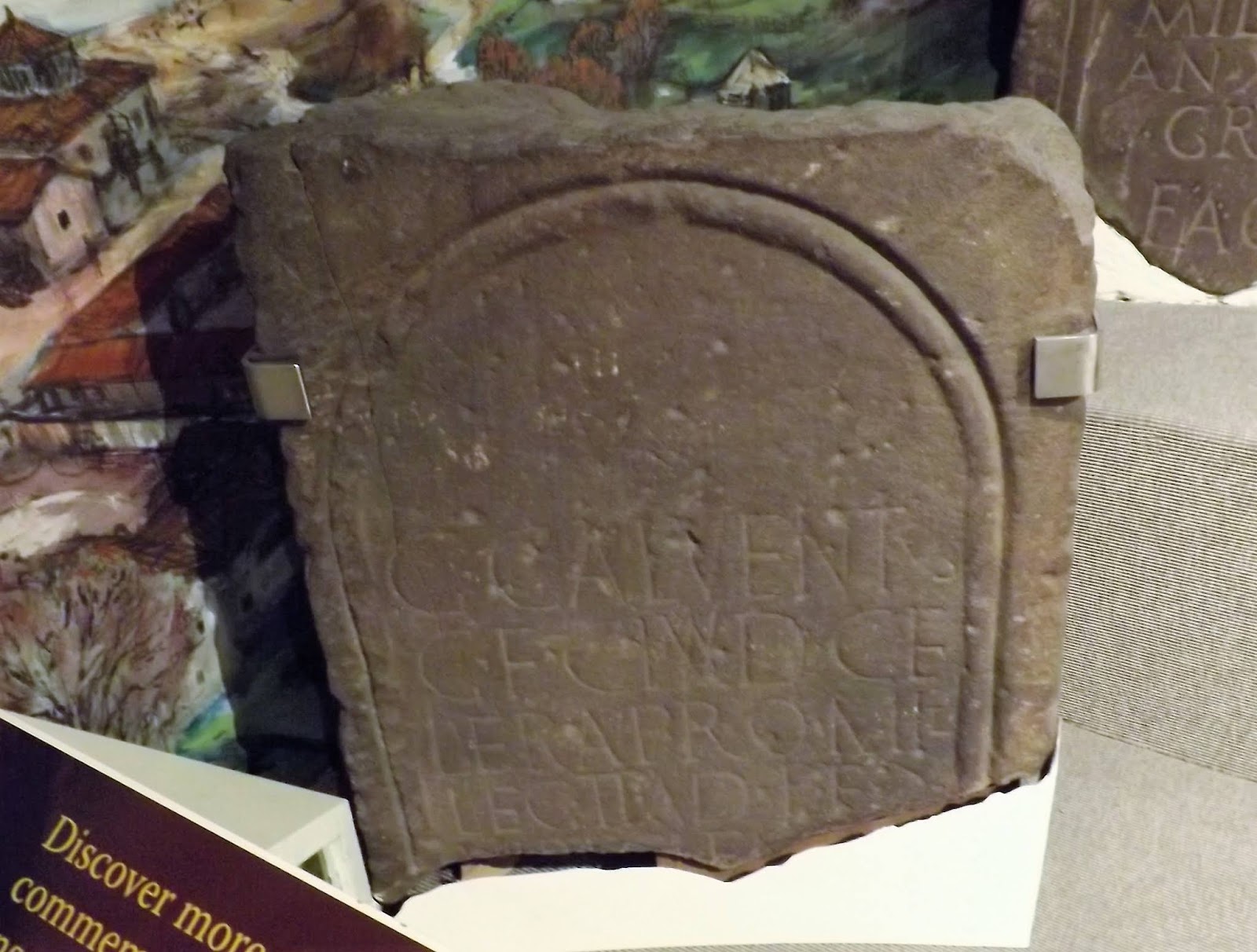 |
| G:CALVENTIVS G:F:CLAVD:CE LER:APRO:MIL LEG:II:AD:P:F VIBI:CLEME[NTIS.... |
A simple inscription reads;
"To Gaius Valerius Crispus, veteran of the II Legion Adiutrix, Loyal and Faithful"
 |
| G:VALERIO CRISPO VETRANO EX:LEG:II AD:PIA |
Below is the tombstone to
"Gaius Lovesius Cadarus of the people of the Papirian voting tribe, from Emerita, a soldier of the Twentieth Legion Valeria Victrix, 25 years old, of 8 years military service. Frontinius Aquilo his heir had this stone made."
Note: Emerita is now Merida in South Western Spain.
 |
| G:LOVESIVS:PAPIR CADARVS:EMERITA:MIL LEG :XX:V:V:AN:XXV:STIP:IIX FRONTINIVS:AQUILO:H:F:C |
The lower part of the next tombstone is all that has survived to record the death of the man in a shipwreck.
".....optio ad spem ordinis in the century of Lucilius Ingennus, who died by shipwreck. He is buried ...."
Note: An 'optio ad spem ordinis' was an optio designated for promotion to the rank of centurion. The last section of the inscription would usually read 'H. S. E.'; which stands for 'hic situs est' or 'he is laid here'. On this stone the 'H' has been missed off indicating that the body was never recovered from the sea to be given a proper funeral.
 |
| ...OPTIONIS:AD:SPEM ORDINIS:>:LVCILI INGENVI:QVI NAVFRAGIO:PERIT: S : E |
The next rather lavish large tombstone was dedicated to Centurion Marcus Arelius Nepos of Legion XX Velria Victrix aged 50 when he died.
Next to him stands his wife with a remarkable amount of detail as to their appearance.
Marcus is depicted holding in his right hand his badge of office, the centurion's vine stick. He is shown bearded, wearing a cloak with a small broach on his right shoulder and proudly sporting his soldiers belt.
His wife is depicted much smaller than him, wearing a mantle and is lifting the hem of her overdress to show the skirt beneath.
A space was left beneath her depiction for her epitaph but for some reason this was never completed.
 |
| D : M M:AVR:NEPOS:>:LEG XX:V:V:CONIVX PIENTISSIMA:F:C VIX:ANNIS:L |
"To the spirits of the departed, Marcus Aurelius Nepos, centurion of the Twentieth Legion Valeria Victrix. His most dutiful wife had this made. He lived 50 years.
Note: On the side of the stone are a carved mason's hammer and set-square. There are also the words SVB ASCIA D[EDICATVM} ("dedicated under the axe") This is thought to be a religious formula, perhaps to deter people from vandalising the grave.

This particular type of Roman standard bearer was tasked with carrying a sheet metal bust of the reigning emperor held aloft on a long wooden pole. The image was often gilded or silvered and the carrying handles on this pole can be clearly picked out.
Likewise I wonder if the curious dog tooth styling to his dress indicates a dog tooth style of chain mail or lorica hamata these soldiers would have typically worn.
 |
| D:M AV[RE]LIVS:DIOGEN ES:IMA]GINIFER |
"To the spirits of the departed, Aurelius Diogenes, an imaginifer."
Note: His name, which is Greek, suggests that Diogenes was from the eastern half of the Roman Empire.
The memorial inscription seen below is thought to have formed part of a much larger monument and is dedicated to a very old soldier and veteran, Cassius Secundus.
 |
| D:M CASIVS:SECVN DVS:MISSVS:HO NESTA:MISSIONE VIX:AN:LXXX ]VS:CON[ |
"To the spirits of the departed Cassius Secundus, honourably discharged from the army. He lived 80 years ...."
Note: The rest of the inscription may have mentioned Cassius' wife (coniunx in Latin). Secundus was obviously very proud of his years spent in the army. His epitaph makes a special point of mentioning his honourable discharge using the correct Latin legal term. His great age marks him as a very old soldier for his time equating to someone living to a hundred in modern times.
Finally a tombstone linking Chester to where our tour of the key Roman bases started, Caerleon, second home (Exeter will always be the first) of II Augusta


More Roman places to come with my visit to the Roman city of Wroxeter following Mr Steve so it will be interesting to compare our notes. In addition I spent some time in the capital just recently and took time to look at Roman Londinium where there is much more to see than a lot of people realise.
This series of posts on Chester will also continue with a look at other aspects of the city's long history ranging from the early medieval to the English Civil War and a look at the Cheshire Regiment's Museum whose proud traditions are borne today in the modern British Army by the Mercian Regiment.


