Saturday, 30 March 2024

All at Sea, Battle of Camperdown - Project Build, Part Seven


Lots of activity in JJ's Shipyard this last couple of weeks as I worked to complete the Batavian battle line and the last five ships needed before moving on to the next stage of the Camperdown collection.

JJ's Wargames - All at Sea, Battle of Camperdown, Project Build, Part Six

If you missed the last group of additions, I've linked them above where you can also find the links to the other models completed so far since October 2023.

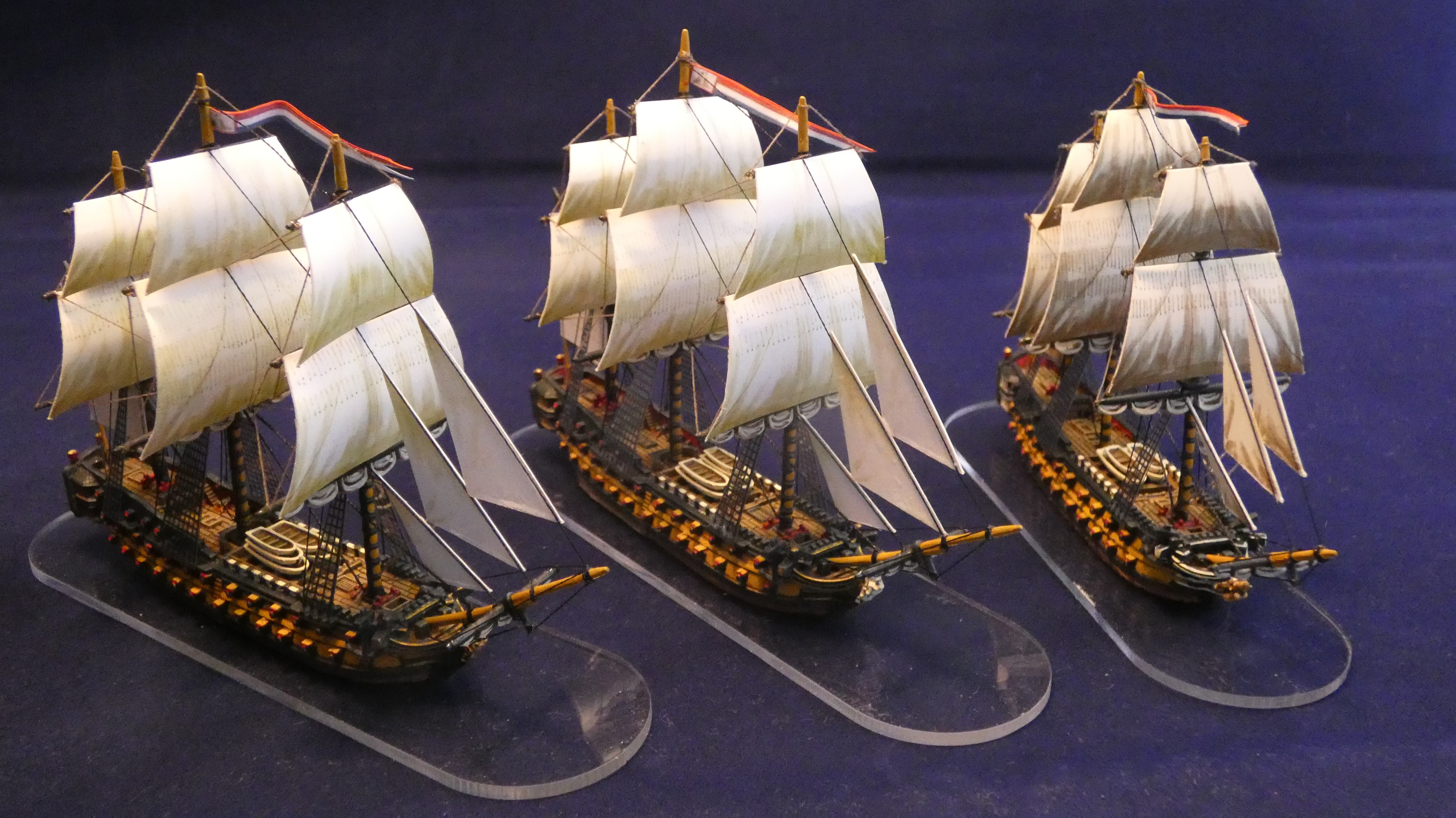
The latest additions to my Batavian battle line, from left to right, Hercules 64-guns, Admiraal Tjerk Hiddes De Vries 68-guns and the razee Mars 44-guns.

The planner below indicates progress too date with the addition of these next three models, leaving just the fourth-rate Beschermer 56-guns and the third-rate Gelijkheid 68-guns to go.

A satisfying look to my project planner with just two more ships to do for the Batavian battle line.

Once the last two line of battle Batavian ships are done, my plan is to finish off the British battle line with work on Admiral Duncan's Windward Division, and then move on to finishing off the light forces of both fleets.


So without further ado I'd like to showcase the three latest additions to my Camperdown collection and a look at the history of these ships.
 
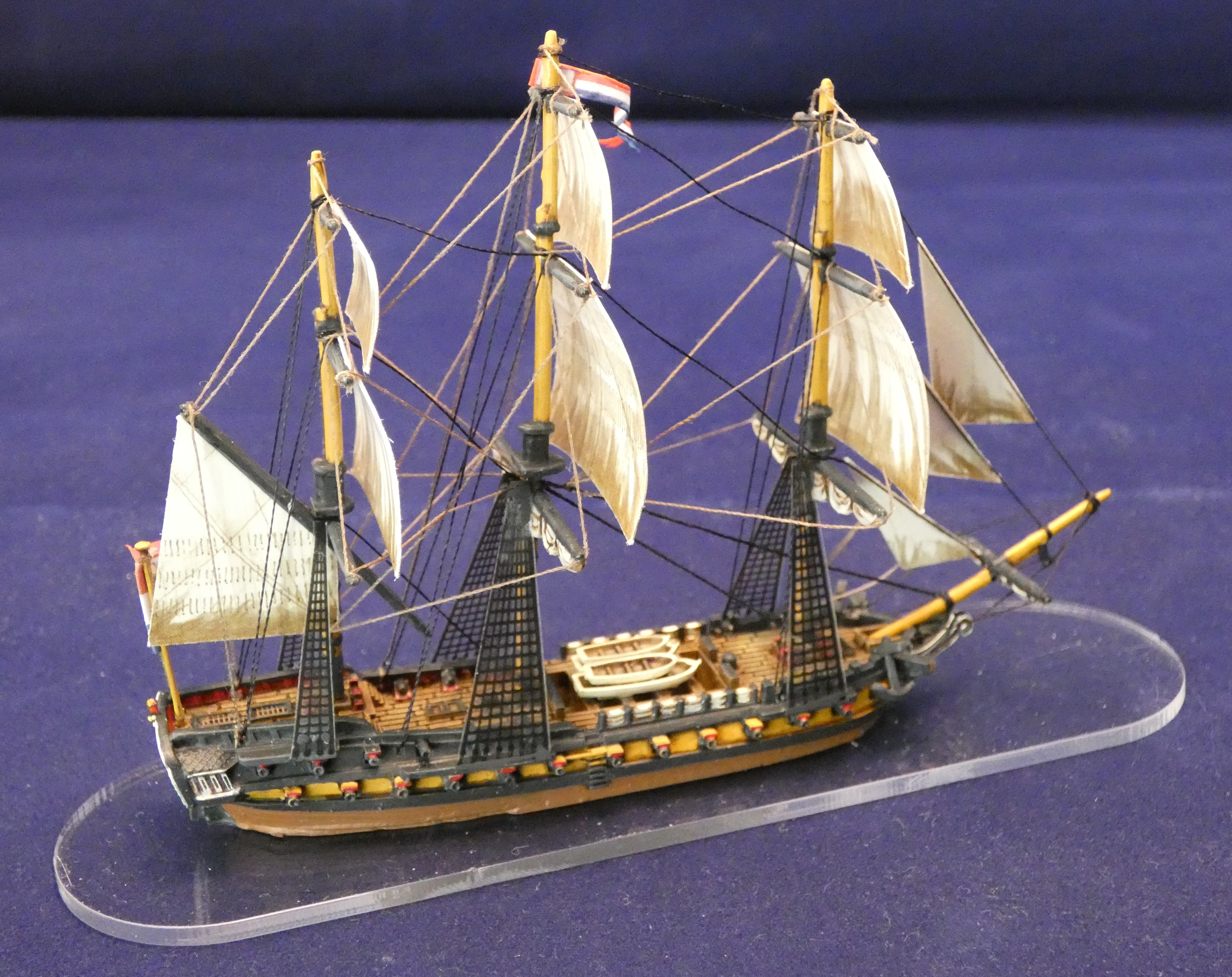
Mars
Mars was a 44-gun fifth-rate razee originally designed and built as a third-rate 68-gun ship of the line, named Zevenwolden and laid down in 1783 in the Harlingen-Friesland shipyard, launching on the following year, later refitting as a razee in 1795 and renamed Mars.


Her general characteristics were:
Tons burthen 684 tons (bm)
Length of gundeck 156 feet
Beam 43 feet, 7 inches
Depth of hold 17 feet, 7 inches

Her armament consisted of:
Gundeck: 26 x 32-pounder long guns
Quarterdeck & Forecastle: 18 x 18-pounders long guns


Not much seems to be recorded about the Mars prior to or after her conversion to a razee and likewise her involvement in the Battle of Camperdown is similarly scant on content.


Under the command of Kapitein ter Zee D. H. Kolf, she would appear to have made little impact in the battle, being part of the centre that escaped the brunt of the initial British attacks and together with the Leijden and Brutus seemed to have soon determined discretion over valour being the preferable option, escaping into the shallower waters, suffering the loss of her mizzen mast but only one killed and fourteen wounded.


She would suffer the fate of several of the other escapees from Camperdown two years later on the 30th August 1799 when she surrendered as part of a Dutch Squadron of eight ships, three frigates and one sloop to the British fleet of seventeen ships under Vice-Admiral Andrew Mitchell during the Vlieter Incident.


Admiraal Tjerk Hiddes De Vries
Admiraal Tjerk Hiddes De Vries was a 68-gun third-rate ship of the line, laid down on the 26th January 1782 in the Harlingen-Friesland shipyard and launching on 12th November 1782.

The Admiraal Tjerk Hiddes De Vries portrayed in a 1797 
painting of the Battle of Camperdown by Martinus Schouman

Her general characteristics were:
Tons burthen 1,300 tons (bm)
Length of gundeck 157 feet, 5 inches
Beam 44 feet, 8.5 inches
Depth of hold 16 feet, 2.5 inches


Her armament consisted of:
Gundeck: 26 x 32-pounder long guns
Upper Gundeck: 26 x 18-pounder long guns
Quarterdeck & Forecastle: 16 x 8-pounders long guns


The De Vries sailed to the Mediterranean in 1783 under the command of Kapitein Van der Beets, and on her return home was put in ordinary until recommissioning in 1795, joining the Republican Batavian fleet.


At the Battle of Camperdown she was under the command of Kapitein ter Zee J. B. Zegers, becoming heavily embroiled in the battle around the Batavian flagship Vrijheid, engaging the British flagship Venerable on her approach and then combining her fire with the Vrijheid to badly damage the 64-gun Ardent, which would see the death of her captain and 148 casualties including 41 killed in the exchange of fire. 


Notably this action appears in the fiction of Patrick O'Brian's 'Desolation Island' when Captain Jack Aubrey recounts his memories of being below decks as a young midshipman aboard the Ardent, and the wrecked ship and casualties that resulted from this encounter.


The arrival of the two other British van 74's, Bedford and Triumph soon helped to relieve the pressure on the Venerable and Ardent with Bedford singling out the De Vries, and later joined by the Triumph after she had forced the Wassenaer to strike at about 14.00.

The battle at its close at 15.00 with the Admiraal Tjerk Hiddes De Vries now struck
and under the watchful eyes of the Bedford and Isis.

However the De Vries put up a hard fight, reportedly suffering heavy damage to her hull and becoming dismasted before finally striking at 15.00. Her casualties are unrecorded.


The Venerable, Ardent, Bedford and Triumph suffered 380 casualties between them including 115 killed, easily the most badly damaged ships among the British fleet alongside HMS Monarch (36 killed/ 100 wounded) leading the Leeward Division, indicating the severity of the fight put up by the Vrijheid and De Vries, Hercules and Gelijkheid.

Hercules
Hercules was a 64-gun third-rate ship of the line, and launched on 12th April 1781 at the Dordrecht Shipyard.


The Hercules is perhaps the most iconic ship from the Battle of Camperdown, appearing as she does in just about every painting and illustration of the battle, on fire, as her crew desperately fought a blaze caused by exchanges of gunfire with the British 74's Bedford and Triumph.

A contemporary impression of the Hercules after her capture at Camperdown

For such an iconic ship I decided to let loose with a bit of artistic licence in the way I wanted her represented in my Batavian battle line, giving her a suitably Herculean figurehead rather than a more usual Dutch lion.


Her general characteristics were:
Tons burthen ? (bm)
Length of gundeck 155 feet, 1 inch
Beam 42 feet, 9 inches
Depth of hold 18 feet, 6 inches


Her armament consisted of:
Gundeck: 26 x 24-pounder long guns
Upper Gundeck: 26 x 18-pounder long guns
Quarterdeck & Forecastle: 12 x 8-pounders long guns


Hercules was the third ship in the Batavian line, part of the Blue Squadron along with the squadron flagship Brutus, the Admiraal Tjerk Hiddes De Vries astern and ahead, the fourth-rate Beschermer and third-rate Gelijkheid.


As with the Mars, information about the Hercules before Camperdown is scarce, but her performance in the battle was much more notable, being, like the Admiraal Tjerk Hiddes De Vries, heavily engaged in the fight with Admiral Duncan's Windward Division that climaxed with the battle around the Batavian flagship Vrijheid.


The fire aboard the Hercules is one of the most remembered features of the Battle of Camperdown
and appears in nearly every illustration and painting of the battle, this particular depiction painted by Thomas Luny.

In the general melee of broadsides it is thought that shots from either the Bedford or Triumph set a barrel of powder on fire on the Hercules, that soon saw flames spread to the rigging as the crew desperately struggled to extinguish the blaze, whilst their ship caused others to avoid colliding with them as they drifted back along the Batavian line, or trying to put as much distance between them and a subsequent explosion that seemed just as likely.


The crew of the Hercules are still desperately fighting the fire, and now resorting
to throwing their powder overboard to avoid their ship exploding and with HMS Russell
in the offing ready to force their surrender.

Following their rapid victory over the Batavian rear, the Powerful, Director, Montagu and Russell headed along the line of battle to support the British windward division and it was the Russell coming up last that encountered the Hercules now overcoming the fire aboard but now with its crew having thrown most of their powder overboard in their attempts to prevent their ship exploding, leaving the Batavian 64 little choice but to haul down her colours.


In the next post, I'll take a look at the last two Batavian ships at the lead of their line of battle, the Beschermer and Gelijkheid.

More anon
JJ

Saturday, 23 March 2024

All at Sea - Scenarios for Light Squadrons and Single Ships


It was back in April last year that I presented a project that I had been working on and something that had been an idea long in the gestation period, principally waiting for a collection of models in the right scale to better present the level of actions I had in mind to write up as a collection of historical scenarios from William James' naval history, built around using Kiss Me, Hardy (KMH) and To Covet Glory (TCG).

JJ's Wargames - All at Sea, Scenario Design Thoughts for Alexander at Bay

The work at that time had progressed to and just beyond, Scenario 52, The Capture of the Alexander which was successfully play tested at the April 2023 gathering of the Devon Wargames Group, link below;

Devon Wargames Group - The Alexander at Bay, All at Sea with Kiss Me Hardy

Since then, other work intervened on the weekly routine of gathering the background material together to construct each scenario and then knit it together with the structure, that is itself a bit of a moving feast as ideas intrude on tweaking bits here and there.

That other work, included the Bantry Bay scenario and collection built last summer, swiftly followed by the commencement of the Camperdown collection started in October, this on the back of a bit of a catch up on other wargames related activities that had through necessity been put on hold during Carolyn's and my four month expedition to the Antipodes, a lovely problem to have I hasten to add.


The initial stage of the project was to design each scenario around a common structure, principally focussed on meeting and chase type engagements, with the obvious inclusion that one could very easily develop into the other depending on circumstances and events.

My draft copy of the first one-hundred scenarios collected from Mr William James's Great History at centre flanked by a free set of ideas for a generic scenario structure, 'Narrow Seas' published by Curs'd Captain on Wargames Vault, sadly no longer available and Sam Willis' informative look at the realities of warfare at sea during the age of sail that influenced my own thoughts about important aspects to try and model.

Since the posting of various AAR's covering my playtesting of scenarios as they were written, both here and on the DWG club blog, and my YouTube video presentation of the first action covered in the collection and indeed the first naval action of the French Revolutionary and Napoleonic Wars, HMB Scourge vs the French Privateer Brig, Le Sans Culottes, the latter aptly named for a game based on KMH, I have had several enquires about progress on the project and what are my plans to make it more widely available.


In recent months, given my focus on the Camperdown work, my replies have been less than complete or definite as the project was on hold to allow me to break the back of the Batavian battle line, which has culminated this week with the last five ships of the Dutch line going into the rigging yard to be completed next week.

My Camperdown Project Planner

This leaves just the seven ships of the line in the British Windward Division to build, followed by eight other small British vessels, a mix of cutters, sloops and frigates and the remaining six Dutch light vessels, so a lot of light appearing at the end of this particular tunnel, and a fun one to be in as well.

James' Naval History of Great Britain can be accessed in the link below and is a wealth of inspiration for Age of Sail gamers looking for scenario ideas other than Pirates of the Caribbean.
https://freepages.rootsweb.com/~pbtyc/genealogy/Naval_History/Vol_II/P_367.html

Thus with the Camperdown collection nearing completion in the summer, I have turned my attention back to the Scenario Collection which has seen the addition of another six scenarios culminating in the completion this week of Scenario 84 - HM Hired Cutter Courier versus the French Privateer Cutter Guerrier 35 miles south east by east of Lowestoft, fought on the 23rd November 1799.

Scenario 84, Courier v Guerrier, 23rd November 1799, 35 miles Se by E of Lowestoft for To Covet Glory.

To quote William James;

'On the 22d of November, at 5 p.m., the British hired cutter Courier, of 12 long 4-pounders and 40 men, Lieutenant Thomas Searle, cruising oft Flushing, observed a suspicious sail bring to a bark. The cutter immediately hauled her wind in chase, and, as she passed the bark, learnt from her that the other vessel was a French privateer. The Courier thereupon crowded sail in pursuit; and on the 23d, at 9 a.m. Lowestoffe bearing northwest by west distant 10 or 12 leagues, succeeded in overtaking the French cutter-privateer Guerrier, of 14 long 4-pounders and 44 men, commanded by Citizen Felix L. Lallemand. A warm and close action ensued, and lasted 50 minutes, when the Guerrier struck her colours.

HMC Courier's SRC completed for To Covet Glory
The Courier had her master, Mr. Stephen Marsh, killed at the commencement of the action, and two seamen wounded, the Guerrier, four killed and six wounded. These as is evident without the aid of a tabular statement, were a well-matched pair of combatants; and the action was manfully sustained on both sides. Shortly after his capture of this privateer, Lieutenant Searle obtained that promotion, to which, by his previous gallantry on more than one occasion, he had fully entitled himself:'

Another famous single ship action to be included in the collection is Captain Thomas Cochrane's famous victory over the Spanish Xebec frigate El Gamo, in command of HM Brig Speedy, made even more famous in the following century by Patrick O'Brian imitating Cochrane's factual success with his character, Jack Aubrey's similar fictional one commanding the sloop Sophie, capturing the Spanish 32-gun frigate Cacafuego.

HMS Speedy, a Royal Navy brig under Thomas Cochrane, 10th Earl of Dundonald, capturing the Spanish frigate El Gamo off the coast of Barcelona, 6 May 1801. Painted by Charles Edward Dixon.

Thus with some very specific models required for some specific scenarios in mind and looking forward to bringing them to the table, I have turned my attention to conducting some more playtests and have placed an order with Only-Games for some test models to work with for the Camperdown project and the scenario collection.

Some very specific models ordered from the collection of 3D models produced by Henry Turner, namely the British brig HMB Speedy, (top right) a Spanish type 32-gun Xebec frigate (to model the Gamo) (bottom left) and the Dutch corvette Minerva (bottom right) to add a specific model to the Camperdown collection.
Only Games - Turner Miniatures

I have some other 3D models produced by my mate Jason, who ran off some small boats, and gun boats for me, that I intend to work on, as well as the models seen above.

Danish gunboats, gun platforms and a mix of ships boats with crews were printed for me by Jason last year and are a hint of future projects. 

My first impression of some early 3D age of sail models was not great, finding the ones I saw, some French 64-gun third rates, small against the Warlord options, often missing channels or chain plates to which the shrouds are attached to the hull. I know that is easily remedied with plastic card, but it struck me as an odd omission.

So preferring not to be an 'early adopter' I have watched the range of these models develop, and though still not sure about the mast and sail sets available for them, preferring plastic and card or even doing some scratch built wire options, the hulls seem to be getting better and so I have my test selection to work with and will post my impressions once they are built.

As regards the Scenario Collection and its completion and availability, I'm afraid its 'watch this space' and I will address that question once I am happy with the finished product for my own use. In the meantime there will be the usual play test AAR's and I will publish some of the AAR scenario plans in PDF as with the Bantry Bay Scenario previously, which includes all the ship record cards as well.

As always, more anon

JJ 

Saturday, 16 March 2024

Battle of Camperdown - The Leeward Division Attacks, Kiss Me, Hardy at the Devon Wargames Group


Last weekend I took the Camperdown collection to the Devon Wargames Group's first March meeting to run The Leeward Division Scenario, I played last month at Chez JJ with Mike and Jack using Far Distant Ships (FDS).

If you missed our playthrough of this scenario using FDS then follow the link below.
JJ's Wargames - Battle of Camperdown - The Leeward Division Attacks, Far Distant Ships

The initial plan had been to do something similar at club with a few additional ideas I had had since that game, but as always the plan changes on first contact and with more folks wanting to play than I had planned for and FDS, being a fleet level game better suited to fewer commanders, I opted to play this time using Kiss Me, Hardy (KMH) better suited to handle multiple players and offering an opportunity to compare and contrast with the FDS game.

My KMH Ship Record Cards (SRC's) have become my standard way of 
recording ship damage during my KMH games and are fairly easy to
pull together and store in a laminated format so they can be used again any time
I want to play a given scenario or big-battle.

It just so happened that during the odd evening when on holiday in Madeira, the previous week, I had time to sit down and pull the Camperdown Ship Record Cards together and thus they were ready for this game and so with a quick bit of printing and laminating when I got home everything was set up to go. 

The chaps all set up to play with their KMH Ship Record Cards seen along the table edge ready to record the firing and damage results.

Needless to say much fun was had by all, and all six players had plenty to do managing their various commands during the game.

The difference in play between KMH and FDS is very noticeable, with the former very good at capturing the feel of a naval battle from this period at the level of ships captain's, commodores and commanders of small squadrons such as this, with lots of narrative and individual ship drama that has become very familiar with the multiple games I have played using them.


FDS on the other hand gives a much better simulation of commanding one or multiple squadrons from the point of view of a flag officer looking to put his command in the optimal position to best allow his captains to fight their individual battles, only enhanced with more squadrons and bigger fleets on the table.

Both rules and the games they produce are in my opinion only enhanced by playing them with these larger models, seemingly emphasising the drama of the battle being portrayed no matter at what level of command the players are involved with.

The battle gets going at last weekend's DWG club meeting

I have put together an AAR of our game on the Devon Club Blog, link below, with thoughts about the comparison between KMH and FDS, where you can follow the drama of our play and during which produced an interesting twist that enhanced the performance of the Batavians versus our first run through of this scenario.

Devon Wargames Group - Camperdown, Attack of the Leeward Division, 'Kiss Me, Hardy'

All in all, I came away thoroughly content that I think I've found two sets of rules that allow for the sweet spot for a particular size of game with multiple players to be catered for as required allowing me much more flexibility around player numbers and time to play any given scenario or big battle, without losing the drama and narrative I look for in a good game.

More anon
JJ

Friday, 8 March 2024

All at Sea, Battle of Camperdown - Project Build, Part Six


It was two months ago since I last reported on progress with the Camperdown collection, and I have to admit that work in JJ's Shipyard was sporadic after Christmas with time having to be made for other activities, which included a lot of blog work preparing and posting my visit report on the Australian Artillery and Armour Museum which demanded the time to do it properly.

If you didn't see the last post on this project or any of the work completed so far you can follow the link below to Post No.5 and links to the preceding posts in the series.

JJ's Wargames - All at Sea, Battle of Camperdown - Project Build, Part Five, The Dutch Rear Completed

That said work has progressed not only with the next three models featured here, but with work on ideas around better presenting a battle scenario in a more manageable time frame, thus the post looking at my game with Jack and Mike play testing the rules Far Distant Ships which produced a very interesting and fun game, and a rule set I'm quite keen to develop games for going forward, again I have attached a link below if you mist my previous post from last month.

JJ's Wargames - Battle of Camperdown - The Leeward Division Attacks, Far Distant Ships

So it is really nice to get back to working the project and present this latest progress in the week when the blog passed Two Million Views, give or take the odd 500,000 bot-crawls, but still a fun number to see after twelve years of writing and journaling my time in the hobby, which to be honest I'd be doing anyway as its amusing to look back over posts at stuff I was focussed on at such-and-such a time.

JJ's Wargames is, and continues to be, a lot of fun to produce and has been the conduit for me meeting and conversing with a lot of folks in the hobby that I might not have otherwise met or chatted with and has only added to the fun of the hobby, so thank you to everyone who has contributed over the last twelve years and, God willing, here's looking forward to the next.
 

Ok, so with the Batavian rear completed before Xmas I moved straight on to getting the centre done, with work on the fourth-rate Batavier 56-guns and the two outstanding third-rates Wassenaer 64-guns and Leijden 68-guns, which will leave just the razee Mars 44-guns and the four ships of the line in the Batavian van, after which I intend to revert back to the British and complete Admiral Duncan's windward division before finishing off the light ships of both sides.

So below we have from left to right Leijden 68-guns, Wassenaer 64-guns and Batavier 56-guns.


Batavier

Batavier was a 56-gun third-rate ship of the line laid down on the 8th September 1777 in the Amsterdam shipyard, launching on the 18th February 1779, and commissioning the following year.


Her general characteristics were:
Tons burthen 1048 tons (bm)
Length of gundeck 144 feet, 7 inches
Beam 40 feet, 10 inches
Depth of hold 16 feet, 5 inches


Her armament consisted of:
Gundeck: 26 x 18-pounder long guns
Upper gundeck: 26 x 12-pounders long guns
Quarterdeck & Forecastle: 8 x 8-pounder long guns


On 5 August 1781, Batavier took part in the Battle of Dogger Bank under Captain Wolter Jan Gerrit Bentinck sailing in the middle of the Dutch line, between the ships Admiraal de Ruyter and Argo. 

The Battle of Dogger Bank, August 5, 1781 - Thomas Luny (National Maritime Museum)

She was engaged by three British ships, and became unmanageable after a fire broke out. The battle, while indecisive tactically, resulted in a strategic British victory and afterwards Batavier was towed to Texel. Bentinck later died of wounds he received in the battle.


On 11th October 1797 Batavier took part in the Battle of Camperdown under Captain Jan Jacob Souter. Early in the battle, the ship was under heavy fire, but soon she drifted off, and she eventually left the scene and fled to Texel.

The battle has been raging for about half an hour and already the Batavier is drifting out of the line, perhaps having come off the worse after an encounter with HMS Triumph 74-guns

The log of the Triumph makes mention of her fighting two or three enemy ships, with the historical commentary suggesting Cerberus and Vrijheid, but this plan suggests Batavier and Wassenaer likely adversaries given their place in the Batavian line. 

TRIUMPH
Log. JAMES READ, Master. Official No. 3081.
October 11th.

P.M. 1\2 past 12, Admiral Onslow began to engage the centre. About 1, Admiral Duncan engaged the van. We soon after fell in between two ships.  About 2, much cut up. Ship on larboard side sheered off, came up a fresh ship.  1\2 past 2, wheel shot away.


On the 30th August 1799 the ship was surrendered to the British fleet under Vice-Admiral Andrew Mitchell during the Vlieter Incident, so called because of the area of the Texel anchorage where the surrender occurred, that saw a breaking out of sentiment towards the House of Orange among loyalist Dutch seamen who refused to take orders from their Republican officers that led to the capitulation to the Royal Navy, including Batavier even though she was the only ship of the Dutch fleet where no mutiny had broken out.


Wassenaer 

The Wassenaar was a 64-gun third rate ship of the line was launched at the Rotterdam Naval Yard and commissioned into the Dutch Navy in 1781.


Her general characteristics were:
Tons burthen 1270 tons (bm)
Length of gundeck 158 feet, 2 inches
Beam 42 feet, 8 inches
Depth of hold 20 feet, 2.5 inches


Her armament consisted of:
Gundeck: 26 x 32-pounder long guns
Upper gundeck: 26 x 18-pounders long guns
Quarterdeck & Forecastle: 14 x 8-pounder long guns

Stern of the Dutch 64-gun ship Wassenaar


On the 11th October 1797 the Wassenaar took part in the Battle of Camperdown under the command of Kapitein ter Zee Adolph Holland. Holland was killed during the battle, and his ship surrendered to HMS Triumph

At 2pm the Wassenaer is shown struck and Triumph has now moved into the battle with the Batavian van and the flagship Vrijheid.


HMS Triumph then sailed on to the centre of the battle, and when the Wassenaar was fired on by a Dutch brig, the crew raised the Dutch colours again. But in the end they were captured again by the British.

At 3pm, with the battle reaching a close, the Wassenaer is shown under the watchful eye of HMS Russell 74-guns as the prizes are boarded.


Leijden

The Leijden was a 68-gun third rate ship of the line was launched at the Amsterdam Naval Yard and commissioned into the Dutch Navy in 1786.


Her general characteristics were:
Tons burthen 1307 tons (bm)
Length of gundeck 155 feet, 1 inch
Beam 42 feet, 10 inches
Depth of hold 18 feet, 7 inches


Her armament consisted of:
Gundeck: 26 x 32-pounder long guns
Upper gundeck: 26 x 18-pounders long guns
Quarterdeck & Forecastle: 16 x 8-pounder long guns


On the 11th October 1797 the Leijden took part in the Battle of Camperdown under the command of Kapitein ter Zee J. D. Musquetier.


As with the Batavier, the Leijden soon fell out of the Batavian Line of Battle in company with the razee Mars and together they made their way out and back to the Texel.

The battle is lost and the Leijden in company with Mars makes good her escape


Likewise the Leijden would suffer the same fate as the Batavier, surrendering on the 30th August 1799 at the Texel to the British fleet under the command of Vice-Admiral Andrew Mitchell.


Work now moves on to the next three ships, the razee Mars, and the two third-rates Hercules and Gelijkheid.

I'm off to the Devon Wargames Group club meeting today to run The Attack of the Leeward Division at Camperdown, this time using Kiss Me, Hardy instead of Far Distant Ships, catering for more players, and it will give me an opportunity to compare and contrast the game it produces in comparison with that played last month using FDS. 

More anon

JJ