Monday, 22 November 2021

Don Featherstone presents The Battle of Salamanca


In the summer of 2019 I fulfilled a lifetime ambition to spend a holiday to Spain and Portugal driving across the two countries from north to south and back again visiting on the way the key battle sites of Sir Arthur Wellesley, the Duke of Wellington during the long Peninsular War, staying in some amazing places along the way that included the castle at Ciudad Rodrigo.


You can follow that journey, if you missed the original series of posts in the link below or in the tab at the top of the blog;


A few weeks ago I was contacted by the host of The Hysterian YouTube Channel to include some of the pictures from my Salamanca battlefield tour to accompany a recording of the late great Don Featherstone recounting his several visits to the battlefield in the company of other greats such as Dr David Chandler together with many other recollections and anecdotes of people he got to know in the wider hobby and involved with military history.


Sad to say I never got to meet the man in person although his work had a great influence on my own progress in the hobby as a young man discovering the delights of it for the first time and I well remember carrying around his book on Wargame Campaigns for weeks on end, reading and re-reading his ideas on running such projects, and his accounts of the fun had with his own circle of friends doing so.


I think now, those of us who had that experience, now in the autumn years of our hobby, owe it to new generations to pass on that enthusiasm and passion that greats like Don Featherstone represent, and even though the hobby has moved on from his ideas for 'blast circles' and scratch built plastic figures carved up to represent this unit or another, his humour and enthusiasm based on that generation's experience of warfare for real, Don Featherstone having served in WWII with the Royal Tank Regiment, shines as an example of what the hobby is all about and how to enjoy learning about history in a unique fun way.


So needless to say I was very pleased to have the pictures I took on the day of our visit to the battlefield of Salamanca included with this presentation by the great man and listening to his recounting of the battle and his visits brought back a lot of happy memories of mine and Carolyn's, driving to and fro across that historic site, imagining the scenes of battle that would have played out there as we went.


There is nothing quite like walking a battlefield to gain a vastly superior insight to what happened there in the way that it did than by simply reading a book and looking at maps and pictures and I would reiterate Don Featherstone's comments to take the time to do it when the opportunity presents.


So if you would like to listen to the man presenting I think to an American audience back in the mid nineties about this particular battle then just click on the link below and if you would like to follow the series of other presentations by Don Featherstone I have included a link to the Hysterian YouTube Channel that has all six videos.


Saturday, 20 November 2021

All at Sea - Spanish & French Cutters & Topsail Schooners

'Sloop' - Carlos Parrilla Penagos
What would be described in the Royal Navy as a Cutter, this fine picture provided the inspiration for my Spanish model of these handy and fast little craft.

It was back in September that I concluded my three post series looking at scratch building a sloop/corvette from the Warlord model brig as part of a series of posts focussing on my small ship collection to allow me to create games summarised in the handy little booklet by C.A. Sapherson and J.R. Lenton which pulls together 100 Small-scale Actions covering the years 1793-1801 from the original source, 'The Naval History of Great Britain 1793-1815' by William James.


In that post I outlined my project to build a broad enough collection to allow me to create any of the one-hundred scenarios contained within it thus making a very handy solution to the occasional need to create a game with an historical background without too much effort and the summary of the spreadsheet I created for those scenarios is illustrated below showing the various types by nationality required.

My collection building plan for my small ship collection based on the vessels used in the Sapherson-Lenton scenario book, with ninety-six of the hundred collated, the other four I think being US -French actions from the Quasi War.

My collection had four obvious deficiencies outstanding, namely a topsail schooner and cutter for my Spanish and French, which would be remedied as soon as I had finished the other stuff I needed to get done, such as a few 28mm AWI British infantry and Indians, some 28mm Vikings, oh and a little Trafalgar game in Nottingham.


Those other projects safely navigated to completion, I turned my attention to these four small models.

A typical French privateer topsail schooner and just the sort of target to attract HM Brig Racoon

There are five scenarios involving a French schooner and three with a cutter, however as well as these there is another need for these models which involves the cruise of the 18-gun HM Brig, Racoon in 1803 in the Caribbean under her 'enterprising' captain, Commander Austin Bissel, who between the 5th to the 10th July captured four French vessels which included three schooners off St Domingo.


Then on the 11th July she captured the French brig Lodi off the disputed French island in the Leogane Roads after a half hour exchange of fire with both ships anchored on spring cables.

Then in August she was off Santiago de Cuba hunting French privateers operating out of Cuban ports, capturing two French schooners, the 3-gun Deux Amis and the 3-gun Trois Freres.


On the 17th August she met and destroyed the French 18-gun corvette Mutine off the Cuban coast, forcing the Frenchman to beach herself and become a complete wreck, with the action allowing another French schooner in company with the Mutine to make the best of things and escape during the fight.


Between the 13th and 14th of October the Racoon captured four French schooners and a cutter. The schooners were the Jeune Adelle and Liza, plus two others whose names were not recorded. The cutter was the Amitie (or Amelie), of four guns and six swivel guns.

The Jeune Adele and Amilie were part of a group of three naval vessels, including the brig Petite Fille.

William James in his inimitable style recounts the capture of these French vessels;

'On the 13th of October, in the afternoon, the Racoon, still commanded by the same enterprising officer, while cruising off Cumberland harbour (better known today as Guantanamo Bay) in the island of Cuba, observed several vessels to windward coming close alongshore, all of which, before sunset, hauled in towards the harbour. 

Having heard of the evacuation of Port-au-Prince, Captain Bissell anchored in a small bay, in the expectation of seeing those vessels pass him in the night. Daylight on the 14th discovered eight or nine sail, a few miles to windward, nearly becalmed. The Racoon instantly weighed, with a fine land wind, and proceeded in chase. 

At 6 h. 30 m. a.m. a brig, a schooner, and a cutter, all apparently full of men, hoisted French colours, and fired guns to windward. The brig attempted to get in-shore of the Racoon, and her two consorts, with the assistance of their sweeps and boats, endeavoured to join her. The land breeze, however, carried the Racoon within gun-shot of the brig; which, after receiving one or two broadsides, struck, and proved to be the Petite-Fille, French national gun-brig, having on board 180 troops, including about 50 officers of all ranks.

HM brig Racoon in action with the French schooner Jeune Adele and the cutter Amelie

Scarcely had the Racoon sent an officer and a small party of men to secure her prize, than the schooner and cutter, having got nearly within gun-shot, commenced firing. Calms and baffling winds prevented the Racoon from getting nearer until 10 a.m., when the sea-breeze set in. At 11 a.m. the two vessels bore up together, evidently with a determination to board the Racoon, the cutter steering for her bows, and the schooner hauling out to pass astern. 

The British brig shortened sail to receive her two opponents, but kept herself under sufficient command to counteract their design. When the assailants had arrived within pistol-shot, the Racoon fired a broadside at the cutter, who speedily returned it with long guns and musketry.

The Racoon then wore round and fired her opposite broadside into the schooner; and so, alternately, maintaining a running fight, and preventing either from boarding. This mode of engaging lasted more than an hour, both schooner and cutter keeping up an incessant fire of musketry; nor was it until she had been literally beaten to a wreck, and had lost many men in killed, that the cutter struck her colours. She proved to be the Amelie, a national vessel, carrying four carriage-guns, with (six) swivels, and upwards of 70 troops.

I have plenty of British brigs ready to stand in for the Racoon to refight her action with French schooner Jeune Adele and the cutter Amelie and to stand in for the Privateer brig Rover versus the Spanish privateer schooner Santa Rita as recounted by James below.

Having taken possession of the cutter, the Racoon crowded sail after the schooner, the Jeune-Adele, carrying six small guns and 80 troops; and which vessel, on being approached within gun-shot and fired at, surrendered without further resistance.

Standing in-shore to rejoin her first prize, the Racoon soon discovered that the Frenchmen on board, while the latter was engaging the cutter and schooner, had overpowered the prize-crew, and run the brig on shore among the rocks. Captain Bissell, however, got back his officer and men. The loss on board the cutter and schooner was about 40 in killed and wounded; that of the Racoon was only one person wounded, Mr. Thompson, the master, who in the early part of the action had received a violent contusion, which completely disabled him.'

The French commanders disclosed that they knew that Racoon was in the area and that the three French vessels had sortied from Cumberland Harbour with the intent to take Racoon by boarding, using their superiority in numbers. Bissell was of the opinion that had the wind remained as calm as it was early in the morning, they might have succeeded, though at great cost.

My interpretation of the schooner Jeune Adele and the cutter Amelie

I have always thought the cruise of HM brig Racoon, off St Domingo and Cuba in 1803, might make an interesting mini-campaign of linked games or scenarios using 'To Covet Glory' and these two models will certainly help facilitate that idea.

As well as the French, my Spanish collection was also in need of a similar reinforcement with three scenarios using a schooner and one a cutter, that being the action fought with 6-gun HM cutter George, commanded by Lieutenant Michael Mackay.

'Encounter in the Parana Guazu' - Carlos Parrilla Penagos
The 2-gun merchant sloop Mercedes, engages a British patrol in the Gazu River, June 2nd 1807.

William James described the action thus:

'On the 3rd of January, at 6 a.m., the British armed sloop or tender, George, of six guns (3 or 4 pounders) and 40 men, commanded by Lieutenant Michael Mackey, being on her passage from Demerara to Martinique, discovered on her lee bow, and at once bore down upon, two sail, which proved to be Spanish privateers; one, a cutter, of 12 guns and 109 men, the other a schooner, of six guns and 68 men.


An action immediately commenced between the George, then on the starboard, and the two privateers on the larboard tack. At the expiration of 40 minutes, the two latter evinced an intention to board. 

The helm of the George was instantly put a-lee, in order to preserve the weather-gage: but the sloop unfortunately missed stays, and, in the act of wearing, fell on board the cutter. The schooner having now gained a position on the George's weather-quarter, both vessels immediately grappled the sloop, and made two vigorous but unsuccessful attempts to board.

My cutter HM Entreprenante should make a good stand in for HM cutter George

Having, in these assaults, killed the George's sailing-master and seven men, and wounded her commander and 10 men, the two privateers, at the third attempt, carried the British vessel; but not without having paid dearly for their victory, their united loss amounting to 32 men killed, and many more wounded.

A more heroic defence than this little affair exhibits has seldom been witnessed. The George, at the moment her colours were struck, had lost more than half of her crew (8 dead and 17 wounded); that crew having been originally less by three-fourths than the number of her opponents.'


Another interesting encounter occurred between the British (or perhaps that should read Canadian) privateer brig Rover of 14-guns under the command of Captain Godfrey and the Spanish privateer schooner Santa Rita of 12-guns, in September, 1800, as described by James;

'On the 10th of September, as the British privateer-brig, Rover, of Liverpool, Nova-Scotia, armed with 14 long 4-pounders and 54 men and boys, under the command of Captain Godfrey, was cruising near Cape Blanco on the Spanish Main, the Spanish schooner Santa-Rita, mounting 10 long 6-pounders and two English 12-pounder carronades, with about 85 men, and accompanied by three gun-boats also under Spanish colours, and which, as well as the schooner, had the day before been equipped by the governor of Puerto-Caballo, on purpose to capture the Rover, came out from near the land to fulfil their orders. 

The privateer brig Rover out of Liverpool, Nova-Scotia
http://retireinliverpoolnovascotia.blogspot.com/2011/04/privateer-brig-rover.html
There is a brilliant ballad to the Rover linked on the blog above

The light breeze which had been blowing having died away, the schooner and two of the gun-boats, by the aid of a number of oars, gained fast upon the brig ; keeping up as they advanced a steady fire from their bow-guns, which the Rover returned with two guns pointed from her stern, and, as her opponents drew near, with her small-arms also.


Apprised, by their motions, that the schooner intended to board on the starboard quarter, and the two gun-boats (the third appeared to keep aloof) on the opposite bow and quarter, the Rover suffered them to advance until they got within about 15 yards of her: she then manned her oars on the larboard side, and, pulling quickly round, brought her starboard broadside to bear right athwart the schooner's bow; upon whose decks, then filled with men ready for boarding, the brig poured a whole broadside of round and grape.


Immediately after this, her active crew passed over to the guns on the opposite side, and raked the two gun-boats in a similar manner. The Rover then commenced a close action with the Santa-Rita, and continued it for an hour and a half; when finding her opponent's fire grow slack, the Rover, by the aid of a light air of wind, backed her head-sails, and brought her stern in contact with the schooner's side. 

The British crew then rushed on board of, and with scarcely a show of opposition carried, the Santa-Rita. The two gun-boats, seeing the fate of their consort, sheered off, apparently in a very shattered state.


Notwithstanding this long and hard-fought action, the Rover had not a man hurt; while, on board the Santa-Rita, every officer, except the commander of a detachment of 25 soldiers, was killed; the whole of the killed, as found on the deck, amounted to 14, and the wounded to 17. The prisoners, including the latter, numbered 71. These, being too many to be kept on board, were all, except eight, landed; the Rover's captain having previously taken from them the usual obligation not to serve again until exchanged. 

This was an achievement that did great honour to Captain Godfrey, his officers, and crew; and proved how well the hardy sons of British America could emulate their brother-tars of the parent country.'

So these last four 'small ships' pretty well conclude this little project, although I still have two Polacre and two Xebecs to add and they may well go on my Xmas list, whilst for the time being I return to some larger ship builds with my two Spanish first rates to finish off the Spanish Cape St Vincent collection and some other models that will have to remain 'TOP SECRET' for the time being, but will be revealed in due time, before I start work on some models for my mate Bob who has put in an order with JJ's Shipyard.

Still to come here on JJ's, mine and Mr Steve's battlefield walk in Devon and Cornwall, and I will have a Vassal update as both Jason, Steve M and I have been battling away in the Trafalgar Campaign in the GMT game 1805: Sea of Glory, started on Trafalgar Day and the Battle of Leipzig from Operational Studies Group which has now gone into the third day of battle as more and more troops arrive befor the city to settle the fate of eastern Europe.

More anon
JJ

Friday, 12 November 2021

Reaping the Whirlwind Campaign for Target for Tonight

Digital Artwork - Piotr Forkasiewicz
https://www.behance.net/piotrforkasiewicz
 
It was back in 2001 that I started playing Target for Tonight by David Wayne Thomas after taking part in a demonstration game run by the author at the annual show run by the Plymouth wargamers and being impressed with the immersive game it produced by breaking a typical night bombing operation into phases and the different risks to aircraft and crew that could happen at any time from take off to landing.

My original 2000 copy of Target for Tonight 

Since then the rules have been reprinted in a glossy new format that seems to be the requirement in this day and age, although the rules remain as they were in their first incarnation and the renewed interest in them following that publication inspired me to get to work on a project that had been long in the gestation period with ideas written down, played with and left and then come back to now and then.

The new look 2018 copy of Target for Tonight

That idea being to use the rules as the basis for a higher level of game recreating the campaigns of Bomber Command between the period 1942-1944 and specifically under the leadership of Air Marshal Sir Arthur 'Bomber' Harris.

Bomber Command Main Force plus Mosquito intruder night fighters all ready for the Berlin Campaign test

With a basic idea mapped out on various bits of paper and with a collection of thirty 1:600 model planes together with another group of 1:300th models covering all four of Bomber Commands main types (Wellington, Stirling, Halifax and Lancaster) plus all the German and British night fighter types, I finally had something to try out at club in March 2019.

The 1:300th collection of bombers and night fighters

Had it not been for a global pandemic interrupting progress the eight game Berlin campaign play test would have been concluded in April or May of last year, but we were finally able to get the last two games played in August and October this year and I've now completed the final set of campaign rules, suitably entitled 'Reaping the Whirlwind' recalling Bomber Harris' speech on June 3rd 1942, putting the Nazi leadership on notice that the air bombing war was about to be turned on German cities with interest.

If you haven't seen the eight game series recreating the first large scale ops that began the Battle of Berlin in August 1943 you can follow the links below.


So Reaping the Whirlwind will allow players of Target for Tonight to assume the role of Harris and his Group Commanders of Main Force as the raids into German occupied Europe are planned and then executed using the game rules before returning to the campaign framework to establish the results of the bombing in comparison to the aircraft and crews lost which will yield a victory point rate and thus a verdict on the progress or not of Bomber Command's campaign.

You'll need a 'Whimpey' if you plan to take a trip to the Happy Valley in Reaping the Whirlwind.

All the stuff you would want, such as Target Marking, Weather, Bomb load outs, Fuel Consumption  and the inclusion of the Wellington, Halifax and Stirling bomber types to fly alongside the Lancasters is included together with a roster of sixty randomised crews to speed up manning the thirty models representing the five groups of Bomber Command Main Force.

All the main bomber types are included to operate alongside the Lancaster squadrons.

As well as the option to play a month of the Berlin Campaign you can easily opt to play two, three, four or five months of the campaign if you have the stamina, and there is a Rhur Valley Campaign for those ready to brave the flak in the Happy Valley and if that is not enough of a challenge you could even have a go at taking out the V Rocket plant at Peenemunde for good measure.

Operations Room Conference, Bomber Command, October 1943 - Herbert Arnould Olivier
Royal Air Force Museum

I haven't tested the Peenemunde or Rhur campaign games but they will use the same structure as the Berlin module and nothing in the rules are written in stone so if you don't like something, change it, and if it works let me know.

The Cyberboard module I used to run our campaign is also included in the download of Reaping the Whirlwind.

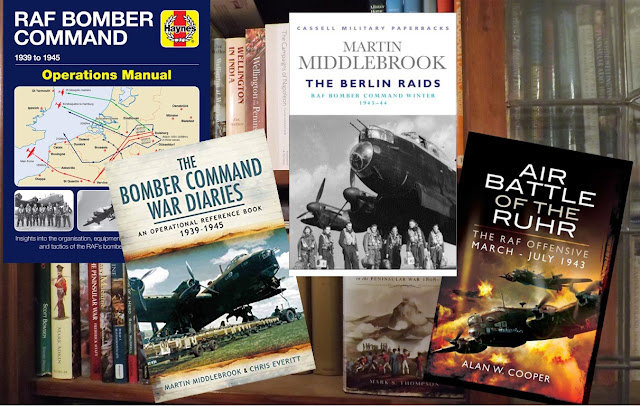
If you're interested in some recommended reading and resource materials that informed Reaping the Whirlwind then the following books might be of interest.

Recommended Bomber Command reading and four books that informed Reaping the Whirlwind 

As well as the rules and the maps (campaign map and five city target maps), counters and blank aircraft record sheets needed to play, I have included the Cyberboard module in the download that I used for running our campaign, for those who would like to make use of it.

As with all the resources here on JJ's, I try to ensure they are done to a good standard and will add to the enjoyment of the hobby and most of the stuff is produced in collaboration with other gamers and friends in the Devon Wargames Group or with other interested gamers such as the Target for Tonight enthusiasts on the Facebook Group and in that spirit is made freely available.

Target for Tonight - Facebook Group

That said Reaping the Whirlwind is released in time for Armistice Day and Remembrance Sunday, so perhaps you might like to make a donation to the Royal British Legion in honour of the 55,000 aircrew who perished on operations with Bomber Command.

https://www.britishlegion.org.uk/get-involved/ways-to-give/donate


Reaping the Whirlwind - Target for Tonight Campaign Game

I have plans to come back to this project with a play through of the Rhur Valley Campaign module and a chance to run out the Wellington squadrons and the Peenemunde mission should make an interesting one off game.

In addition another fellow member and friend in the DWG has put together a collection to run the 617 Squadron Dam Busters Operation and I look forward to bringing you pictures and updates around all these ideas in months to come.

In the meantime I hope you enjoy Reaping the Whirlwind.

Next up on JJ's: Battlefield walks with Mr Steve, Vassal games of 1805 Sea of Glory and OSG's Leipzig and we're 'All at Sea' with some new small ships added to the collection.

Sunday, 7 November 2021

A Sensory History of Ancient Warfare, Reconstructing the Physical Experience of War in the Classical World - Conor Whately


When I saw this title on the new listings from Pen & Sword I was really intrigued and thrilled to get it as a birthday present and moved it rapidly to the top of my 'to read' stack of books that occupies a discreet section of my book shelf.

The back of the dust jacket lists the reasons for that intrigue thus:
  • An ambitious new approach to the subject of ancient warfare.
  • Assesses the evidence for what ancient battles and sieges would have looked, sounded, tasted, smelled and felt like to its participants.
  • Re-examines the contemporary testimony of ancient historians, poets and artistic representations, as well as the evidence of both traditional archaeology and reconstruction/re-enactment.
  • Case studies examined in detail are: Cinaxa (401 BC); Issus (333 BC); Cannae (216 BC); Jerusalem  and Masada (66-74 AD); Strasbourg (357 AD); Edessa (544 AD). 
One of the really interesting aspects of historical wargaming for me and others is developing, through our games, a different insight into the issues that faced the commanders and their men engaged in the struggle we are attempting to replicate on the table and part of that understanding starts with an appreciation of what the situation looked like from the man on the ground being Alexander the Great inspiring his men before the Battle of Issus with encouraging words whilst passing direct orders to subordinates, to the poor bloody infantry standing in the front line, shield braced for impact and preparing to face the ultimate challenge in the life of most human beings, faced with the terrible prospect of mortal combat with the enemy up close and personal.

Having a clear understanding of the challenges faced by each soldier, at each level of command within an army, better still described by them as near to the time of the action that they were able to record their experiences of that action, the more likely we are able to reflect those experiences in the game we produce and thus start to appreciate why events may have unfolded in the way they did.

Thus with the other aspects of the hobby such as reading accounts, walking the terrain, looking at the insights that modern day re-enactors can bring, we can use these perspectives to feed into a more appreciative experience around the wargames table.

So it was with a cautious level of interest that I approached this title as an opportunity to perhaps fill a gap in the literature surrounding the experience of warfare in the ancient world that is better represented in other periods, such as John Keegan's 'The Face of Battle' published in 1976 and a book I read several years ago now or Paddy Griffiths 'Forward into Battle'.

Interestingly Whately highlights the particular impetus for his book as being The Smell of Battle, the Taste of Siege: A Sensory History of the Civil War by Mark Smith a similar tome that covered the assault on Fort Sumter in Charleston, the sights of First Bull Run, the smells of Gettysburg, hunger at Vicksburg, and the close quarters of the submarine H.L. Hunley. He then goes on to state when considering a similar study for the ancient period;

"Digging deeper might seem problematic, for Smith was able to draw on a body of evidence that we do not have in antiquity, namely early photographs, newspaper reports and personal diaries, among others. Yet, despite these seeming limitations, we have extensive accounts of warfare, and some of the striking and useful pieces of evidence include the historical epics )Homer's Iliad), Latin histories (Livy's Ab Urbe Condita), later  classicizing histories (Procopius' Wars), and military manuals (Maurice's Strategikon)."

Noting that with the aforementioned studies, their focus in the main is on generals at the expense of the common soldier, and indeed with little or no inclusion of the experience of women and children and the day to day life of civilians, he highlights other sensory sources such as papyrological, legal and material evidence, looking at foodstuffs and the trade in animals, thus giving a sense of the foods people were eating and the animals they were in daily contact with; this evidence contributing to building a picture of the living conditions of the soldiers and their diets, mixed with the topography of a given theatre and its associated weather patterns, adds in to the sensory picture of what warfare would have been like for the 'Common Grunt'.

My own picture of the Epitaph of Marcus Caelius, first ranking Centurion of the 18th Legion who died in the Varian disaster aged 53 and referenced by Whately in his introduction to the book describing the likely battle in the Teutoburg Forest from the view point of the Roman soldiers engaged in that battle.
JJ's Wargames - Xanten LVR Archaeological Park & Roman Museum

The book then launches into an introduction that attempts to portray firstly the experiences of the common Roman soldiers to their commanders, faced with fighting in the Teutoburg Forest, rain soaked, hungry, weighed down with their kit under constant attack or threat of attack from close assault and missile fire, eventually overwhelmed as much by fatigue as by the enemy as they slipped around on muddy ground trying to hack their way through a forest whilst staving off an ever more confident foe.

This first description rather sets the tone for the book presenting the reader with a description of the other seven battles and sieges, based on the literary accounts and sources described with the author filling in the missing bits and attempting to 'cross the T's and dot the I's'.

In his introduction Whately attempts to define what a 'Sensory History' looks like when he describes the structure of Smith's American Civil War book, noting that in it, he divides the book into five chapters to help understand one particular engagement through the lens of the five physical senses; recounting one chapter devoted to the sounds of the Battle of Fort Sumter (April 1861) or the visual impact in another chapter covering the Battle of First Bull Run (July 1861).

As his Teutoburg Forest account illustrates, and he readily acknowledges, the same kind of sensory accounts in the ancient world don't exist and thus the prose has to turn to conjecture.

An example of the difficulty of writing a book like this is exemplified by the listing and detailing of the various sources for describing Alexander's battle with Persian King Darius in 333 BC, ranging from Plutarch, Justin, Polybius, Diodorus, Curtius and Arrian and the mosaic from Pompeii.

Here we have accounts written in the first, second and third centuries AD no doubt relying on other previous and perhaps first hand sources now lost to history and with four of the aforementioned authors, Plutarch, Justin, Diodorus and Curtius 'short of technical military material'.

Lucius Flavius Arrianius (Arrian) the Greek historian, and Roman commander who fought the Alans, one of the more accomplished military sources.

Perhaps the most compelling source is Arrian who was at least an accomplished general and author of the short tract on tactics, famous for his defeat of the Alans in the second century AD, and describes the Battle of Issus in detail which Whately goes through, but rightly pointing out that;

'Unfortunately, despite the battle's fame, the contradictory details found in the different accounts make reconstruction difficult' 

And so the reader is left to consider what follows with that very important caveat, which is educated guesswork at best; interesting yes, but not entirely satisfying in terms of moving our understanding much further forward other than conjecture.

Apart from the enjoyable aspect of reading the detail about certain battles that I had a top line familiarity with prior to reading this book and enjoying the accounts that were pieced together from sometimes opposing sources, I can't say I was convinced by the attempt at building the sensory picture.

The fundamental difficulty I have with the book is that it seems to me to fall down at the hurdle that Whately highlights himself in his introduction, namely the lack of primary source evidence, and in his 'Acknowledgements' section of the book when he refers to an exchange on Twitter which posed the question 'could this kind of work be done about the ancient world given the source limitations?'

Thus we are left with an account that, frankly, I could probably assess myself based on my own extensive reading of other periods of military history, mixed in with the usual diet of 'sandal and swords' fiction that I like to read anyway to supplement the lack of such first hand primary accounts that very much feed the imagination when I'm working on other period collections.

Perhaps I'm being a little harsh and that my perspective is slightly coloured by my disappointment at what the dust jacket boldly declares as an ambitious new approach. Yes the book is definitely ambitious, but I remain unconvinced about the 'new approach' and until we have the unlikely discovery of the diary of an ordinary optio in the ranks of your typical Augustan legion, giving me the real life first hand insight into ancient warfare, similar to the accounts of Peninsular War veterans outlined below, I think I will remain unconvinced.

The artwork of Peter Dennis in Osprey's, The Jewish Revolt, really appear to capture well the experience and likely look of  the sensory experience of combat, with the siege of Jerusalem and Masada both featuring in the text.

To perhaps better exemplify my point and to further extend Whately's consideration of Mark Smith's Civil War account, and the lack of similar classical ancient sources you can look at the wealth of primary accounts from an earlier period of military history before even photographic evidence and the wonderful first hand accounts left by British and some French veterans of the Peninsular War, devoid of any poetry or attempts to influence a political master, but simply telling the reader what they saw and experienced in the face of battle, descriptions that we simply lack for the classical period.

These are accounts that I used to help me construct a very focussed look at recreating the Battle of Talavera for my own Talavera 208 project:

Lieutenant Girod de l'Ain of the 9me Legere is quoted describing the attack of the British light cavalry into the Northern Valley as seen from his position on the lower slopes of the Sierra de Segurilla as his regiment skirmished with General Bassecourt's Spanish infantry;

"this was a charge by some English cavalry, that we saw arrive from afar like a hurricane, it was a regiment of dragoons charging in order of battle and launched full tilt... We observed this line of enemy cavalry, incapable of manoeuvre, following a single direction so blindly, that we shouted with one voice: 'They are deserting, they are deserting!' But soon saw one of our regiments of legere (the 27me Legere) which, marching in column close to an isolated house, found itself in the path of this cavalry; not having time to form square, it threw itself around the house, with their backs against the four walls; the square thus found itself naturally formed, and the more solid ... The English line extended well beyond both sides, to right and left ... the two wings no longer master of their horses ... continued on their course straight ahead, always flat out. We then saw a line of French cavalry, which stationed in the rear, came up at the 'petit trot' before the English cavalry; it was the brigade of General Strolz, composed of the 10eme and 26eme Chasseurs a Cheval. We anxiously wondered what would happen when these two lines of cavalry met; but the shock did not last long: we saw the English line pass through the French line, without stopping or losing their formation; we only had time to notice a few sabres flash in the air and the smoke of some pistol shots... but soon our chasseurs remounted and, a little shaken, launched themselves at the gallop in pursuit of the English dragoons, which only stopped in the waters of the Alberche, where they were all taken prisoner."

The attack by General Lapisses's  French I Corps, 2nd Division at Talavera
Ensign Aitchison of the 3rd Guards recalled the attack;
"The French came on over the rough and broken ground  ..... in the most imposing manner and with great resolution."

A French officer described the first line of columns attack;
"The French charged with shouldered arms as was their custom. When they arrived at short range, the English line remained motionless, some hesitation was seen in the march. The officers and NCOs shouted at the soldiers, 'Forward March; don't fire'. Some even cried 'They're surrendering'.  The forward movement was therefore resumed; but it was not until extremely close range of the English line that the latter started a two rank fire which carried destruction into the heart of the French line, stopped its movement and produced some disorder. While the officers shouted at the soldiers 'Forward: Don't Fire' the English suddenly stopped their own fire and charged with the bayonet. Everything was favourable to them; orderliness, impetus, and the resolution to fight with the bayonet. Among the French on the other hand, there was no longer any impetus, but disorder and surprise caused by the enemy's unexpected resolve. Flight was inevitable."

And finally 

Ensign John Aitchison of the 3rd Guards described the effects of French artillery fire and the troops response to it;
"a tremendous cannonade - shot and shells were falling in every direction - but none of the enemy were to be seen - the men were all lying in the ranks, and except in the very spot where a shot or shell fell, there was not the least motion - I have seen men killed in the ranks by cannon shots - those immediately around the spot would remove the mutilated corpse to the rear, they would then lie down as if nothing had occurred and remain in the ranks, steady as before. The common men could be brought to face the greatest danger, there is a spirit which tells me it is possible, but I could not believe that they could be brought to remain without emotion, when attacked, not knowing from whence. Such however was the conduct of our men I speak particularly of the Brigade on 28th July, and from this steadiness so few suffered as by remaining quiet the shots bounded over their heads."

I applaud Conor Whately for his attempt with this book, but the constraints he and other ancient scholars work under in this particular area of military history when attempting to extract the detail similar to the level that we have in the accounts above, makes this book's ambitions a very high bar to pass and one that I felt it missed despite the effort.

In addition I think the contribution made by re-enactment groups that have worked really hard at trying to recreate the dress, living conditions, food and other aspects of walking a day in the caligae of your average Roman soldier as with the Ermine Street Guard group, and others, for example, have offered more of the understanding and insight that the classic sources struggle to match.

The other area that I feel offers the kind of opportunity this book attempts to develop is the gradual translations of the tablets being found on Hadrian's Wall at Vindolanda where the kind of 'first hand' insights that the classical world lacks are starting to be revealed, and I hope and look forward to a book compiling the best finds to help give a comprehensive look at that world through them. Perhaps that book exists and I've missed it!

The tablet above is a letter of appeal from a civilian to a governor seeking redress for a beating received at the hands of a subordinate.
Translation:
" he beat(?) me all the more.......goods...or pour them down the drain(?). As befits an honest man(?) I implore your majesty not to allow me, an innocent man, to have been beaten with rods and, my lord, inasmuch as(?) I was unable to complain to the prefect because he was detained by ill-health. I have complained in vain(?) to the beneficiarius and the rest(?) of the centurions of his unit. Accordingly(?) I implore you mercifulness not to allow me, a man from overseas and an innocent man, about whose good faith you may inquire, to have been bloodied by rods as if I had permitted some crime."
JJ's Wargames - British Museum, Part Two, The Romans

Finally in terms of fictional accounts to help bridge this large gap, I can think of no better recommendation that picking up copies of Adrian Goldsworthy's Vindolanda series of fictional accounts of life in first century Britain and the exploits and adventures of Centurion Flavius Ferox which I think now number three books in the series and very enjoyable reads; with all the scholarly input that Dr Goldsworthy is able to weave into them with the inclusion of a detailed note at the back of each book outlining the known historical record that underpins his fictional account.

A Sensory History of Ancient Warfare is published by Pen & Sword Books and is 175 pages which include:

Acknowledgements
List of Illustrations
Introduction

Part I: The Greek World
Chapter 1 The Battle of Cunaxa (401 BC)
Chapter 2 The Battle of Issus (333 BC)

Part II: The Roman World
Chapter 3 The Battle of Cannae (216 BC)
Chapter 4 The Sieges of Jerusalem (70 AD) and Masada (72-74 AD)

Part III Late Antiquity
Chapter 5 The Battle of Strasbourg (357 AD)
Chapter 6 The Siege of Edessa (544 AD)

Conclusion
Notes and References
Bibliography and Further Reading
Index

The fact that I sincerely applaud Conor Whateley's attempt at composing a 'Sensory History' is demonstrated by my reading it cover to cover and really enjoying reading about the battles described and the unique aspects surrounding them, together with the sources relied upon to do that. For that aspect alone I enjoyed it and include it as a useful resource and addition to my Ancient's book collection, but in terms of its declared objective of presenting a sensory historical account of them, I remain unconvinced, but tentatively look forward to other new insights going forward from perhaps other yet undiscovered sources.

My copy of 'A Sensory History of Ancient Warfare' is in hard back and has a list price of £19.99, but at the time of writing can be picked up for a little as £11.00 

Wednesday, 3 November 2021

Assault River Crossing, Second Battle of Oporto 12th May 1809 - Tiny Wars Played Indoors

The Serra Convent overlooking the River Douro at Oporto from where British infantry led by the 3rd (Buffs) Foot crossed to occupy the Seminary on the cliffs above on the opposite bank and around which Sir Arthur Wellesley placed his gun batteries in support of them and other Allied troops crossing to attack the French under Marshal Soult who occupied the city, 12th May 1809
 
A few weeks ago, Bill Slavin sent me an email giving me the 'heads-up' on his next game in the series from O'er the Hills Scenario Book which I have been looking forward to with great anticipation following his post about how he had built his table to refight the Oporto Crossing.

Stand to Games - O'er the Hills, Early Peninsula War Scenarios pdf Version

This scenario playing follows the others Bill has been working through since he started his series of games with 'The Leopard's Debut, The Battle of Rolica, played back in December 2020.

I personally have really enjoyed seeing someone else translating this scenario book, designed to be played with the rule set Over the Hills, and Bill's games have brought back lots of memories of the original play tests Steve M and I did when I was working on putting the book together.

If you are new to the series of games then I have listed below the series of links here on JJ's that will take you to Bill's blog, Tiny Wars Played Indoors where you can see his AAR's for each of the games played so far.


When writing the Oporto scenario, I was adapting an earlier game that we played with the computer moderated rules, Carnage & Glory and needed to make the game a much more easily translatable set up for most wargamers to be able to set up on the table.

The battle was fought over and around a deep cliff edged river gorge with the outskirts of the city of Oporto and the key stronghold of the Seminary, occupied by British troops, the main features of the terrain to be fought over once the battle commenced, following the discovery of the British troops by part of the French garrison.

Our Oporto Table from the original game set up.

Thus, to make this a more easily playable game I opted to leave the gorge out of the map, using the wargamers old friend, 'the dreaded edge of the table' to represent this imposing terrain feature with the possibility of British reinforcements arriving in the Seminary from said table edge together with supporting British artillery fire directed from it on to certain areas of the table representing the batteries of guns Wellesley set up in support of his assault crossing.

Of course Bill was having none of that and opted to go large by building his representation of the gorge, cliffs and wine barges carrying British troops to produce, in my humble opinion his best table yet, leaving me rather 'gobsmacked' at his ability to 'adapt adopt and improve' with a post detailing his build for others interested  in having a go.

Tiny Wars Played Indoors - Building Porto

Frankly, I never imagined anyone going this far with this scenario and was amazed at the ingenuity of this table, and Bill's post is well worth a look to see his ideas on how to put together a put up and take down version of this game.


So if that little preamble hasn't wetted your appetite to see how Bill's game turned out with the troops in battle array across his table, then move on and wait for my next post about something else, but I think a few of the pictures of the game below will prod your curiosity still further.

The game was quite remarkable and one I would not have expected after playing it several times and seeing others having a go with similar outcomes.


When writing a scenario based on an historical actions and constrained by certain known limitations you tend to end up working within a bell curve of outcome probabilities with the the extreme, but still possible, outcomes hopefully moved to the ends of the curve and with the more likely outcomes very much in its centre.

I think Bill's account of his game shows what happens when the game starts to explore the less likely extremes and also the historical peril that Marshal Soult and his corps faced once Wellesley had established a foot hold on the French side of the river, requiring bold and immediate response to stabilise the situation.


The fighting that followed in this game is a classic struggle to retain and regain initiative and made for a fascinating read.

So if you would like to know more then just follow the link below to Tiny Wars Played Indoors for the full details and more great pictures of the game as it unfolded.


Next up: Mr Steve and I have been battlefield walking with a trip back to the early English Civil War in Cornwall and the seat of the Prayer Book Rebellion in Devon, and I have a book review.

More anon 
JJ